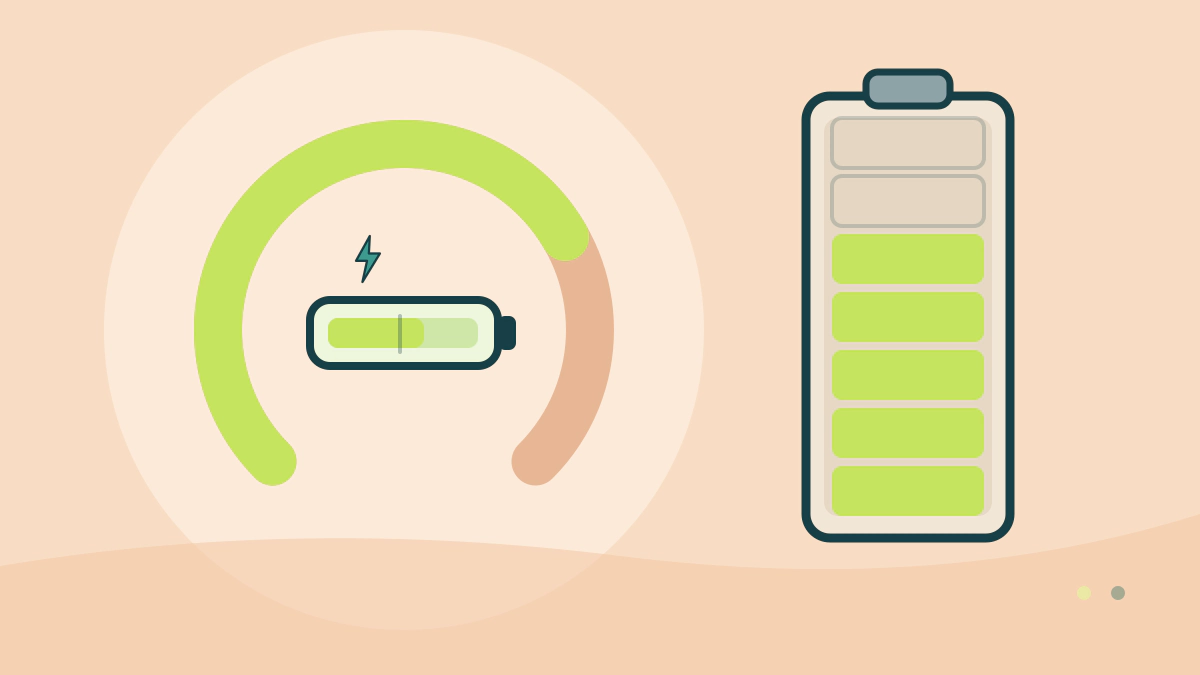
SOC means state of charge, the share of an EV battery's capacity that remains. Learn to read the percentage and convert it to kilowatt-hours.
What does SOC mean for an EV battery?
SOC stands for state of charge: the share of an electric vehicle battery’s capacity that is currently available, usually displayed as a percentage. A dashboard reading of 60% means the car’s battery gauge reports that 60% of its scale remains. The DOE Alternative Fuels Data Center uses “state-of-charge” when explaining how depleted a battery is and why charging times differ.
SOC describes energy stored in the traction battery. It does not describe how far the car will travel, how healthy the battery is, or how much power a charger will deliver. Those are related questions with different answers.
What the percentage is measuring
The traction battery pack stores electricity for the electric motor. The pack’s capacity is the amount of energy it can hold, commonly stated in kilowatt-hours.
During AC charging, the vehicle’s onboard charger monitors voltage, current, temperature and state of charge while charging the pack. AFDC’s glossary describes it that way and says the charger also communicates with the charging equipment. The percentage on the screen is the vehicle’s summary of that information.
That makes SOC a gauge reading, not a laboratory measurement of every cell. It is most useful for the car you are sitting in. Comparing the percentage between two different models is less useful, because the same percentage can represent different amounts of energy.
Turning SOC into kilowatt-hours
The arithmetic is simple when the pack’s capacity is known. Multiply the capacity by the state of charge.
For a pack with 75 kWh of capacity:
| SOC | Energy represented | What it means |
|---|---|---|
| 100% | 75 kWh | The top of the car’s displayed scale |
| 80% | 60 kWh | 80% of the stated capacity |
| 50% | 37.5 kWh | Half of the stated capacity |
| 20% | 15 kWh | One fifth of the stated capacity |
| 10% | 7.5 kWh | A low reading that calls for a charge plan |
If the car goes from 20% to 80%, the difference is 60% of 75 kWh, or 45 kWh. At a steady 50 kW, that would take 0.9 hours. Real charging rarely holds a steady rate, so treat that as arithmetic, not a stopwatch prediction.
The table uses a hypothetical pack to show the method. Use the capacity figure for your vehicle, not a number from a brochure for a different trim.
Why SOC changes charging speed
AFDC states that charging power varies by vehicle and battery state of charge. It also lists state of charge, battery capacity, battery type, the vehicle’s internal charger capacity and the equipment as factors in charging time.
That is why a DC fast charger with a high kilowatt rating does not deliver its full rating for the whole session. The car accepts what its battery can take at that moment. A low SOC often allows more power, while a high SOC often brings a lower rate. The shape of that change is the vehicle’s charging curve, covered in what is an EV charging curve.
For a driver, the practical point is to plan around energy, not just percentage. A stop from 10% to 60% can add more energy per minute than a stop from 60% to 100%, though the exact behavior depends on the car.
SOC, capacity and state of health
These three terms are easy to mix up.
- SOC is how full the battery is now. It moves on every trip.
- Capacity is how much energy the battery can hold, measured in kilowatt-hours.
- State of health compares the battery’s present capacity with its capacity when new.
AFDC notes that studies it cites found an EV battery could have at least 70% of its initial capacity left at the end of its useful life, if it has not failed or been damaged. That is a statement about capacity over time, not about the state of charge on a particular morning. For the health side, see what is battery state of health.
Reading SOC well in daily use
Use the percentage as the anchor and the range estimate as a second opinion. The percentage tells you what is in the pack. The range number tells you what the car thinks that energy will do under current conditions.
When a dashboard shows both, ask which one changed. A range estimate is a forecast, so it can respond to conditions differently from the percentage. That is the forecast adjusting, not necessarily the battery shrinking.
What 100% means in your car is defined by the manufacturer. Follow the owner’s manual for charging guidance, especially before a long trip or in extreme temperatures. For the chemistry behind different packs, see LFP versus NMC EV batteries. More terms are in the Automotive Glossary.
Frequently asked questions
Does state of charge affect charging speed?
Yes. AFDC says charging power varies by vehicle and battery state of charge, and it lists SOC among the factors that change charging time. Many cars accept more power at a low SOC and less as the pack fills, but the exact curve is model-specific.
Is 100% SOC the same as a completely full battery?
It is the top of the car’s displayed scale, which is the number the driver can act on. The manufacturer defines what that percentage represents and may publish charging guidance for daily use. Follow the owner’s manual rather than assuming every car treats 100% the same way.
Is state of charge the same as state of health?
No. State of charge is how full the pack is now. State of health compares the pack’s current capacity with its capacity when new. A car can show 100% SOC and still have reduced state of health.
How many kilowatt-hours are left at 30% SOC?
Multiply the pack’s capacity by 0.30. A 75 kWh pack at 30% holds about 22.5 kWh. Use your vehicle’s capacity figure, since pack sizes differ by model and trim.