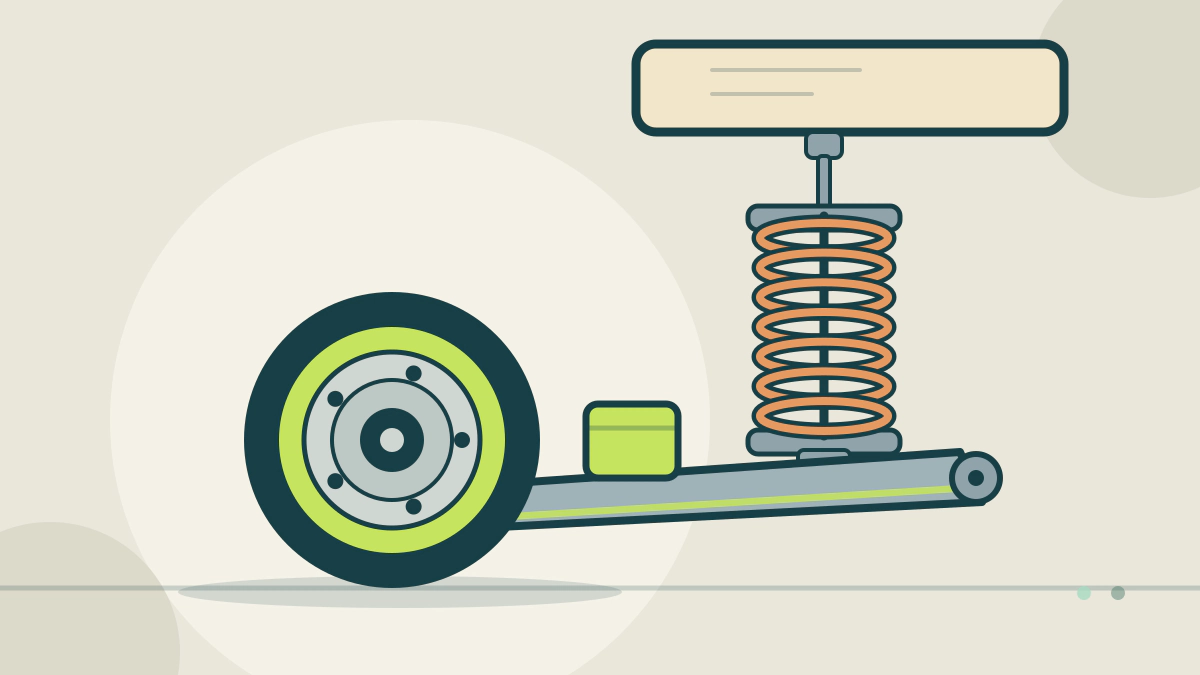
Unsprung weight is the mass that moves with each wheel instead of resting on the suspension springs, and it shapes ride comfort, grip and wheel control.
What is unsprung weight?
Unsprung weight is the mass of the parts that move with the wheel and are not carried by the suspension springs. That group includes the tire, the wheel and the parts mounted at the wheel end, such as the hub and wheel bearing. The body, passengers and cargo rest on the springs and make up the sprung weight.
ZF, which makes suspension and driveline components, describes the split in its explanation of shock absorber function: the suspension separates the sprung masses, meaning the vehicle body and payload, from the unsprung masses, meaning the axle and wheels.
Why engineers separate the two
The springs and dampers carry the body and filter road inputs. The unsprung parts sit below them and have to follow the road surface directly. Every bump pushes those parts upward, and the spring and damper then control the resulting motion.
Less unsprung mass means less inertia for the same suspension hardware to manage. ZF states on its A 133 rear axle page that a reduction in unsprung masses results in improved ride comfort. The reverse logic matters too: adding mass at the wheel makes the suspension’s job harder.
What counts as unsprung
| Part | Usually unsprung? | Why |
|---|---|---|
| Tire and wheel | Yes | They turn and follow the road surface directly |
| Hub and wheel bearing | Yes | Mounted at the wheel centre |
| Axle | Yes | Moves with the wheels it carries |
| Control arm | Partly | One end follows the wheel, the other attaches to the body |
| In-wheel motor | Yes | Sits inside the wheel and moves with it |
| Body, passengers, cargo | No | Carried by the springs |
The table shows why the total is not a simple sum of whole components. ZF notes that an optimised control arm link weight reduces unsprung mass on its control arm page, even though only part of the arm moves with the wheel. A link connects the steering knuckle to the body, so one end travels with the wheel and the other stays with the chassis.
Vehicle curb weight includes both groups. It tells you the total mass of the car, not how that mass is divided between the body and the wheels.
What the mass does over a bump
Imagine the tire meeting a raised seam in the pavement. The tire and wheel are pushed upward, compressing the sidewall and moving the unsprung parts. The spring and damper then absorb that energy and settle the body.
A light wheel assembly can change direction quickly and return to the road sooner. A heavy one carries more momentum, so the damper has more work to do and the tire may spend slightly longer unloaded. That is the practical reason engineers care about the number: it affects how consistently the contact patch stays on the road.
Why in-wheel motors and big wheels attract attention
An SAE International technical paper describes the effect in electric vehicles with in-wheel motors. The authors state that adding the motor significantly increases unsprung mass, which lowers the mass ratio of the body to the wheel and deteriorates ride comfort and safety. Their proposed suspension work is a response to that trade-off.
A larger or heavier wheel and tire has a similar direction of effect. It also adds rotating mass, which must be accelerated and slowed, so the change is not only about ride.
What unsprung weight does not tell you
It is one input among several. Spring rate, damper tuning, tire construction, suspension geometry, bushings and the distribution of mass across the car all influence the result. Two cars with the same corner mass can ride and handle differently.
Manufacturers rarely publish unsprung weight as a specification. A corner weight scale measures the total load at each wheel, not the sprung and unsprung split, so a number from a scale is not the same thing. Treat an advertised wheel weight as one data point rather than a handling verdict.
What to check when changing wheels or brakes
- Ask for the weight of the new wheel and tire and compare it with what comes off. The difference is the mass added or removed at that corner.
- Keep overall diameter, width, offset and clearance within the manufacturer’s approved specification. The plus-sizing guide explains the trade-offs.
- Treat a heavier wheel, a larger brake package or an in-wheel component as a suspension change, not only a styling change.
- After a change, have the alignment checked and the fasteners torqued to the manufacturer’s figures.
Frequently asked questions
Is unsprung weight the same as wheel weight?
Not exactly. The wheel and tire are the largest and most obvious parts, but hubs, bearings and the axle also move with the wheel. A control arm and other links contribute only partly.
Does less unsprung weight always improve handling?
No. It can help the suspension control the wheel, but grip and handling also depend on tires, damping, geometry and weight distribution. A change that lightens a wheel but alters its size or offset can make things worse.
Is unsprung weight the same as rotating mass?
No. Rotating mass includes parts that spin but are not at the wheel, such as internals in the engine or transmission. Unsprung weight includes non-rotating parts at the wheel end as well as the wheel itself.
Can a driver reduce unsprung weight?
Yes, within limits. Lighter wheels, tires and wheel-end components reduce it, provided the sizes and load ratings stay within the manufacturer’s specification. Check the owner’s manual and the door jamb label before changing wheel or tire sizes.