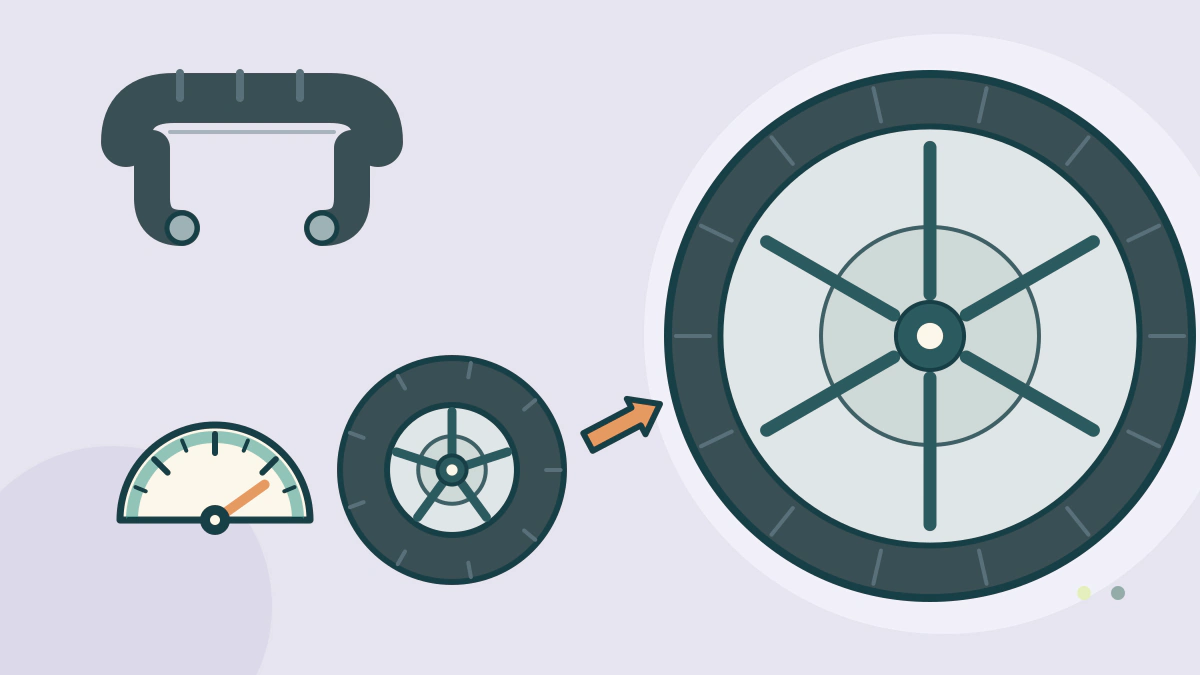
See what plus-sizing changes on a car: sidewall height, unsprung mass, speedometer error, load index, TPMS and ABS, checked against factory wheel specs.
Does plus-sizing a wheel make a car handle better?
Plus-sizing can sharpen steering response, but it is a trade, not a free upgrade. A larger wheel with a shorter sidewall keeps overall tire diameter close to stock while reducing the rubber between rim and road. Turn-in feels more direct. The ride gets firmer and the rim has less protection.
What plus-sizing keeps the same
The goal is to hold overall diameter close to the original. Kia’s 2026 K5 owner’s manual lists three factory sizes for the same car: 205/65 R16 on a 6.5J x16 wheel, 235/45 R18 on a 7.5J x18 wheel, and 245/40 R19 on an 8.0J x19 wheel. Width, sidewall and wheel size all change. Diameter barely does.
| Size | Wheel | Sidewall | Overall diameter | Load index |
|---|---|---|---|---|
| 205/65 R16 | 6.5J x16 | 133 mm | 673 mm | 95 |
| 235/45 R18 | 7.5J x18 | 106 mm | 669 mm | 94 |
| 245/40 R19 | 8.0J x19 | 98 mm | 679 mm | 94 |
Sidewall is width times the aspect ratio, doubled, plus the wheel diameter in millimeters. The 19-inch factory fit is about 0.9 percent larger than the 16-inch one, not 19/16 larger. That is why gearing and the speedometer stay close.
Kia’s wheel replacement section says new wheels should be equivalent to the factory units in diameter, rim width and offset. It adds that an incorrect size can affect wheel and bearing life, braking, handling, ground clearance, body-to-tire clearance, speedometer and odometer calibration, headlamp aim and bumper height.
The sidewall trade-off
Sidewall is the tire’s cushion. A shorter one flexes less, so response feels quicker, and it passes more road surface into the cabin. It also leaves less material between rim and pothole. NHTSA notes that a tire can suddenly lose pressure after a pothole strike or a curb. A very short sidewall moves more of that impact toward the wheel.
Kia’s caution is blunt: wheels that do not meet its specifications may fit poorly and cause damage to the vehicle or unusual handling and poor vehicle control.
Unsprung mass and rotating inertia
Unsprung mass is what the suspension does not carry: wheels, tires, hubs, brakes and part of the suspension. A larger wheel can weigh more, so ask the seller for weights rather than assuming. Even at equal weight, more of that mass sits farther from the axle, and rotational inertia rises with radius. Accelerating and braking that wheel then takes more effort. That is reasoning from geometry, not a measured result.
Speedometer, ABS and stability control
Kia explains why diameter matters beyond the dashboard. The anti-lock brake system compares wheel speeds, and tire size affects wheel speed. Kia says all four tires must be the size originally supplied, because a different size can make ABS and stability control work irregularly.
A diameter change produces a proportional error. Kia’s 2027 Telluride specifications list tires from 235/65 R18 to 265/45 R21. The 18-inch sizes work out to about 763 mm overall. The 21-inch size works out to about 772 mm, roughly 1.2 percent larger. A car calibrated for the 18 would then read about 1.2 percent low.
Load index, speed rating and TPMS
Load index is the number after the size, and Kia’s table shows why it matters. The 16-inch K5 tire carries load index 95, which Kia lists as 1,521 lb (690 kg). The 18-inch and 19-inch tires carry load index 94, or 1,477 lb (670 kg). A larger wheel does not automatically bring a higher load rating.
NHTSA points owners to the Tire and Loading Information label on the driver’s door edge or post for the correct size and pressure. It says to buy tires that are the same size as the original or another size the manufacturer recommends. The label lists load index and maximum load rating. NHTSA also notes that passenger cars, light trucks and vans from model year 2008 onward must have a tire pressure monitoring system, so new wheels need compatible sensors and the manual’s reset procedure.
A fitment check before you pay
- Read the wheel and tire specification in your owner’s manual.
- Compare the new overall diameter with the original.
- Confirm the load index meets the door label.
- Ask how the tire pressure sensors transfer and reset.
- Check clearance at full steering lock and over bumps.
- Ask your insurer and dealer in writing before buying.
Our steel versus alloy wheels guide covers nut seat and sensor hardware. For the efficiency side, see aftermarket wheels and EV range. The parent hub is Car Modifications and Tuning.
Frequently asked questions
Does plus-sizing change the speedometer reading?
It can. The speedometer is calibrated to a tire diameter, and a larger diameter turns fewer times per mile. The displayed speed then reads low by roughly the percentage change in diameter. Keep the new diameter close to stock to keep the error small.
Can I reuse my tire pressure sensors on new wheels?
Often yes, if the sensors fit the new wheel and the vehicle can relearn them. Some wheels need different sensor hardware. Ask the wheel seller and check the reset procedure in your owner’s manual before the install.
Does a bigger wheel always mean a harsher ride?
No, but it usually moves that way. A shorter sidewall has less rubber to absorb road input, and a heavier wheel gives the suspension more mass to control. Tire construction and pressure also matter, so compare complete sets rather than wheel diameter alone.
Is plus-sizing bad for fuel economy?
A diameter change alters the final drive ratio, and a wider or heavier tire can add rolling resistance. Keeping overall diameter close to stock keeps gearing close to stock. Any efficiency change depends on the specific tire and wheel, so treat claims without measured data with caution.