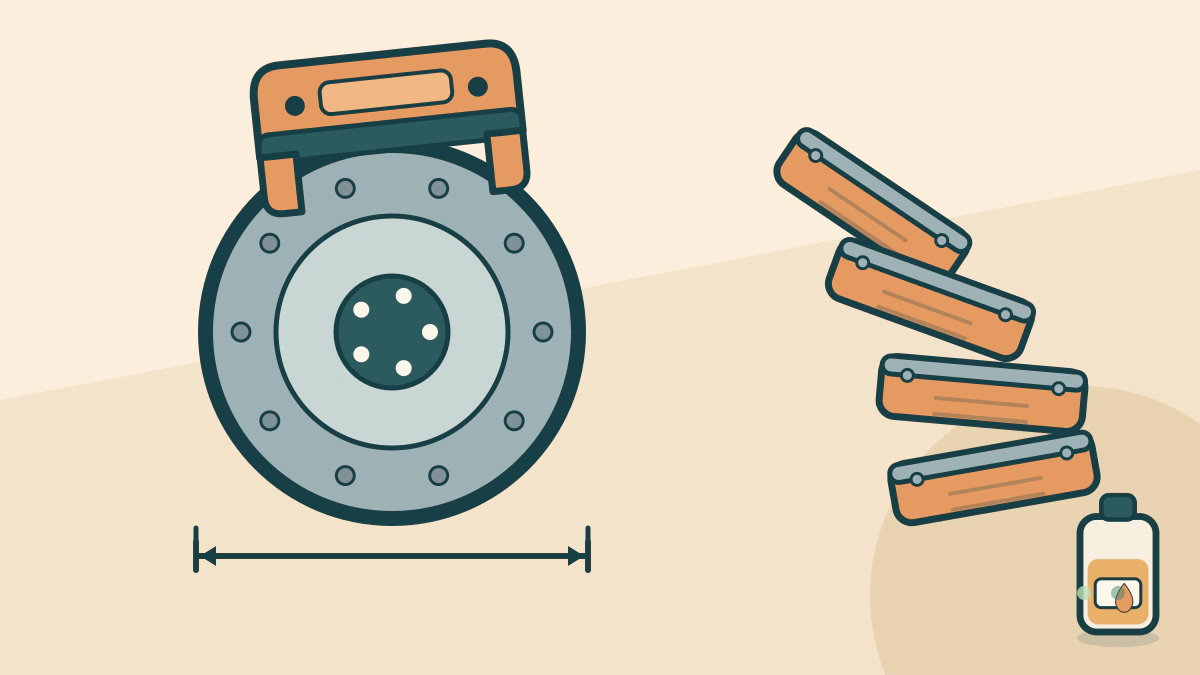
Compare daily-driver brake upgrades, including pad compounds, larger rotors, fluid and cooling, plus the wheel clearance and balance checks that come first.
What brake upgrade makes sense for a daily driver?
Start with worn parts, tires and fluid, then choose the smallest change that fixes the problem you actually have. A larger brake kit is not automatically better for commuting. Pads, rotors, fluid and cooling each solve a different issue, and some changes make a car worse in traffic.
The federal brake standard describes what a new vehicle must do, not what an aftermarket combination will do. This guide sits within the wider Car Modifications and Tuning category.
What FMVSS 135 already guarantees, and what it does not
FMVSS 135 applies to passenger cars built on or after September 1, 2000, and to multi-purpose vehicles, trucks and buses up to 3,500 kg (7,716 lb) GVWR built on or after September 1, 2002 (49 CFR 571.135). It tests the vehicle loaded to GVWR as well as lightly loaded, at ambient temperatures from 0 C to 40 C.
The cold-effectiveness requirement is a 100 km/h stop in 70 m or less. The standard also includes 15 heating snubs from 120 km/h or 80 percent of top speed, whichever is slower, then a hot-performance stop and cooling stops. Those tests show that the original system was validated for fade and heat, not just one panic stop.
The standard covers the complete vehicle, so a kit validated on one model is not automatically validated on another.
Pads and rotors are the first real upgrade
Pad compound is the most consequential daily-driver choice. Wilwood’s chart says street performance applications usually operate between 500 F and 1,000 F, while many road-race compounds are intended for above 1,000 F (Wilwood). Several high-temperature pads are marked racing only and not for street use.
That matters because a pad designed to work hot can feel weak when cold. A street pad that bites from the first stop is usually the better commute choice. If the pads are simply worn, a quality street compound may be all the upgrade the car needs.
Rotor size changes leverage. A larger rotor gives the caliper more radius to work against, so the same line pressure produces more torque. FMVSS 135 evaluates brake factor and front-to-rear balance, which is why changing only one axle can make the car less stable under hard braking (49 CFR 571.135).
For wear diagnosis, see brake pads versus brake rotors and when rotors need replacement.
Fluid and cooling decide how repeatable the brakes feel
Brake fluid is rated by boiling point. FMVSS 116 sets a minimum dry boiling point of 205 C for DOT 3, 230 C for DOT 4 and 260 C for DOT 5, with lower wet boiling points after moisture absorption (49 CFR 571.116). The reservoir label must name the fluid the manufacturer specifies.
Do not assume a higher DOT number is better for your car. DOT 5 is silicone-based, while DOT 3 and DOT 4 are not, so the fluids are not interchangeable. Use only the grade the cap specifies. For interval guidance, see how often brake fluid should be replaced.
Cooling is the other half of fade resistance. Airflow through the wheel well removes heat between stops. Ducts can help a heavy car or a mountain descent, but they must not rub on tires, steering parts or brake lines.
Wheel clearance and the parts around the caliper
A larger rotor or caliper can hit the inside of the wheel spokes. Check clearance with the wheel fitted, not on a bare hub. Many big-brake kits include a fitment template, and the spare wheel should be checked too.
Brake hoses, wheel-speed sensors and dust shields need room through the full steering and suspension travel. Check them with the suspension loaded and the wheels turned both ways.
Matching the upgrade to daily driving
| Change | What it changes | Daily-driver upside | Watch out for |
|---|---|---|---|
| Performance street pads | Cold bite, dust, noise and heat range | Better initial response without track-only behavior | Break-in procedure and rotor compatibility vary by maker |
| Larger rotors or big-brake kit | Brake torque, heat capacity and unsprung mass | Less fade in repeated hard stops | Wheel clearance, spare fitment and front-to-rear balance |
| Fresh DOT 4 fluid | Boiling point margin | More consistent pedal in heat | Use only the grade on the reservoir cap |
| Cooling ducts | Airflow to the brakes | Lower temperatures on long descents | Rubbing, blocked airflow and debris damage |
Tires belong in the same decision. A brake upgrade cannot shorten stopping distance beyond what the tires can transmit.
When the work should go to a professional
Brake bleeding, ABS service and torque-to-yield fasteners need the manufacturer’s procedure and often a scan tool. A pedal that sinks, a warning light or a pulling car needs diagnosis before any upgrade. The Car Care Council recommends an annual brake inspection covering lining wear, fluid level, rotor thickness and hose condition (Car Care Council).
If the car has an electronic parking brake, regenerative braking or brake-by-wire, treat a hardware change as a system change that may need software calibration.
Frequently asked questions
Do bigger brakes stop a car faster in normal driving?
Usually not on the first stop from legal speed, because tire grip is already the limit. They mainly add heat capacity and repeatability.
Are track pads safe on the street?
Many are not. Wilwood marks several high-temperature compounds as racing only, and a pad that needs heat can have weak cold response.
Can I upgrade only the front brakes?
You can buy a front kit, but front-to-rear balance still matters. Ask the kit maker about balance and ABS compatibility.
Does DOT 4 fluid always replace DOT 3?
No. Use the grade on the reservoir cap or in the owner’s manual. DOT 4 has a higher boiling point, but the seals are designed around a specific fluid.