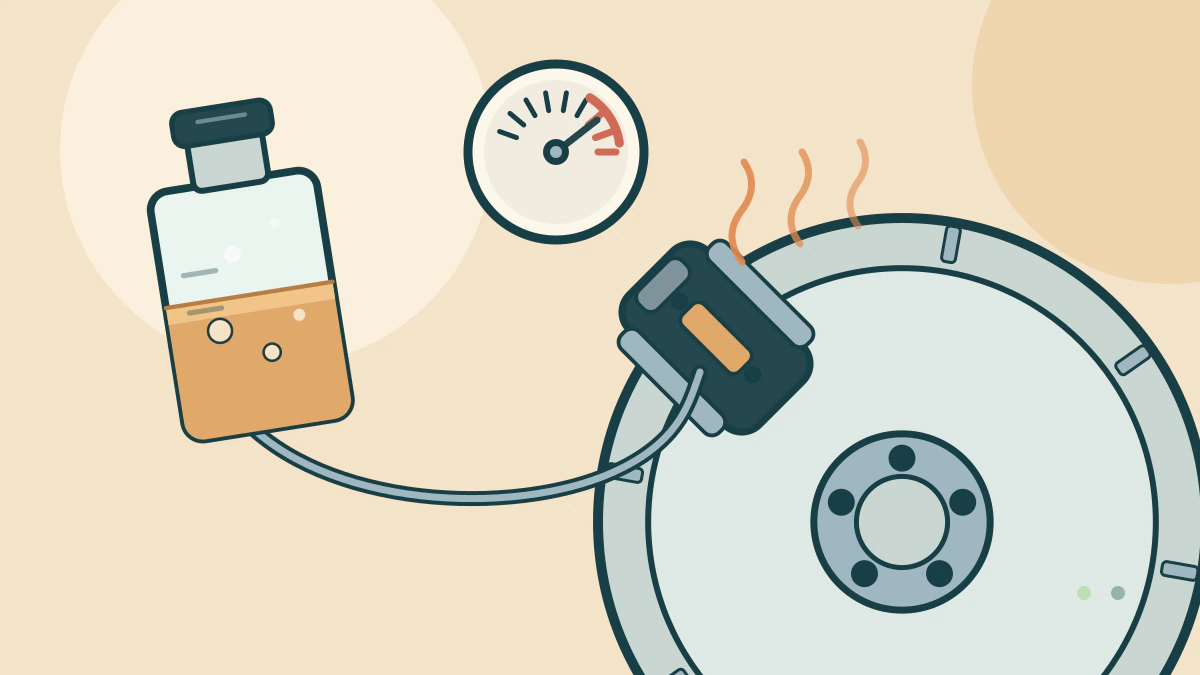
Track braking can heat brake fluid to its boiling point. See what DOT dry and wet boiling points mean and what manufacturer track guides require.
Why does brake fluid decide how long you can brake hard?
Brake fluid matters on track because repeated high-speed stops can heat it to its boiling point, and boiled fluid leaves the pedal long or soft with little warning. Cooling the car afterward does not restore it. Chevrolet’s 2027 Corvette track guide states that boiled brake fluid is compromised and must be replaced. This guide sits in the Motorsports and Performance Driving hub.
Braking turns motion into heat at the pads and rotors, and the Corvette guide’s temperature warnings show that heat reaches the fluid. On the street, the next mile usually carries it away. On a circuit, the next corner arrives first, so heat stacks up session after session.
What a brake fluid grade actually guarantees
Federal Motor Vehicle Safety Standard No. 116 sets minimum boiling points for new fluid. 49 CFR 571.116 lists a dry and a wet figure for each grade.
| Grade | Minimum dry boiling point | Minimum wet boiling point | Marking note |
|---|---|---|---|
| DOT 3 | 205 °C (401 °F) | 140 °C (284 °F) | Grade on the container |
| DOT 4 | 230 °C (446 °F) | 155 °C (311 °F) | Grade on the container |
| DOT 5 | 260 °C (500 °F) | 180 °C (356 °F) | Marked silicone base or DOT 5.1 non-silicone base |
Those are floors for fresh fluid in a lab test, not a reading from your reservoir. The standard also requires the container to show the grade and the minimum wet boiling point in Fahrenheit.
The wet figure comes from a lab procedure: a humidified sample is boiled again. It simulates moisture pickup, not your car.
Why the wet number matters more on track
A 2026 Kia K5 owner’s manual says brake fluid constantly absorbs moisture from the air and that this lowers its boiling point. It warns that a low boiling point allows vapor pockets to form under hard braking, and that fluid exposed to open air for a long time should never be used.
Vapor is the failure mode: a gas pocket compresses, a liquid does not, so fluid that boils in a caliper gives a longer pedal before pressure builds.
This is why an old, unopened bottle is not a shortcut. The Corvette guide asks for fluid from a sealed container and says to replace fluid over one year old or of unknown age before track use. The replacement interval article covers street schedules; a track day adds a separate reason to start with known-fresh fluid.
What manufacturer track guides require
Chevrolet publishes track guides alongside the owner’s manual. Two examples show the target is model-specific.
The 2027 Corvette guide specifies DOT 4 high performance fluid with a dry boiling point above 310 °C (590 °F). The 2019 Camaro guide sets a lower bar: above 279 °C (543 °F), before every track event or session.
Both guides ban silicone or DOT 5 fluid. The Corvette guide also requires a level check before each event and says to replace high-performance fluid with GM-approved fluid before returning the car to public roads.
A higher dry boiling point buys heat margin. It does not fix a leak, a worn pad or a dragging caliper.
Bleeding and flushing are not one universal procedure
The Corvette guide says its brake systems require specific flushing and bleeding processes, found in the service manual. It also says to disconnect the battery first, because a self-test could pressurize the system while it is open.
Manual or pressure bleeding is accepted for a flush, but the sequence depends on the brake system fitted to the car. A gravity bleed copied from a forum is not proof the job was done correctly.
The Kia manual adds the everyday rules: clean around the cap, use the specified fluid, and never mix types. Brake fluid also damages paint.
For a street car with unknown history, use a shop with factory service information.
How to manage brake heat during a track day
Check the reservoir before each session, and have the system inspected if the level keeps falling.
Watch the car’s warnings. The Corvette guide describes two stages. The first asks the driver to brake less and back up the braking points. The second means fluid temperature is near boiling: start a cool-down lap, then flush.
Install and inspect any cooling parts the guide lists. The Corvette guide says its rear ducts are for track use only and should be removed after the event.
After the day, treat a soft pedal as a fault. The same guide notes that a boil can behave like a leak, so inspection comes before another session. The post-track inspection guide covers the wider check, and brake fluid warning signs covers symptoms away from the track.
Frequently asked questions
Can I use DOT 5 fluid in a car that specifies DOT 4?
Chevrolet’s track guides say not to use silicone or DOT 5 fluid. A DOT 5 container must be marked silicone base or DOT 5.1 non-silicone base. Use the grade your owner’s manual specifies, not the highest number.
Does a soft pedal after a session always mean the fluid boiled?
No. Air, a leak, a worn pad or a mechanical fault can produce similar symptoms. Chevrolet notes that a boil can behave like a leak, so inspect the system rather than topping up and driving again.
How often should track-use brake fluid be changed?
There is no single interval for every car. The Corvette guide replaces fluid older than one year or of unknown age before track use, and again after a boil. Your model’s guide and the fluid maker’s instructions set the rest.
Can I top up the reservoir between sessions?
Check the level, but do not treat a low level as a routine top-up. The Kia manual says the level falls as linings wear and that frequent additions call for inspection. Opening a hot system also risks contamination.