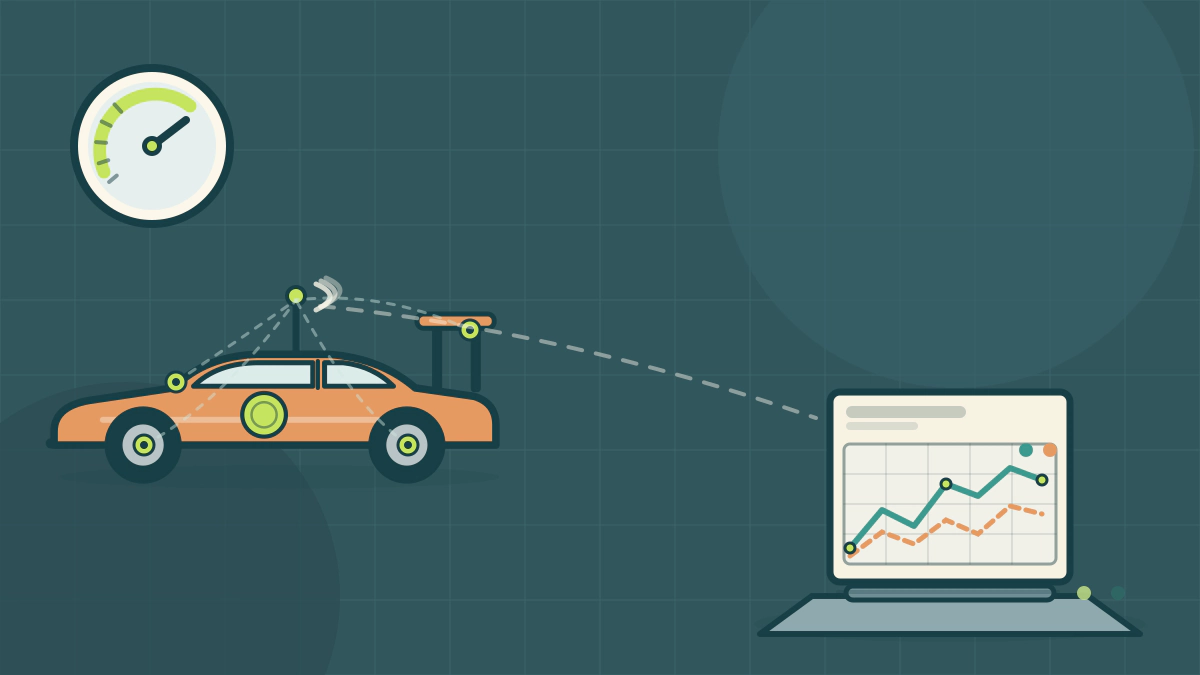
See what a race car data logger records, how sensors and logging rates shape the data, and why teams and sanctioning bodies rely on it.
Why do race cars carry data loggers?
A race car carries a data logger to record sensor readings and calculated values during a run, so the team can study what the car actually did once it returns to the pits. The device does not make a car faster by itself. It supplies evidence for setup, driving and reliability decisions.
The SCCA’s 2026 General Competition Rules treat data collection devices as instrumentation. Section 9.3.16 allows them in every class that permits the installation or addition of gauges, indicators or instruments. The same section shows that logging is not only a private engineering tool. SCCA places its own data acquisition devices on selected cars to assist performance balancing, and those cars must report to impound after their sessions.
What a logger actually records
A sensor converts a physical measurement, such as pressure, into an electrical signal. The logger measures that signal and assigns it to a channel with a name such as Fuel Pressure. MoTeC’s user manual describes channels as the path that carries a value to logging, displays, alarms and calculations.
That is why one logger can cover very different parts of the car. The same manual gives suspension position and engine temperature as examples. A lambda meter can add air-fuel ratio. GPS adds speed and position, which the analysis software uses to build a track map and compare driven lines. Engine data can arrive over a CAN bus instead of through separate wires.
| Recorded item | Typical source | What the team reviews |
|---|---|---|
| Suspension position | Travel sensor | Body movement through a corner and over curbs |
| Engine temperature | Temperature sensor | Warm-up, cooling margin and heat soak |
| Air-fuel ratio | Lambda meter | Mixture under load |
| Speed and position | GPS | Line, braking points and time lost by section |
| Engine channels | ECU over CAN | RPM, throttle and other operating data |
Logging rate, start conditions and memory
Each channel has its own logging rate. MoTeC’s manual warns that a value logged too slowly can produce meaningless readings. Suspension position normally needs 200 samples per second or more. Engine temperature needs about one sample per second.
Faster is not automatically better. Logging a slow-changing value at a high rate does not improve accuracy. It only uses memory and lengthens the download. The manual also notes a ceiling: a channel cannot be logged faster than its source updates. Some inputs update at 5000 Hz, some communication devices at 50 Hz, and some internal calculations at 100 Hz.
Logging does not have to run from power-up to shutdown. The team can set conditions. MoTeC gives an example: start when the car exceeds 50 km/h, and stop when engine speed stays below 500 rpm for 10 seconds.
Memory sets the other limit. The available logging time depends on how many channels are recorded and how fast each one runs. When memory fills, the logger either stops or cycles through the old data. The configuration software reports the available time before the session.
Logging is not the same as telemetry
A logger stores data for later analysis. A telemetry radio sends selected values to a remote location, such as the pit garage, while the car is running. MoTeC lists the live uses: current vehicle condition, position on track, lap times and fuel remaining.
The two functions answer different questions. Telemetry supports a decision during the session. Logging supports a review after it.
What sanctioning bodies do with the data
Series rules can make data part of eligibility, not just engineering. SCCA’s racing memo RM 25-04 sets a submission deadline for Spec MX-5. After each timed session, competitors must send the AiM data file for all timed laps within 30 to 60 minutes. The memo warns that missing or non-functioning data may be grounds for a penalty or disqualification.
The SCCA rulebook draws a line around its own collection. Data from the club’s devices is used for performance balancing and not for compliance, and participation is not protestable. That separation matters. A series can gather data for one purpose without turning every channel into a technical inspection.
What the numbers cannot settle
A log is only as good as its sensors and its context. A channel logged too slowly can hide a spike. A lap trace without tire, weather and setup notes is hard to interpret later.
That is why teams pair the file with a run sheet. The record shows what the car did, while the notes explain what changed. Data acquisition also belongs to the technical history covered by the evolution of American road racing. This guide sits in the Motorsports and Performance Driving hub.
Frequently asked questions
What does a race car data logger record?
It records sensor readings and calculated values, such as suspension travel, engine temperature, air-fuel ratio, speed, position and engine data from the ECU. Each value is stored on its own channel at a chosen rate. The team can then compare runs and check how the car behaved.
How often should a data logger sample a channel?
Often enough to capture the changes that matter. MoTeC’s manual gives 200 samples per second or more for suspension position and about one per second for engine temperature. Logging faster than needed wastes memory and download time without improving accuracy.
Is data logging the same as telemetry?
No. Logging stores data in the car for later analysis. Telemetry transmits live data to a remote location such as the pits. A car can use one or both, and the choice depends on whether the team needs a decision now or a review later.
Can a series require a driver to hand over data?
Yes. SCCA’s Spec MX-5 memo requires competitors to send AiM data files within 30 to 60 minutes of each timed session, and missing data can bring a penalty. Other series set their own rules, so read the current rulebook for your class.