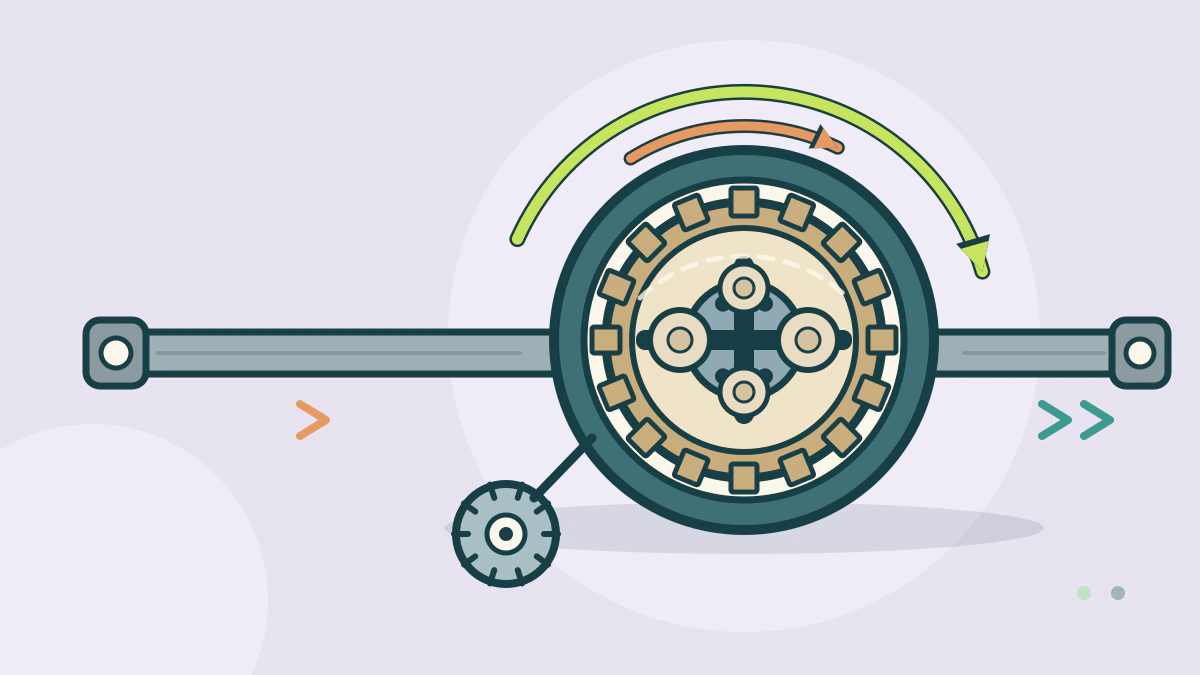
Compare open, limited-slip and locked differentials, the clutch, cone and gear types, and how torque bias changes cornering in a race car.
What does a differential do in a corner?
It lets the two wheels on an axle turn at different speeds while still receiving torque from the engine. The outside wheel travels a longer path, so it must rotate faster. An open differential allows that speed difference, but it also splits torque roughly evenly. If one wheel loses grip, the car may not move. The same split affects how the car turns, which is why differential choice belongs with the Motorsports and Performance Driving chassis package.
A limited-slip differential changes that balance. Eaton describes it as a unit that shifts part of the torque to the wheel with more traction while limiting slip at the other. The amount it can shift is called the bias.
A fully locked differential goes further. It joins both axles so they turn at the same speed. That can be useful in a straight line or on a loose surface, but it fights the speed difference a corner requires.
Open, limited-slip and locked compared
| Type | Torque behavior | Cornering effect | Typical role |
|---|---|---|---|
| Open | Near-equal split, both wheels may spin | Inside wheel can lose drive | Baseline |
| Clutch limited-slip | Bias rises as torque is applied | Stabilizes the car on power, can bind at low speed | Rebuildable race unit |
| Gear limited-slip | Torque sensing through helical gears | Smooth, progressive, helps rotate the car | Sports-car and road-racing unit |
| Locked or spool | Both axles forced to one speed | Strong drive, but scrubs and pushes the front | Drag and off-road unit |
Eaton notes that lockers can be noisy and harsh on the street, with unpredictable effects in corners and on wet surfaces.
How a clutch-type limited-slip works
A clutch-type unit uses packs of friction and steel plates behind the side gears. Springs apply an initial clamping load. When one wheel begins to slip, the clamping load increases and the plates transfer more power to the other wheel.
The design is common because it can be rebuilt: Eaton says replacing the clutch plates renews the unit. A cone-type unit uses friction-lined cones instead of plates, and Eaton warns that cone units can chatter and are not typically rebuildable.
In racing, tuning matters as much as layout. Spring preload sets how firmly the unit resists differentiation before torque arrives. FIA Le Mans Hypercar rules require a unique, homologated front ramp, which shows how closely the rules watch this part.
How a gear-type limited-slip works
A gear-type unit, such as a Torsen, uses helical gears rather than clutch plates. When torque passes through the gears, thrust forces push them against the casing. That contact creates friction, which resists wheel spin. The bias grows with torque load, so the unit is mild at low load and stronger under throttle.
Torsen quotes torque bias ratios of about 2:1 to 2.5:1 for its Type-2 products and 3:1 to 4:1 for the T-2R. The ratio compares the torque the high-traction tire can receive with what the low-traction side can sustain.
The gear type has a limit. It needs some reaction torque on both outputs. If one wheel is completely lifted, zero torque multiplied by any bias ratio is still zero. Torsen notes that brake force can sometimes provide the reaction torque instead of the road.
What it changes at corner entry and exit
At corner entry, a differential can resist the car’s turn. A clutch unit with high preload keeps some locking force even off the throttle, which can make the front push wide. A geared unit differentiates more freely at low load, so it obstructs turn-in less.
At corner exit, the differential becomes a power-delivery device. As the driver opens the throttle, the loaded outside wheel can take more torque. A limited-slip unit sends drive there instead of spinning the inside wheel. Torsen says a helical unit can create a positive yaw moment that helps the car around the curve. Tire grip is the other half; the touring versus performance tires comparison covers the road-car trade-off.
Too much locking can undo the benefit. The car may push wide, the inside tire may scrub, and the driver may have to fight the steering. The right setting depends on the corner, the tire and the driver’s style.
Why center differentials are a separate story
A four-wheel-drive race car may also have a center differential between the axles. Audi’s Torsen unit, introduced in the 80 quattro in 1986, normally split torque 50:50. When one axle could not use its share, up to 75 percent could go to the axle with more grip.
That is a different job from a rear-axle limited-slip. The center unit changes front-to-rear balance; the axle unit changes left-to-right balance. That tradition is part of the history of American road racing.
Frequently asked questions
Is a limited-slip differential the same as a locking differential?
No. A limited-slip unit biases torque but cannot lock both wheels. A locking differential can join the axles and send all available torque to the wheel with grip.
What does torque bias ratio mean?
It compares the torque the high-traction wheel can receive with what the low-traction side can sustain. At 4:1, Torsen says the unit stays locked unless the low-traction tire has less than a quarter of the high-traction grip.
Does a gear-type limited-slip work with one wheel in the air?
Not by itself. The unit needs reaction torque on both outputs, and zero torque on one side gives zero on the other. A brake can sometimes supply that reaction.
Do racing differentials need maintenance?
It depends on the type. Clutch-type units have wearable plates and can be rebuilt. Eaton says gear-type units are not typically rebuildable. Follow the supplier’s service intervals.