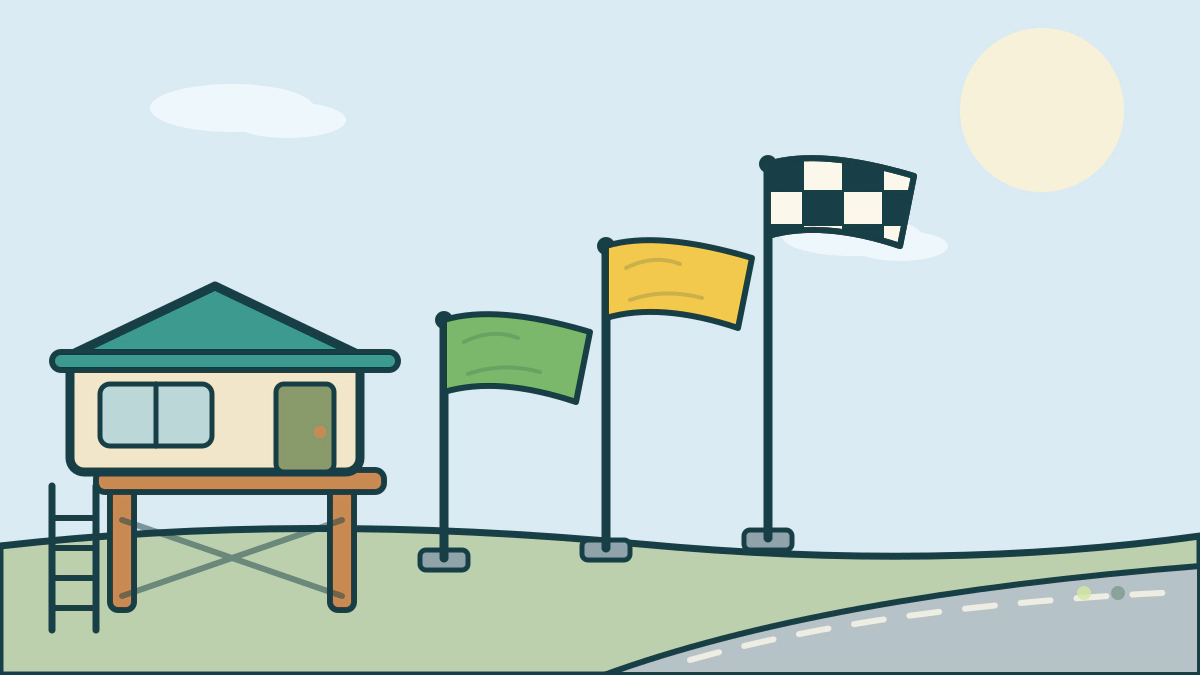
Read track flags the way an organizer's rulebook defines them: green, yellow, blue, white, black, red and checkered, with the response each requires.
What do track flags mean?
Track flags are the organizer’s commands, and their meanings are defined in that event’s rulebook. The core set covers the start, hazards, passing, mechanical problems, a stopped session and the finish.
The descriptions below follow SCCA’s published flag rules for its Time Trials and road racing events (SCCA flags, 2026 GCR). Other organizers use similar colors, but the details and the flag set can differ.
What does a green flag mean?
A green flag means the course is clear and competition is underway. It is normally shown only by the start and finish official (SCCA flags). At a race start it may be waved, and after a yellow-flag incident a green flag at the next station tells you the track is clear again.
What do the yellow flags require?
A standing yellow warns of an incident beside the track. Slow significantly and continue at reduced speed. A waving yellow warns of greater danger, with the track partly or completely blocked. Slow significantly and be ready to stop, and pass in single file where possible (SCCA flags).
Passing is not allowed from the yellow flag until you are past the incident. SCCA defines the zone as starting at a line across the track from the flag and ending at a line across the track from the last part of the incident, which can include the car, driver, officials or debris (SCCA flags). A double yellow at all stations means the whole course is under yellow, as on a pace or safety-car lap (2026 GCR).
| Flag | What it means | What to do |
|---|---|---|
| Green | Course is clear and competition is underway | Proceed, but do not overdrive what you can see |
| Standing yellow | Incident beside the track | Slow significantly, no passing until past the incident |
| Waving yellow | Great danger, track partly or fully blocked | Slow significantly, be ready to stop, no passing |
| Double yellow at all stations | Whole course is under yellow | Slow down, no passing; expect a pace or safety car |
Which flags warn about the surface or slower traffic?
A yellow flag with vertical red stripes is the debris flag. It warns of a slippery surface or debris and is shown standing, but may be put away before the hazard is gone (SCCA flags).
A white flag warns of a much slower vehicle, ambulance or other emergency vehicle on the racing surface, and SCCA shows it standing for two stations before the vehicle. A blue flag tells a driver that a faster car is close and wants past. A standing blue is a warning; a waving blue means let the car by as soon as it is safe (SCCA flags).
What do the black flags mean?
A furled black flag pointed at your car is a warning for unsafe or improper driving. An open black flag with your number means go directly to the pits and report to the official named in the regulations. Do not take another lap (SCCA flags).
Black shown at all stations, usually with an “ALL” board, stops the session. All cars stop competing and return to the pits with caution (SCCA flags). A black flag with an orange or red ball, called the meatball, means your car has a mechanical problem and you must pit (SCCA flags).
| Flag | What it means | What to do |
|---|---|---|
| Blue | A faster car is close behind | Let it pass as soon as it is safe |
| White | Slow vehicle or emergency vehicle ahead | Caution, be ready to change line |
| Open black with your number | You are wanted in the pits | Go directly to the pits, do not take another lap |
| Black with orange or red ball | Mechanical problem | Pit and report the fault |
| Red | Session stopped, extreme danger | Stop immediately at the side, stay until released |
| Checkered | Session finished | Continue cautiously to the pit lane |
What does a red flag require?
A red flag means extreme danger and a stopped session. Come to an immediate, controlled stop at the side of the track, preferably before and within sight of a staffed station, and stay there until an official releases you (SCCA flags).
Red and black-all flags are decisions made by race control. SCCA’s road racing rules say the red flag can only be displayed by order of the race director or chief steward, relayed through race control (2026 GCR).
How do you learn the flags for your event?
Read the supplementary regulations and attend the drivers’ meeting. Some events use a minimal flag set: yellow, black and checkered, plus blue where passing is allowed. Yellow then covers white and debris conditions, and black covers both behavioral and mechanical situations (SCCA flags).
Some tracks also use lights instead of flags, and the event regulations should say where (SCCA flags). The track day tire guide and the Motorsports hub cover other preparation, and the history of American road racing explains how the sport’s rules developed.
Frequently asked questions
What does a waving yellow flag mean?
It means the incident ahead is serious, and the track may be partly or completely blocked. Slow significantly and be prepared to stop. Do not pass until you are past the incident.
Can a driver pass under a yellow flag?
No. Passing is prohibited from the first yellow flag until you are past the incident.
What should a driver do if a black flag shows their number?
Go directly to the pits and report to the official named in the regulations. Do not take another lap. A furled black flag is only a warning.
Do all tracks use the same flags?
No. The colors are widely similar, but the flag set, the meaning of a minimal set and the use of lights can differ. Read the supplementary regulations before you go on track.