Compare a racing harness with a three-point belt on restraint geometry, standards, head-and-neck devices and street legality before changing a car.
What is the real difference between a racing harness and a three-point belt?
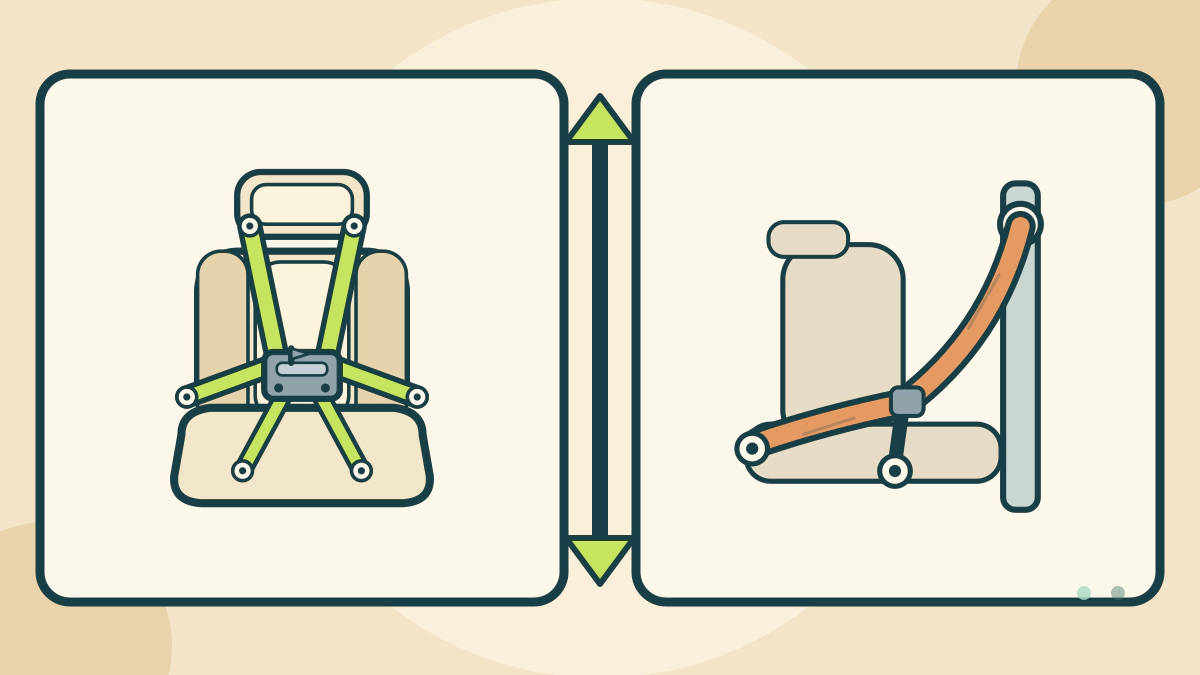
A three-point belt restrains the pelvis and upper torso and lets you move. A racing harness adds crotch straps and tight shoulder straps to hold you in a race seat, and it works only as part of a system that includes the seat, mounts and usually a head-and-neck restraint.
Both are tested, but to different standards and for different jobs. A street belt must meet FMVSS 209 as a seat belt assembly. A competition harness is homologated to FIA 8853-2016 or certified to SFI 16.1 (FIA 8853-2016, SCCA GCR).
What does a three-point belt do in a crash?
FMVSS 209 defines a Type 2 assembly as pelvic restraint plus upper torso restraint. It requires the upper torso restraint to work without shifting the pelvic belt into the abdominal region and to minimize vertical forces on the shoulders and spine (FMVSS 209). The buckle must be easy to release and designed against accidental release.
That geometry lets you turn and reach the controls. Retractors, and in newer cars pretensioners and load limiters, manage belt force.
How does a racing harness change the geometry?
FIA 8853-2016 describes a harness with two shoulder straps, two pelvic straps and two crotch straps. The crotch straps resist “submarine” movement, the tendency to slide forward under the pelvic strap (FIA 8853-2016). The standard does not allow retractors, and each shoulder strap must have its own attachment.
SCCA’s road racing rulebook adds installation detail. It requires a 5-, 6- or 7-point harness, over-the-shoulder straps, a single release for lap and shoulder belts, and shoulder straps mounted behind the driver and supported above a line drawn downward from the shoulder point at 20 degrees with the horizontal (2026 GCR). Each lap and shoulder belt needs its own mounting point, with at least SAE Grade 5 or metric 8.8 bolts.
The result is a much more upright occupant who cannot move around in the seat.
Why does a harness usually come with a head-and-neck restraint?
FIA 8853 defines a frontal head restraint as a device that restrains the head relative to the torso in a frontal or angled impact, reducing loads on the head and neck (FIA 8853-2016). The HANS is one type of FIA-approved FHR.
Organizer rules link the two. SCCA Time Trials Safety Level 2 requires a 5-, 6- or 7-point harness, and its harness rules say two-inch shoulder straps may only be used with a head-and-neck device (SCCA Time Trials). SCCA road racing requires an SFI 38.1 or FIA 8858 head-and-neck restraint (2026 GCR).
The FHR, seat, roll structure and harness are checked together.
Can you use a racing harness on the street?
NHTSA’s position is that a seat belt assembly sold for use in a motor vehicle must be certified to FMVSS 209, whether it is original equipment or a replacement (NHTSA interpretation 11316). In an interpretation about a Schroth harness, NHTSA treated the harness as a Type 2 seat belt assembly and said it must be certified to FMVSS 209 before it could be sold (nht94-733).
That does not make every harness illegal. It means a competition harness without the required certification is not a compliant seat belt for a road car. Removing factory belts can also create a problem for a business under the “make inoperative” rule (NHTSA interpretation 11316). State inspection rules and insurers can add requirements, so check the label, your state law and your policy before changing a street car.
| Aspect | Three-point belt | Racing harness |
|---|---|---|
| Straps | Lap and diagonal shoulder strap | Two shoulder, two pelvic and two crotch straps |
| Main job | Restrain pelvis and upper torso in a road crash | Hold a driver in a race seat under high loads |
| Movement | Allows turning and reaching controls | Very limited once tightened |
| Main standard | FMVSS 209 seat belt assembly | FIA 8853-2016 or SFI 16.1 |
| Head and neck | Designed with the car’s airbags and seats | Usually paired with an FHR device |
| Street use | Fitted and certified with the vehicle | Needs FMVSS 209 certification to be a road belt |
Which restraint fits your driving?
Use the street belt on the street and the harness on the track, with the seat and structure that the organizer requires. If you are building a track car, choose the harness and FHR together and confirm the installation against the rulebook. If you are driving to the track in a street car, the factory belt is the restraint that matches the car.
The history of the three-point belt explains why the street design became standard. The roll cage guide covers the structure a harness is meant to work with, and the Motorsports hub lists the rest of the safety section.
Frequently asked questions
Does a 5-point harness need a roll bar?
It depends on the organizer. SCCA Time Trials Safety Level 2 pairs a 5-, 6- or 7-point harness with a 4-point roll bar, so check the supplementary regulations before buying.
Can a factory belt stay with a racing harness?
Many track cars keep both, and some organizers allow it. Do not remove or disable a factory belt on a street car without checking NHTSA and state rules. The harness must also not interfere with the factory belt or its buckle.
How long does a racing harness last?
FIA 8853-2016 says the validity of a harness expires five years after the year of manufacture (FIA 8853-2016). SFI 16.1 restraints have a two-year recertification period (SFI list). Harness labels show an expiration date. Replace damaged or expired belts.
Is a 4-point harness enough for track driving?
Some organizers accept four-point harnesses, and the FIA 8854/98 standard covers four-strap designs for some historic cars. SCCA road racing requires 5, 6 or 7 points, and Time Trials Level 2 requires 5 or more. Read the rulebook.