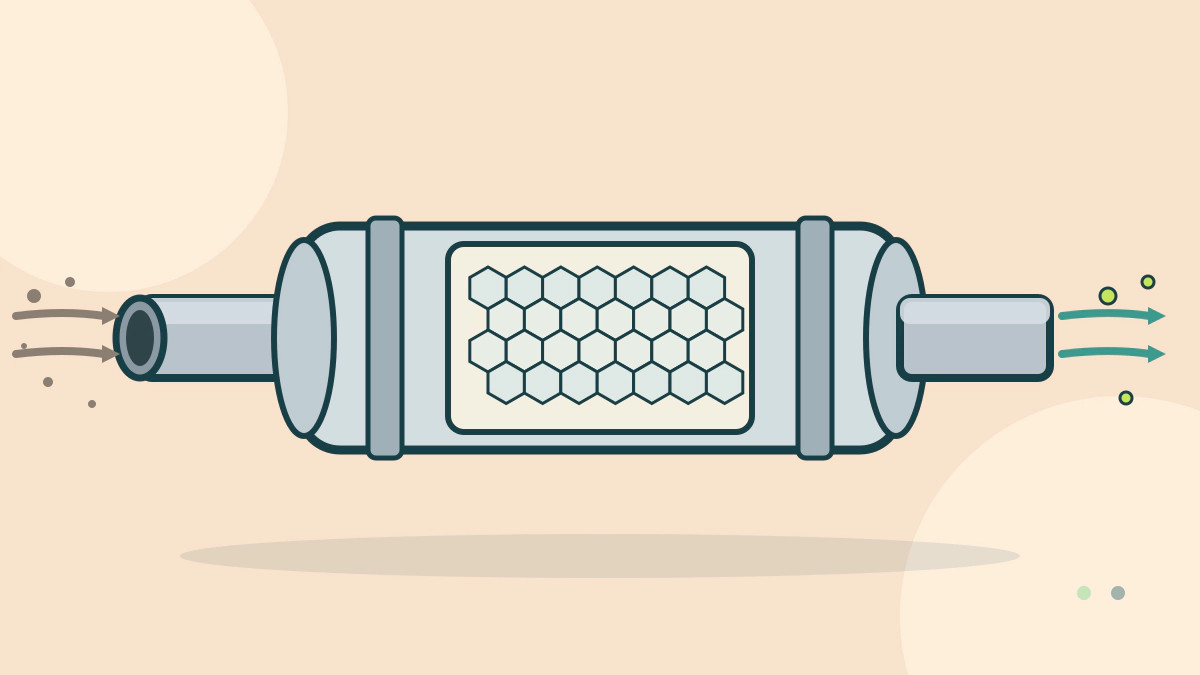
A catalytic converter does not trap pollutants. It converts carbon monoxide, hydrocarbons and nitrogen oxides into carbon dioxide, water and nitrogen.
What does a catalytic converter remove?
A three-way catalytic converter removes carbon monoxide, unburned hydrocarbons and nitrogen oxides from the exhaust by converting them into carbon dioxide, water and nitrogen. The pollutants are not stored inside the unit. They leave the tailpipe as different molecules.
The distinction matters. A filter traps particles and must be cleaned or replaced. A catalytic converter is a flow-through device. Its precious-metal coating speeds up chemical reactions in the exhaust stream, and the gas keeps moving. The DOE catalyst report describes three simultaneous jobs: oxidizing carbon monoxide to carbon dioxide, oxidizing unburned hydrocarbons to carbon dioxide and water, and reducing nitric oxide and nitrogen dioxide to nitrogen.
What goes in and what comes out
| What enters | Reaction | What leaves |
|---|---|---|
| Carbon monoxide (CO) | Oxidized | Carbon dioxide (CO2) |
| Unburned hydrocarbons (HC) | Oxidized | Carbon dioxide and water |
| Nitric oxide and nitrogen dioxide (NOx) | Reduced | Nitrogen |
| Carbon dioxide (CO2) | Unchanged | Carbon dioxide |
| Soot and particulate matter | Not the main target | Particles, handled by a diesel filter |
The first three rows are the “three” in three-way. The fourth row is a reminder that the converter does not reduce carbon dioxide. It can create CO2 while removing CO. That is chemistry, not a design flaw: the carbon and oxygen atoms have to go somewhere. EPA’s smog page notes that CO2 makes up roughly 99% of the greenhouse gases emitted from a tailpipe. EPA
Why the engine computer matters
A three-way converter has to oxidize some gases and reduce others at the same time. That balancing act depends on what is in the exhaust at each moment. The DOE report describes the converter as a redox reactor, not a single-purpose filter.
EPA’s timeline credits on-board computers and oxygen sensors, introduced on most new cars in 1981, with helping optimize converter efficiency. EPA timeline A converter that is working correctly is therefore part of a system, not a stand-alone add-on.
What it does not remove
Carbon dioxide is the main greenhouse gas in gasoline exhaust. The converter does not capture it. It also does not remove soot or particulate matter in the way a diesel particulate filter does. The DOE Alternative Fuels Data Center describes a diesel aftertreatment stack in which exhaust passes through a particulate filter and a diesel oxidation catalyst, then selective catalytic reduction uses a reductant such as urea or ammonia to convert NOx into nitrogen and water. AFDC
That is why a diesel and a gasoline car do not share one universal converter recipe. A gasoline three-way converter targets CO, HC and NOx. A diesel may use an oxidation catalyst, a particulate filter and selective catalytic reduction, depending on the engine and model year.
The converter also does not turn CO2 into fuel, and it does not make the exhaust disappear. It changes the composition of the exhaust while the mass continues out of the tailpipe.
What can keep it working, or stop it
Fuel quality matters. EPA’s timeline says lead in gasoline may cause disintegration of catalytic converters, which is one reason unleaded gasoline was introduced. Leaded gasoline was fully prohibited after 1995. EPA timeline
Sulfur matters too. EPA says low-sulfur gasoline was established with the Tier 2 light-duty standards to maintain the performance of catalytic converters. EPA basic information The converter is designed around the fuel it is certified to use.
The federal standards themselves cover more than the three gases. The fully phased-in Tier 3 limits in 40 CFR 86.1811-17 address NMOG plus NOx, particulate matter, carbon monoxide and formaldehyde. eCFR A converter helps meet those limits, but it is one part of the emission control system.
Temperature is another limit. A converter does less work before it heats up, because a three-way catalyst is inefficient at low temperatures. EPA MOVES report The guide to why cold starts cause higher emissions explains that side. For the wider accounting boundary, see tailpipe versus lifecycle emissions.
Does the converter remove pollution from the air?
No. It changes the exhaust before it leaves the car. The total mass still leaves as gases, and some of those gases, including CO2, are still greenhouse gases. The gain is that CO, unburned fuel and NOx are converted into substances that are less harmful at the tailpipe.
That is also why a missing or failed converter can raise emissions sharply. EPA’s smog page says cars and trucks are 98% to 99% cleaner than late-1960s models for smog-related pollutants, a change that depended on emission controls and cleaner fuel. EPA The EPA emissions label guide shows how the remaining smog and greenhouse gas performance is presented to buyers.
A converter is a regulated device. Removing one from a road car is treated as tampering under federal law, as the emissions equipment guide explains. The Fuel and Efficiency hub covers related fuel and emissions topics.
Frequently asked questions
Does a catalytic converter remove carbon dioxide?
No. It can produce carbon dioxide when it oxidizes carbon monoxide. CO2 is a separate greenhouse gas, and the converter does not capture or store it.
Does a catalytic converter remove all exhaust pollutants?
No. It targets carbon monoxide, unburned hydrocarbons and nitrogen oxides. Particulate matter is handled mainly by a filter on diesel vehicles, and CO2 passes through.
What makes a converter three-way?
It performs oxidation and reduction at the same time. Carbon monoxide and hydrocarbons are oxidized, while nitrogen oxides are reduced to nitrogen.
Can a converter remove soot from a diesel?
Not as its main job. A diesel particulate filter traps soot, while selective catalytic reduction can convert NOx to nitrogen and water.