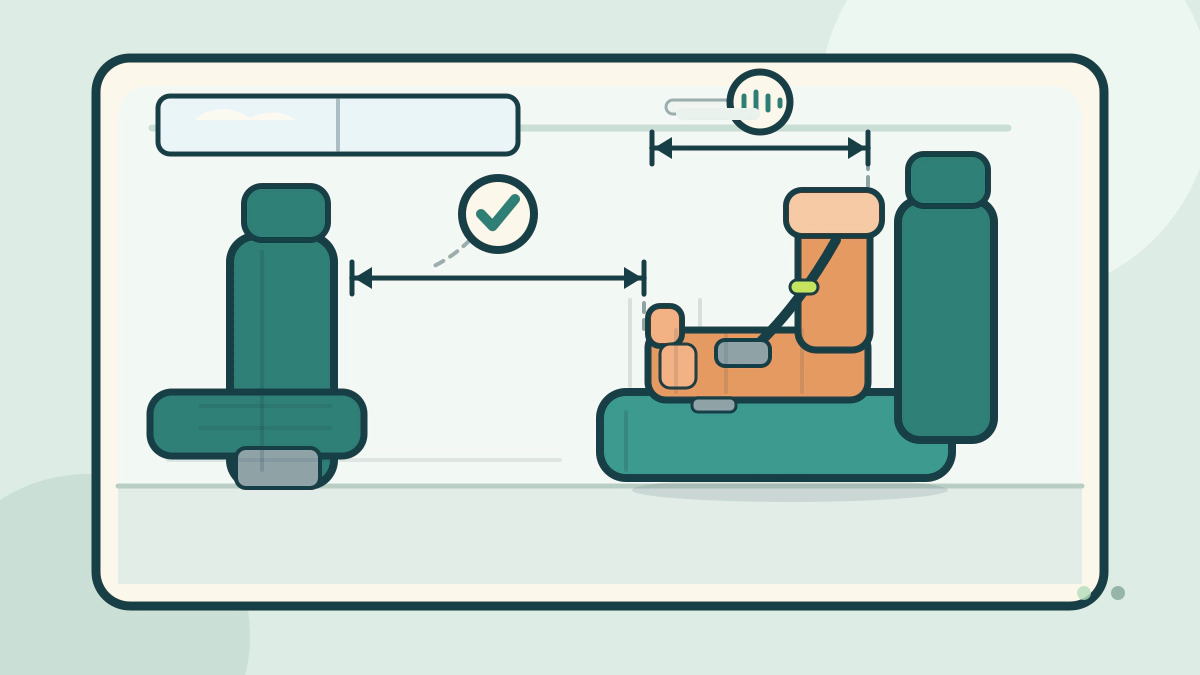
Use published SUV dimensions, LATCH layout and a real seat-check to judge car seat fit before you buy a family vehicle.
What does car seat fit in an SUV actually mean?
Fit means your child restraint installs tightly at the right angle, holds your child correctly, and still leaves room for the other seats and passengers you need to use. A seat that fits one SUV may not fit another, even when both have three rows and two sets of lower anchors.
NHTSA is direct: not all car seats fit in all vehicles. It tells buyers to test the seat they plan to use before buying. Published dimensions help you build a shortlist, but they do not replace that test.
The seating position matters more than the cargo number
Start with the position where the child will ride. A bench, captain’s chairs and a third-row seat each change the space around the restraint.
NHTSA describes a minimum of two rear seating positions with lower anchors and typically at least three tether anchors. In an SUV, tether anchors may sit on the back of a seat, on the floor, on the ceiling or somewhere else. Read the vehicle owner’s manual to find them, and do not mistake a cargo tie-down for a tether anchor.
A middle seat can be narrow or have a hump. A captain’s chair may add side room but remove the middle position. Check whether the installed seat blocks the folding mechanism, the third-row release or the seat belt buckles for other passengers.
Published dimensions are a shortlist tool, not a fit test
Two current three-row SUVs show how close published second-row numbers can be.
| Second-row measurement | 2026 Honda Pilot | 2027 Kia Telluride |
|---|---|---|
| Legroom | 40.8 in | 43.0 in |
| Hip room | 57.4 in | 56.5 in |
| Shoulder room | 61.7 in | 61.2 in |
The Pilot figures come from Honda’s 2026 Pilot specifications. The Telluride figures come from Kia’s 2027 Telluride specifications. These are interior measurements, not the distance between lower anchors. They do not describe cushion shape, seatback angle, buckle stalk length or how deeply the anchors sit in the seat bight.
A difference of an inch in hip room will not tell you whether a wide convertible seat fits beside a booster. Use the numbers to drop vehicles that are clearly too small, then measure the actual seat area with the car seat you own.
Check the LATCH hardware where you will install the seat
IIHS rates LATCH hardware on how easy it is to find and use. Its criteria say lower anchors should not be buried too deep or blocked. The top tether should be on the rear deck or within the top 85 percent of the seatback or within 24 inches of the top. Hardware near the tether should be labeled clearly so it is not confused with a tie-down.
A “good+” LATCH rating means the vehicle has an extra LATCH position and, in a three-row vehicle, tether anchors in all seating positions (IIHS LATCH criteria). That matters if you expect to use the third row regularly.
Weight limits can change the installation method. NHTSA says to find the lower-anchor limit on the car seat label. If there is no label, subtract the car seat’s weight from 65 pounds. Once the child exceeds the limit, reinstall with the seat belt. Use the lower anchors or the seat belt, never both. A forward-facing seat should also use the top tether when both manufacturers allow it.
Test the seat in the exact SUV
Bring your child restraint to the dealership and install it in the position you plan to use. Ask for enough time to do it without rushing.
Check four things. Push and pull the restraint at the belt path; IIHS says it should not move more than 1 inch side to side or front to back. Confirm the recline angle the car seat requires. Check that the front seat can still move to a usable position without pressing on the restraint. Then sit in the other second-row position and climb into the third row with the seat installed.
Do the same test with the child in the seat if possible. A seat that installs easily may still leave the harness or headrest at the wrong height. NHTSA’s car seat inspection page can point you to a certified technician, usually at no charge, if you want a second check.
Where SUVs differ from sedans
The taller body brings a higher load-in height and a bigger rear opening, which help when you lift a heavy infant seat. It can also make it harder to lean in and tighten a tether.
Three-row SUVs add another question: can you reach the third row with a rear-facing seat in the second row? Test that path with the car seat installed. For wider class differences, see compact versus midsize SUV for families. Cargo figures are covered in how to rank SUVs by cargo usability. See the family and accessible vehicle hub for related buying guides.
Frequently asked questions
Can I use the middle seat if the SUV has only two sets of lower anchors?
Only if the car seat maker and the vehicle owner’s manual allow that position and method. Some middle positions allow a seat belt installation but have no lower anchors.
Does a wider SUV always fit three car seats across?
No. Hip room does not describe cushion shape, buckle positions or the space between anchors. Three narrow seats may fit where two wide ones do not. Test the combination.
Can I install a car seat with the seat belt instead of LATCH?
Yes, when the car seat and vehicle allow it. NHTSA says to follow the vehicle manual for locking the seat belt, and to add the top tether for a forward-facing seat when permitted.
When should a car seat be replaced after a crash?
Follow the car seat manufacturer’s instructions and NHTSA’s crash criteria. Some seats must be replaced after any crash, while others may be reused after a minor one. The rules are explained in when child car seats need replacement after a crash.