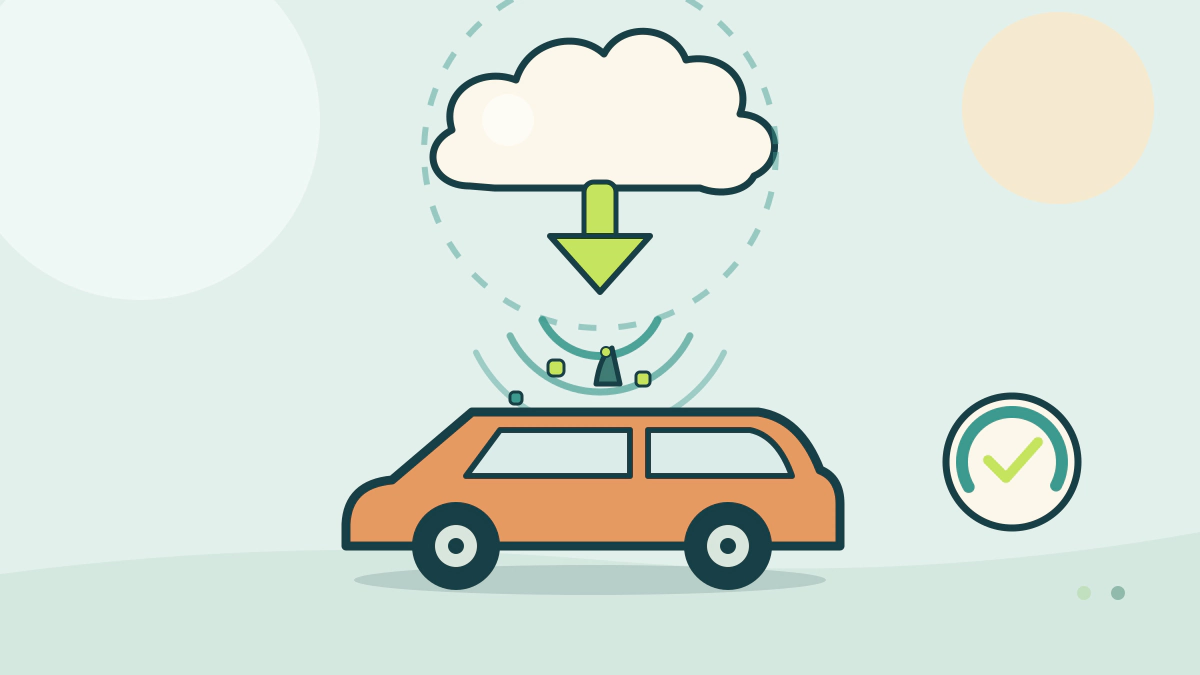
Follow an over-the-air update from wireless download to parked install, see what the car checks before it starts, and learn where the process stops.
How does an over-the-air car update work?
An over-the-air update is a software package delivered by a wireless link and installed by the car itself. The download can happen while you drive, but the install usually waits until the vehicle is parked and the conditions are safe.
NHTSA defines over-the-air, or OTA, as a software update distribution method that uses wireless transmission (NHTSA guidance). That definition covers the delivery, not a particular feature.
The download and the install are separate stages
Kia’s 2026 owner’s manual describes the split clearly. The car can download software automatically while it is being driven, then notify the owner through the app or the vehicle screen. The install starts only after the vehicle is turned off and the owner chooses Update Now (Kia manual).
The parking conditions are part of the design. Kia requires the car to be off, in Park, with the parking brake set, the exterior lights off and the hood shut. The 12-volt battery must be charged enough, and the systems being updated must not be running.
Ford describes a similar pattern from the owner’s side. Some updates require the vehicle to be parked with the ignition off, and scheduling them for overnight or another idle period avoids losing the car for the day (Ford software updates).
What the car checks before it installs
An update is code, so the car has to know where it came from and whether it is complete. NHTSA’s voluntary guidance tells manufacturers to limit firmware changes to authorized and appropriately authenticated parties, and to use digital signing so a module does not boot modified firmware (NHTSA).
The same section asks manufacturers to protect the update servers, the transmission path and the updating process, and to consider compromised servers, insider threats and man-in-the-middle attacks. It also asks them to limit rollback attacks, where an attacker installs older, more vulnerable software.
These are recommendations, not a uniform federal test. The practical result is that two cars can use very different levels of protection.
| Stage | What happens | What you may see |
|---|---|---|
| Download | The car receives the package over cellular or Wi-Fi | A notification that an update is ready |
| Verify | The car checks the package and its source | Usually nothing; the install should not begin if the check fails |
| Install | Modules are reprogrammed while the car is parked | Progress screen, screen cycling off and on |
| Confirm | The car reports the installed version | A completion message and release notes |
Why an update can take over the car
During the install, Kia says the vehicle cannot be used, charged or started remotely. The manual also notes that a high-voltage module may switch on to charge the 12-volt battery. The rear occupant alert may not work, so the manual tells the owner to check the back seat visually.
That is why the install is gated behind Park and a closed hood.
Updates can carry recalls, not only features
An OTA update is also a way to deliver a safety remedy. NHTSA’s recall record for campaign 21V354 describes a Mercedes-Benz MBUX software update that fixed a rearview camera display problem. The remedy was an over-the-air update, no dealer action was needed, and the campaign was launched in waves based on the vehicle’s subscription status (NHTSA recall record).
A recall remains open until the remedy is completed. If an OTA remedy never arrives or fails to install, check the VIN at NHTSA’s recall lookup and ask a dealer to finish the work.
What OTA does not cover
Not every module can be updated remotely. Hardware faults, worn parts and crashes still need a workshop. Some updates also depend on the vehicle’s subscription or connectivity service being active.
Kia’s manual adds a firm limit: OTA cannot be used if the vehicle software has been modified or replaced. A modified car may need a dealer visit instead of a download.
The install can also fail. That is a separate problem from how the system works, and it has its own recovery steps. Read what to do after a failed vehicle software update before retrying.
Before you approve an update
Read the release notes first, because they say what changes and whether the car will be unavailable. Park somewhere safe with space around the vehicle, and do not plan to drive until the screen confirms completion.
Check the 12-volt battery if the car has been sitting. Kia lists a sufficiently charged battery as a condition for the install. Remove any diagnostic dongle from the OBD port, because Kia says a connected tool can block the process.
Leave the hood closed and do not replace the battery during the install.
For the ownership picture, read how automotive software updates change car ownership. The Car Technology and Electronics hub collects the wider electronics coverage.
Frequently asked questions
Can I drive while an over-the-air update installs?
No. The download can happen while driving, but the install requires the vehicle to be off and parked. Kia also says the vehicle cannot be used or charged during the install.
Does an OTA update use my phone’s data plan?
Not usually. The car uses its own cellular connection or a Wi-Fi network. Ford says Wi-Fi is not required for its updates but recommends it for a faster download.
Is an over-the-air recall remedy as good as a dealer repair?
It can complete the same software remedy without a visit, but the recall stays open until the work is confirmed. If the update does not install, a dealer still needs to finish it.
Why has my car not received an update yet?
Releases often go out in waves by model, trim, software version or subscription status. A car that does not meet the conditions may wait, and a modified vehicle may be excluded entirely.