Compare heated and ventilated car seats, including how each feels, when they switch off, the burn and cleaning warnings, and what to check on a test drive.
What is the difference between heated and ventilated car seats?
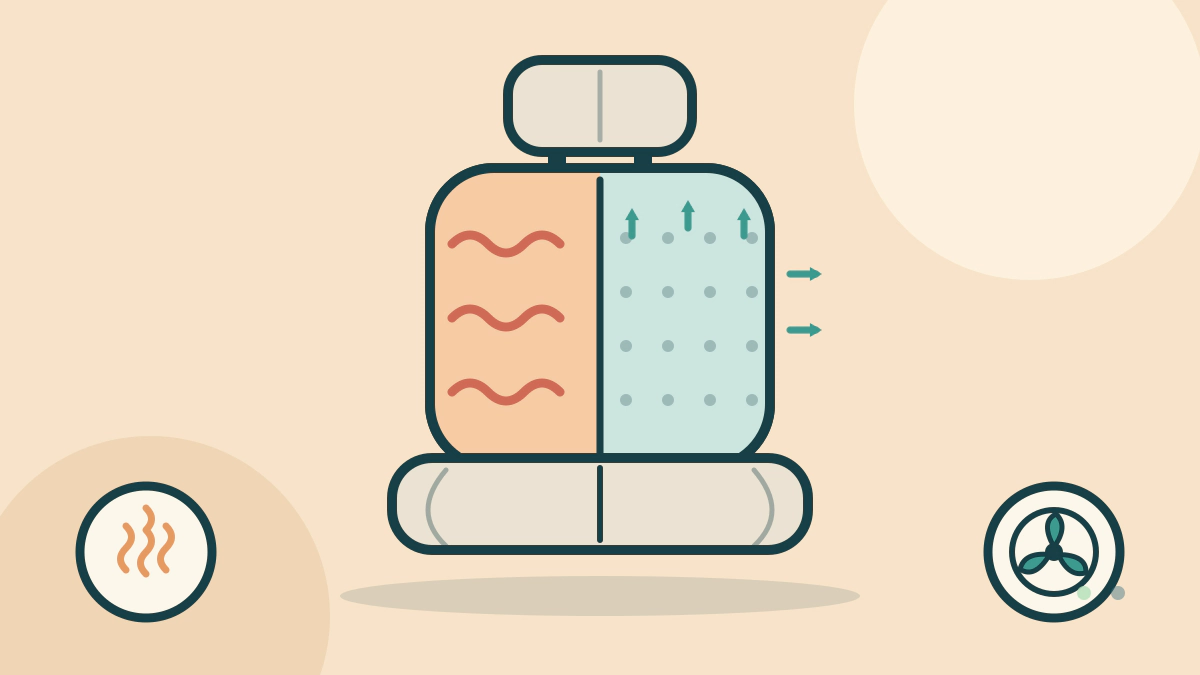
Heated seats warm the cushion and backrest; ventilated seats move air through the seat to help cool and dry the occupant. The two systems solve opposite problems, and a vehicle may offer one, both or neither. Kia’s 2024 Telluride manual treats them as separate features with separate controls, so a “climate seats” label on a window sticker does not tell you which one is fitted.
Heat usually comes from elements built into the seat. Ventilation usually comes from fans that move air through the cushion. Neither system replaces the cabin heater or air conditioner. Both sit in the wider Car Technology category of comfort and convenience features.
How heated seats work and when they help
Kia says the seat warmer is provided to warm the front seats during cold weather. On the Telluride, you push the lever up to warm the front seat; rear seats use buttons. Each push changes the temperature setting.
The heater defaults to OFF whenever the engine start/stop button is turned on. That means a cold morning start needs a fresh press every time. Pushing the lever for more than 1.5 seconds while the heater is running turns it off.
Kia says the heater then controls the seat temperature automatically to help prevent low-temperature burns. The manual notes that the heating system switches off and on automatically depending on the seat temperature. You can raise the setting again, but it soon returns to the automatic mode.
What ventilated seats actually do
A ventilated seat is not an air-conditioned seat. Kia calls the feature an air ventilation seat and describes pushing the levers down to ventilate the seat cushion. Each push changes the airflow setting.
The fan moves air through the seat cushion. That helps with heat and moisture, but the air is not chilled like the output of the cabin air conditioner. On a humid day the seat can feel much better without the cabin temperature changing at all.
Ventilation also defaults to OFF at every restart on the Telluride.
How the two systems compare
| Question | Heated seat | Ventilated seat |
|---|---|---|
| Main effect | Adds warmth | Moves air through the cushion |
| Control on the Telluride | Push lever up, or press rear button | Push lever down, or press rear button |
| Setting after restart | OFF | OFF |
| Main risk | Burns during long use | Liquid, solvents and damaged fans |
| Best conditions | Cold mornings | Hot, humid weather |
| Energy use | Extra electrical load | Fan load |
The table describes the Kia system, not every car. Other manufacturers use different switches and menus, and some allow the last setting to be remembered.
Kia’s Smart Temperature Comfort Control System can also tie the seat heater, ventilation and heated steering wheel to the cabin temperature. Even then, the features default to OFF when the vehicle restarts.
Warnings that matter more than comfort
Kia warns that a seat warmer can cause burns, even at low temperature, if it is used for a long time. The manual names people who may not be able to react: infants, children, elderly or disabled people, hospital outpatients, people with sensitive skin, people who burn easily, fatigued people, intoxicated people, and people taking medicine that causes drowsiness.
That warning is about supervision, not about avoiding the feature. Check the rear seat and be careful about leaving a child or a passenger who cannot feel or report heat on a heated seat.
Ventilated seats have different cautions. Kia says not to use organic solvents such as paint thinner, benzene, alcohol or gasoline when cleaning. It also says not to put heavy or sharp objects on the seat, to wipe up spills, and to dry the seat completely before use.
Energy use, covers and the trim question
Heated seats are not free to run. FuelEconomy.gov lists heated seats, window defrosters and heater fans among the features that use additional power and lower fuel economy in cold weather. A ventilation fan also draws current, though Kia does not publish a wattage in the manual.
Aftermarket seat covers add another variable. A cover can interfere with side airbags and can block heaters or vents, so check the manual and the cover instructions first. Seat cover compatibility with side airbags explains what to verify.
When comparing trims, ask three questions. Does the seat heat, ventilate or both? Are the controls physical buttons or buried in a screen? Does the setting survive a restart? For the cabin side of the same decision, see automatic climate control explained.
Frequently asked questions
Do ventilated seats blow cold air?
No. They move air through the seat cushion, and Kia describes the feature as ventilation rather than cooling. The air comes from the cabin, so the seat feels cooler mainly because moving air carries heat and moisture away. The cabin air conditioner still does the actual cooling.
Can a heated seat burn you?
Yes. Kia warns that burns are possible even at low temperature during long use, and it lists people who may not notice or report the heat. That includes young children, older adults, people with sensitive skin and anyone who is drowsy or intoxicated. Check passengers and switch the seat off when it is not needed.
Why do the heated and ventilated seats turn off after a restart?
Kia designs both features to default to OFF whenever the engine start/stop button is turned on. The setting is not lost because of a fault. The driver has to switch the feature on again.
Can I use ordinary interior cleaner on a ventilated seat?
Check the owner’s manual first. Kia warns against organic solvents such as alcohol, paint thinner, benzene and gasoline on the air ventilation seat. It also says to wipe up spills and dry the seat completely before use. A mild product applied to a cloth is safer than spraying liquid into the perforations.