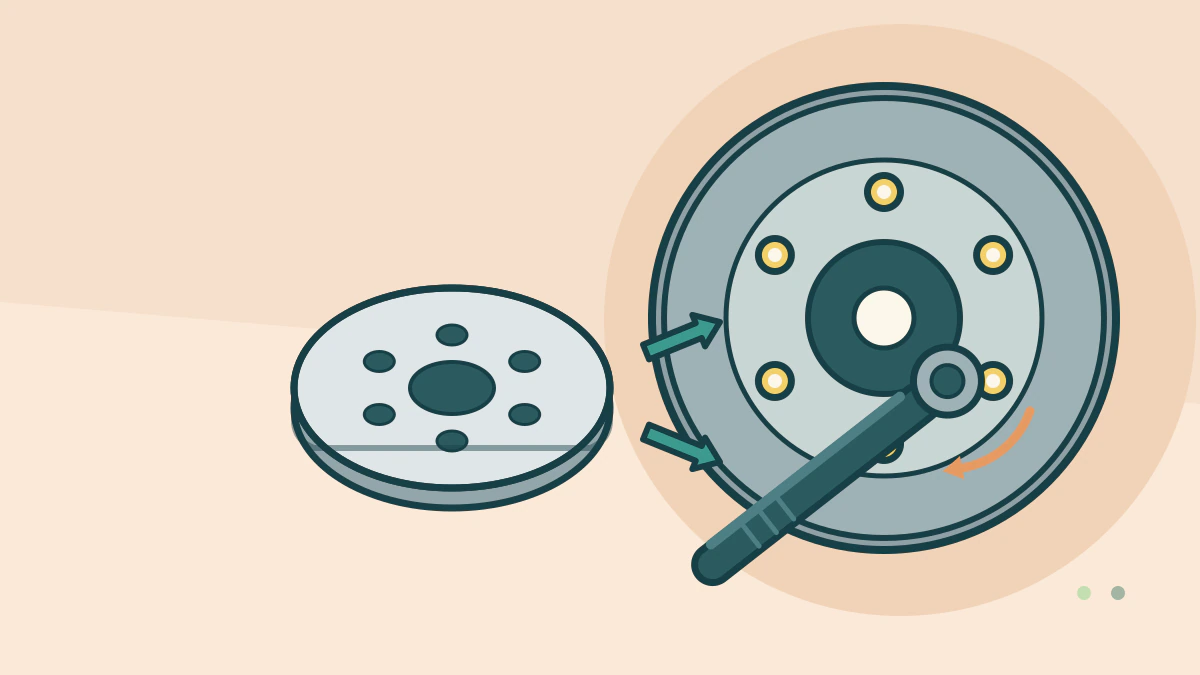
How wheel spacers change offset and track, why stud length and torque matter, what they do to bearing load, and why state rules differ on their use.
Are wheel spacers safe?
A wheel spacer can be safe, but only when the part, the studs and the installation are correct for that vehicle. A spacer moves the wheel outward. That changes the load path, uses up stud length or adds a second set of fasteners, and may break a state rule. The risk comes from those changes, not from the word spacer.
What a spacer changes about offset and track
A spacer sits between the hub and the wheel. Its thickness acts like a drop in wheel offset: the wheel moves outward by roughly that amount. Because both sides of an axle move, the track grows by about twice the spacer thickness.
That is the same geometry described in our guide to wheel offset. Massachusetts allows wheel track to be increased by tires and rims by no more than four inches total beyond the manufacturer’s specification, and then states plainly that spacers used to increase wheel track are prohibited.
Kia’s manual gives the manufacturer’s side. It says replacement wheels must be equivalent to the factory units in diameter, rim width and offset, and that an incorrect size may adversely affect wheel and bearing life, braking and stopping ability, handling, ground clearance, body-to-tire clearance, speedometer and odometer calibration, headlight aiming and bumper height.
Stud length and nut engagement
A slip-on spacer is sandwiched between hub and wheel and uses the original studs. Its thickness is stud length the lug nut no longer has. If too little thread remains, the nut can strip or pull off under load. The spacer maker has to supply matching longer studs or the design is wrong for the car.
A bolt-on spacer or adapter fastens to the hub with its own nuts, and the wheel then fastens to the spacer. That adds a second joint. Both sets of fasteners have to be correct, and the adapter has to be hub-centric so the wheel is centered by the hub, not by the studs.
Torque is not a matter of feel. Kia’s specification table for the 2026 K5 lists wheel lug nut torque at 79 to 94 lbf-ft (107 to 127 N-m). Use the figure for your own vehicle and a calibrated wrench.
What the extra offset does to bearings and hubs
Moving the wheel outward increases the distance between the tire’s contact patch and the hub face. The same vertical load then creates a larger bending moment on the hub, wheel bearing and suspension. That is mechanics, and it is why a wide spacer is not the same as a thin one.
Kia lists wheel and bearing life among the things an incorrect wheel size can affect, which points at the same load path. How much life is lost depends on thickness, wheel offset, tire grip and driving.
The federal in-use inspection standard is a useful check on the result. It rejects a wheel with visible cracks, elongated bolt holes or evidence of repair by welding, and requires all wheel nuts and bolts to be in place and tight. Vermont’s inspection manual adds that loose, missing or cracked studs, nuts and lugs are grounds for rejection, and so are elongated stud or bolt holes.
Why the legal answer changes by state
There is no single national spacer law. Massachusetts prohibits spacers used to increase wheel track. Vermont’s manual focuses on hardware condition rather than banning the part, rejecting damaged or loose fasteners and elongated holes. Other states may treat the device differently again.
That means the same spacer can be legal in one state and a rejection item in another. Check your state’s inspection manual or ask the inspection station before buying.
Why a qualified shop is worth the labor
A correct installation is mostly about details that are easy to skip: cleaning the hub face so the spacer sits flat, confirming the spacer is hub-centric, checking stud length and thread condition, torquing both fastener sets in the right sequence, and checking for rubbing at full lock and over bumps.
Kia’s manual adds a warranty point. It says the vehicle should not be modified and that damage or performance problems resulting from a modification may not be covered. That does not decide whether a spacer is safe. It does decide who pays if something goes wrong.
| Type | How it mounts | What to check before driving |
|---|---|---|
| Thin slip-on shim | Between hub and wheel on original studs | Remaining stud length and nut engagement |
| Thick slip-on spacer | Between hub and wheel, usually with longer studs | Hub-centric fit, stud length, torque |
| Bolt-on adapter | Bolted to hub, wheel bolted to adapter | Torque of both fastener sets, centering, clearance |
| Pattern-changing adapter | Two bolt patterns, extra thickness | State rule, load rating, added offset, clearance |
Frequently asked questions
Are wheel spacers illegal?
It depends on the state. Massachusetts prohibits spacers used to increase wheel track, while other states do not ban them and instead inspect the hardware.
Do spacers damage wheel bearings?
They can shorten bearing life by moving the wheel further from the hub, which increases the bending load. A thin spacer on a light car is a different case from a wide spacer on a heavy truck.
Can I install wheel spacers myself?
Only if you can confirm hub-centric fit, correct stud length and the torque figure for your vehicle, and you have a calibrated torque wrench. If any of those checks is uncertain, a qualified shop should do the work.
Do I need an alignment after fitting spacers?
Spacers change track width and offset, not the camber, caster or toe settings directly. An alignment is still worthwhile if the work disturbed suspension parts or if the tires show uneven wear. Ask for the printout and compare it with the manufacturer’s range.