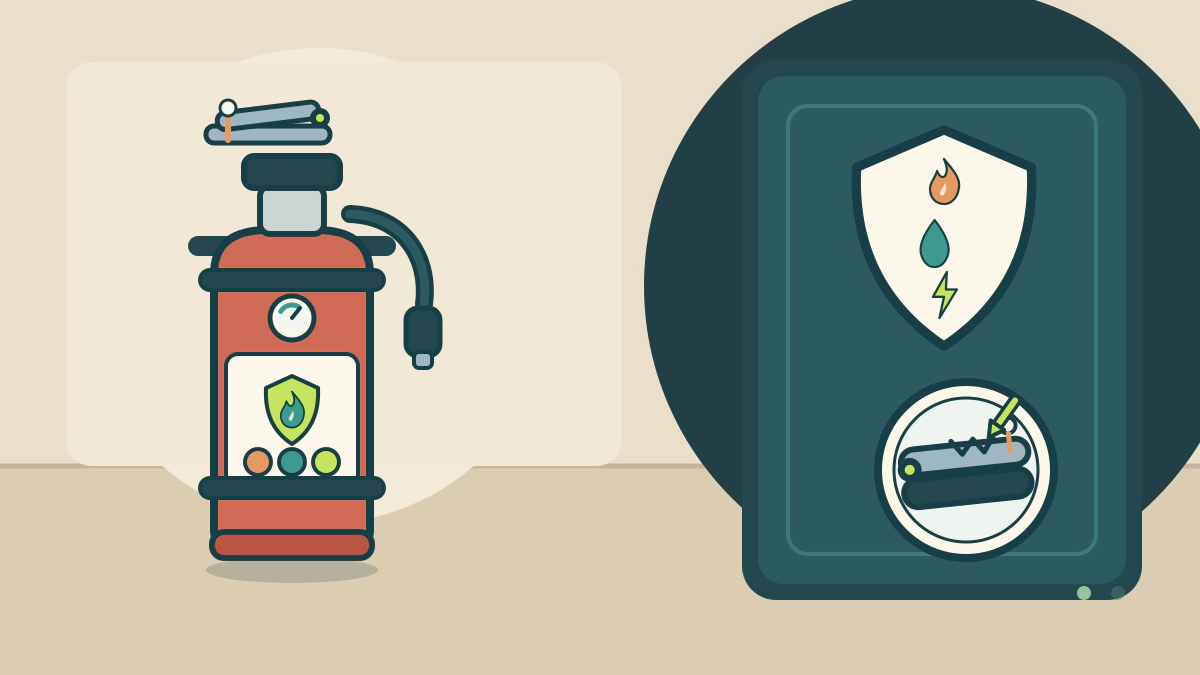
Choose a car fire extinguisher by its A, B and C rating, mounting bracket and inspection routine, and know when official guidance says to walk away.
What should you look for in a car fire extinguisher?
Look for a readable label that covers Class A, B and C fires, a charge gauge, and a bracket that holds the unit firmly. The federal rules reviewed here do not require one in a private car.
The U.S. Fire Administration says to pull over, turn off the engine, get everyone out and call 911. It says not to fight the fire yourself and not to open a hood or trunk if you think a fire is inside.
A federal rule does require extinguishers on commercial power units. 49 CFR 393.95 sets a 5 B:C minimum for many commercial vehicles and requires a secure mount. That rule does not apply to your car, but it is a useful benchmark.
What the A, B and C letters mean
OSHA’s guide defines the classes. Class A is ordinary combustibles such as paper, cloth, wood, rubber and many plastics. Class B is flammable liquids such as gasoline, oil, grease and solvents. Class C is energized electrical equipment.
A multipurpose dry chemical extinguisher is labeled for A, B and C fires. OSHA says a water extinguisher is for Class A only, and a carbon dioxide unit is for B and C only.
| Label | What burns | Car example | What to check |
|---|---|---|---|
| A | Paper, cloth, wood, rubber, many plastics | Cabin trim, paper, clothing | Label includes A |
| B | Gasoline, oil, grease, solvents | Fuel and engine fluids | Number before B |
| C | Energized electrical equipment | Wiring, motors, electronics | Label includes C |
| D | Combustible metals | Not typical in a passenger car | Special agent only |
| K | Cooking oils and fats | Not a car hazard | Kitchen units |
The number before the B is not a weight. OSHA says it is the square feet of a Class B fire a non-expert should be able to put out.
Why B:C is the rating to understand first
49 CFR 393.95 requires a UL rating of 5 B:C or more for many commercial power units, and 10 B:C for placarded hazardous materials. The rating must be marked on the unit, with a way to see whether it is charged.
B and C are the classes tied to fuel and electrical equipment. A car carries both, which explains why a B:C rating is the baseline in the federal commercial rule.
An A rating matters because fire can reach paper, clothing or trim. A multipurpose A-B-C unit covers all three, OSHA says.
Size, mounting and reach
NFPA says choose one large enough for a small fire but not so heavy that it is hard to handle.
49 CFR 393.95 requires it to be readily accessible and mounted so it cannot slide, roll or move vertically. It also requires an agent that does not need freeze protection. The rule is for commercial vehicles, but the questions apply to a car kit.
Mount it where you can reach it without unbuckling and where it cannot become a loose object. Read the owner’s manual before drilling, and keep the unit away from pedals and seat tracks.
Inspection: what to check and how often
OSHA’s workplace rule requires a monthly visual inspection and an annual maintenance check. Some stored-pressure dry chemical units also need six-year maintenance and a 12-year hydrostatic test. Those intervals apply to workplaces, not your car.
For a car unit, check the gauge, pin, nozzle and body. Look for corrosion, a cracked hose or a needle outside the marked range. NFPA says to read the instructions and learn the parts before a fire.
A partly discharged unit is not a spare. Both rules call for a fully charged, operable extinguisher, so recharge or replace it per its label.
When to leave the extinguisher alone
USFA says never return to a burning vehicle; move everyone at least 100 feet away and clear of traffic. Do not open a hood or trunk if you suspect fire there, because added air can make it grow.
NFPA’s conditions are narrow: the fire is small and not growing, everyone is out, the fire department has been called, and the area is not filled with smoke. A car fire can fail those tests quickly. If it has, the extinguisher stays in the bracket.
What to add to the rest of the kit
An extinguisher is one item in a roadside kit. Best items to keep in a roadside emergency kit covers warning gear, first aid and jump-start equipment. What to keep in your car at all times covers everyday items. Browse Car Accessories and Equipment for the rest.
Frequently asked questions
Do I need a fire extinguisher in my car by law?
The federal rule reviewed here does not require one in a private passenger car. 49 CFR 393.95 applies to commercial power units and sets ratings and mounting rules for them. Check state and local rules for any different requirement.
What size car fire extinguisher should I buy?
There is no universal size. Use the B number as the clearest guide: OSHA says it reflects the square feet of flammable liquid fire a non-expert should handle. NFPA adds a practical test: you must be able to lift and use it.
Where should I mount a car extinguisher?
In a bracket you can reach without leaving the driver’s seat, secured so it cannot roll or slide. 49 CFR 393.95 uses that mounting language for commercial vehicles. Keep it away from pedals and seat tracks.
Can I use a home extinguisher in my car?
Only if its label covers the fire you face and it is rated for the job. A multipurpose A-B-C dry chemical unit is the common choice because OSHA lists it for all three classes. Check the label for storage temperature.