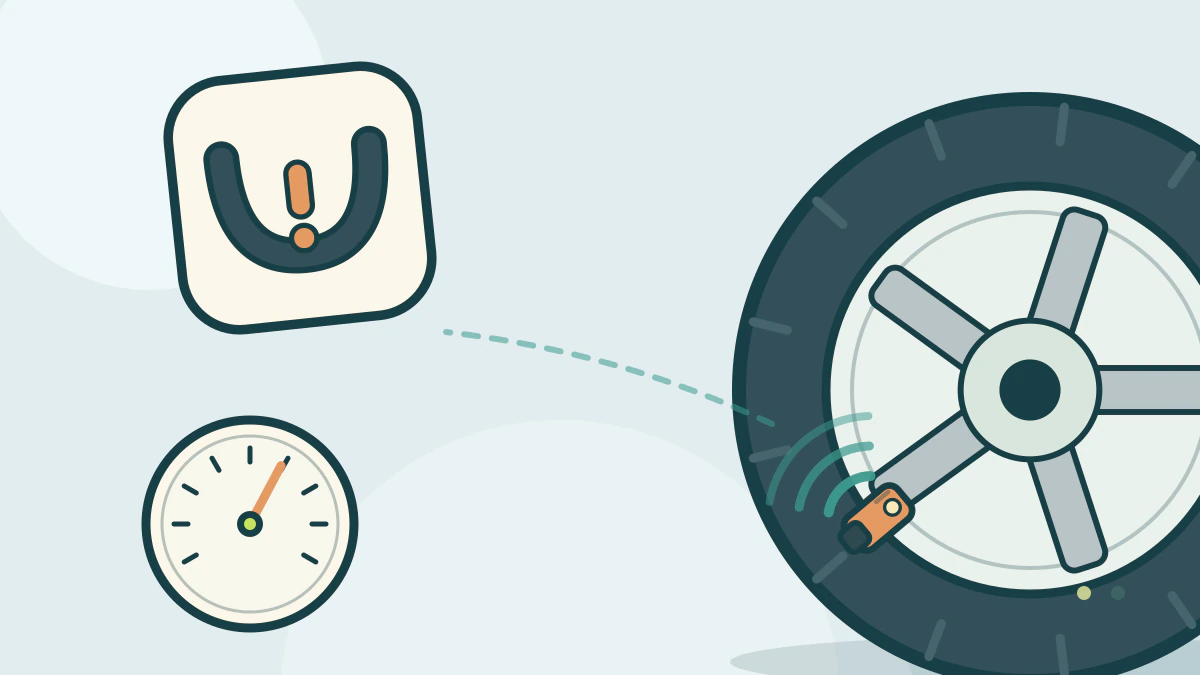
TPMS stands for tire pressure monitoring system. Learn how direct and indirect systems work, when the warning must trigger and what it cannot do.
What is TPMS?
TPMS stands for tire pressure monitoring system: a system that detects when one or more tires is significantly underinflated and lights a warning telltale. Federal rule FMVSS No. 138 uses exactly that job description (49 CFR 571.138).
The rule covers passenger cars, multipurpose passenger vehicles, trucks and buses up to 10,000 pounds GVWR, except vehicles with dual wheels on an axle.
NHTSA states that all passenger cars, light trucks and vans from model year 2008 onward must have TPMS (NHTSA). Some 2006 and 2007 models have it too.
Direct and indirect systems
NHTSA describes two designs. A direct system uses sensors located in the tires. An indirect system uses wheel speed and other vehicle sensors instead.
Both send information to an on-board processor. The processor interprets the signals and lights the TPMS symbol when pressure falls below the acceptable level.
Each design has a practical consequence. A direct system can report individual tire pressures when the vehicle has a display for them. An indirect system infers a problem from how fast the wheels turn, so no pressure sensor sits inside the tire.
Neither design removes the need for a gauge. NHTSA calls TPMS a warning device and says it is not a substitute for regular tire maintenance.
When the warning must light
FMVSS 138 sets a specific trigger. The telltale must light within 20 minutes when a tire’s pressure falls to 25% below the vehicle’s recommended cold pressure, or to the pressure in the rule’s table, whichever is higher (49 CFR 571.138).
| Tire type | Maximum or rated pressure | Minimum activation pressure |
|---|---|---|
| P-metric, standard load | 35, 44 or 51 psi | 20 psi |
| P-metric, extra load | 41 or 49 psi | 23 psi |
| Load Range C | 51 psi | 29 psi |
| Load Range D | 65 psi | 35 psi |
| Load Range E | 80 psi | 35 psi |
The “whichever is higher” wording matters. Take a light truck with a recommended cold pressure of 35 psi. Twenty-five percent below that is 26.25 psi. The table value is 20 psi, so the warning may wait until about 26 psi.
That is well below the recommended pressure. A tire can be underinflated and still silent.
Where the recommended pressure comes from
The recommended cold pressure is printed on the vehicle placard. FMVSS 110 requires that placard on the driver’s side B-pillar (49 CFR 571.110), with fallback locations when that spot will not work.
Use the placard, not the number molded into the tire sidewall. The sidewall figure is a maximum for the tire, not the vehicle’s recommendation. The placard versus sidewall guide explains the difference.
What the light means and what it does not
Light on: at least one tire is significantly underinflated. NHTSA advises inspecting the tires and checking pressure as soon as possible. The symbol should go out once the tires are properly inflated.
Light flashing: on vehicles with a combined lamp, FMVSS 138 requires at least 60 seconds and no more than 90 seconds of flashing, then steady illumination, when the system detects a malfunction. NHTSA describes the same pattern and says it repeats at each start-up until the fault is repaired.
Light on a cold morning: NHTSA says this can happen when pressure dips below the threshold overnight and rises as the tires warm. Check the pressures anyway.
The lamp is not a gauge and not a schedule. A tire losing pressure slowly may trigger no warning until it is far below spec. A tire that keeps dropping between checks is a separate problem, covered in tire pressure keeps dropping.
The rest of the dashboard abbreviations are listed in the Automotive Glossary.
Common TPMS confusions
- TPMS is not a replacement for a gauge. NHTSA recommends a monthly check with an accurate gauge.
- The light is not always about a puncture. Cold weather, a slow leak or a faulty sensor can all produce a warning.
- A TPMS fault is not a pressure reading. A flashing lamp means the monitoring system itself has a problem.
- Not every system shows four pressures. Some vehicles display only a single warning symbol.
- Sensor service is vehicle-specific. After a wheel swap or sensor replacement, the relearn procedure comes from the owner’s manual.
Frequently asked questions
Is TPMS required on every new vehicle?
The standard applies to passenger cars, multipurpose passenger vehicles, trucks and buses up to 10,000 pounds GVWR, except those with dual wheels on an axle. NHTSA says all passenger cars, light trucks and vans from model year 2008 have TPMS. Heavier vehicles fall outside that rule.
Why does the TPMS light come on when it is cold?
Cold air lowers tire pressure. NHTSA notes that a marginally low tire can dip below the warning threshold overnight and rise again as it warms. Check and adjust pressures when the tires are cold.
What does a flashing TPMS light mean?
On a combined telltale, a flash of 60 to 90 seconds followed by steady illumination signals a system malfunction, not necessarily low pressure. The sequence repeats at each start-up until the fault is fixed. Have the system inspected.
Can I drive with the TPMS light on?
Check all tires with a gauge before deciding. If one is low, inflate it and look for the cause. If pressures are correct and the light stays on, the system or a sensor needs attention. NHTSA advises acting promptly rather than treating the lamp as cosmetic.
Bottom line: TPMS is a warning system for significant underinflation, not a pressure gauge. The placard sets the target, and a monthly gauge check still does the real work.