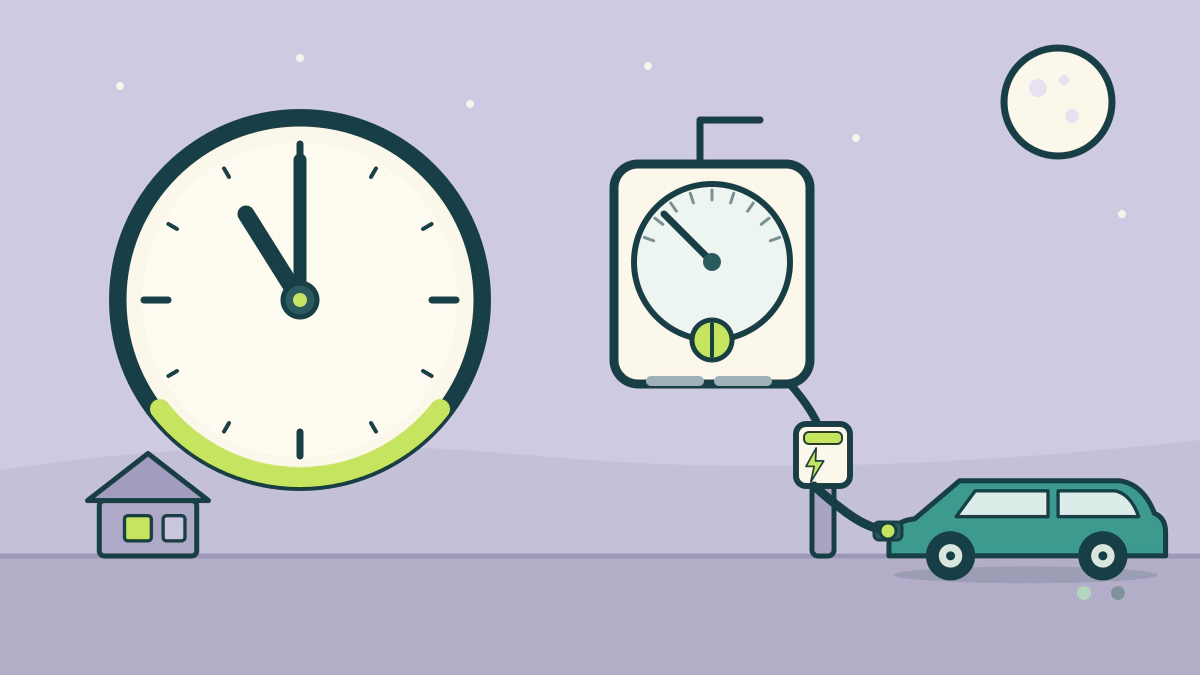
Understand how utility time-of-use periods, whole-house versus EV-only rates and managed charging programs change when and what you pay to charge.
How does a time-of-use rate change EV charging?
It changes the price by the hour, so the same battery costs different amounts depending on when you plug in. The size of that effect depends on the rate’s periods, the rest of your household’s electricity use and whether the rate applies to the whole house or only the car.
EIA’s glossary defines time-of-day pricing as a special electric rate feature under which the price per kilowatthour depends on the time of day. EIA’s explanation of electricity prices says demand is usually highest in the afternoon and early evening, when supply costs more.
That is why the cheap window often starts late at night. It is also why the expensive window can overlap the hours when a household cooks, cools the house and does laundry.
Whole-house, EV-only and separate meters
California’s regulated utilities show the range of designs. The CPUC lists whole-house EV rates such as PG&E’s EV-A and EV2-A, EV-only rates such as PG&E’s EV-B, and separately metered options such as SCE’s TOU-D-PRIME. SDG&E offers both EV-only and whole-house versions.
The difference matters more than the name. A whole-house rate puts every appliance on the same clock. An EV-only rate requires a separate meter or a qualifying setup, and it may come with its own fixed charges. The CPUC also reports a submetering protocol that lets a customer manage EV load separately from the facility load.
Super off-peak is a window, not a guarantee
The CPUC says EV time-of-use rates have a very low super off-peak price at times when energy costs the utility least. That is the window most drivers want. Whether it actually saves money depends on the rest of the tariff, a question covered in the off-peak charging guide.
The window is set by the tariff, not the car, and the car may not accept full power for the whole window. A charging curve tapers as the battery fills, so a short super off-peak period may deliver less energy than the driver expects.
The rest of the house is on the same clock
A household that moves only the car to overnight hours may still pay more. Air conditioning, electric heat, a heat pump water heater and laundry can dominate the bill. If those loads stay in the expensive period, the EV shift may not offset them.
Run the comparison with a year of usage data, not one mild month. Ask the utility for the actual periods and all charges, including fixed charges and any minimum bill. Then test the same annual consumption under both rates.
Managed charging programs change the timing for you
Some utilities pay for the ability to pause or slow charging during high-demand events. Austin Energy’s Power Partner EV program is one example. Events typically run June 1 through September 30, between 2 p.m. and 10 p.m., up to 15 times a month. The utility says charging may be paused or slowed, the battery is not drained, and the driver can override an event.
That is a demand-response program, not a time-of-use rate. Read the program terms separately. A driver who needs a full battery by a set time should know how an event affects that deadline.
Rate features that change the answer
| Feature | What it does | Check before enrolling |
|---|---|---|
| Flat rate | Same price at every hour | Whether the EV load is large enough to matter |
| Whole-house TOU | Prices all household electricity by period | Annual use in each period, not just the car |
| EV-only TOU | Bills the charger separately | Meter cost, wiring and fixed charges |
| Super off-peak window | Lowest price for a defined set of hours | Window length and the car’s charging curve |
| Demand charge | Bills the highest short-term draw | Whether the charger or site can limit power |
| Managed charging | Utility can pause or slow sessions | Override rules and event frequency |
How to compare without guessing
Get the tariff sheet for each option. Write down the periods, seasons, fixed charges and any bill protection. Multiply each period’s price by the kilowatthours you actually use in that period, then add the fixed charges.
Use your own numbers. A rate that saves money for a 15,000-mile driver may lose for a 6,000-mile driver, and a household with electric heat has a different load shape from one with gas heat. Rates also change, so repeat the comparison when the utility files a new tariff.
AFDC’s home charging page makes the same point in simpler terms: actual residential electricity costs depend on the equipment, the time of day and how long the charger runs. The meter measures kilowatthours; the tariff decides what each one costs.
For other state and regional ownership topics, see the US state and regional automotive guides.
Frequently asked questions
Does a time-of-use rate always lower the cost of charging an EV?
No. It lowers the price only during the hours the tariff defines as cheaper. If those hours do not match your charging window, or if other household loads stay in the expensive period, the total bill can rise.
What is a super off-peak period?
It is the lowest-priced window in some EV time-of-use tariffs, typically late at night. The CPUC describes super off-peak prices as very low, but the exact hours and prices are set by each utility’s approved tariff. Check the tariff, not a marketing page.
Can I keep a flat rate and still charge overnight?
Yes. Charging overnight on a flat rate is fine, but the clock does not change the price. The benefit appears only when the rate itself prices those hours lower. A separate EV rate may require a meter or enrollment.
What is the difference between an EV-only rate and a whole-house rate?
An EV-only rate prices the charging circuit separately, usually through a dedicated meter. A whole-house rate puts the EV and the home’s other electricity on the same time-of-use schedule. The right choice depends on the metering cost, the home’s load and the household’s schedule.