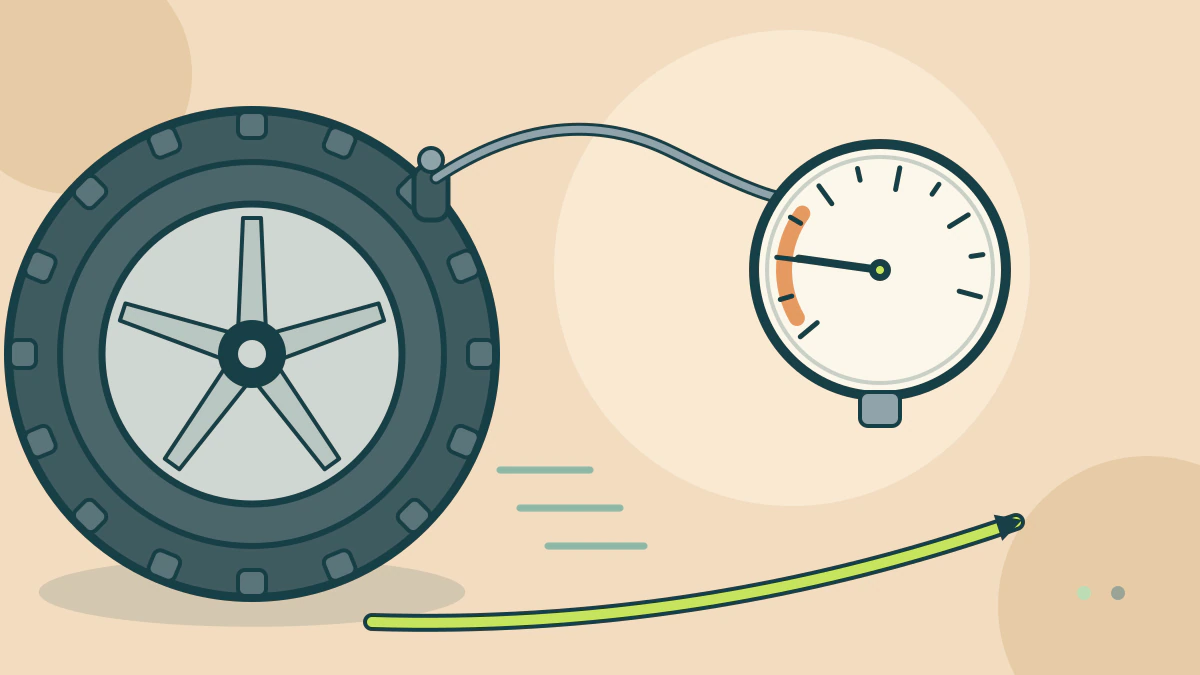
Underinflation raises rolling resistance and wastes fuel. See what EPA and NHTSA say about psi, TPMS, cold checks and the real size of the savings.
How does tire pressure affect fuel economy?
Underinflated tires increase rolling resistance, so the engine works harder to move the car; keeping tires at the vehicle’s recommended cold pressure preserves fuel economy and safety. The effect is real but modest, and it is smaller than the effect of driving style.
fueleconomy.gov puts the average gain from proper inflation at 0.6%, with up to 3% in some cases. It also says underinflation lowers gas mileage by about 0.2% for every 1 psi drop in the average pressure of all four tires.
What rolling resistance means
A tire flexes as it rolls. The sidewall and tread deflect, then spring back, and some of that energy turns into heat instead of forward motion. Lower pressure means more deflection and more energy lost.
NHTSA’s tire guidance explains the same idea from the design side. It says a 10% reduction in tire rolling resistance is estimated to produce a 1% to 2% improvement in vehicle fuel economy. Low-rolling-resistance tires are built to reduce that loss.
Pressure is one input into rolling resistance. Tire construction, tread compound and size are others. That is why the realistic gain from inflating tires is measured in tenths of a percent to a few percent, not in double digits.
The published numbers in context
| Situation | Fuel-economy effect | Basis |
|---|---|---|
| Tires at recommended cold pressure | Baseline | Manufacturer setting |
| Average 4 psi below recommendation | About 0.8% lower | 0.2% per psi, fueleconomy.gov |
| Average 10% below recommendation | About 2% lower | Arithmetic from the same rate |
| Aggressive driving | 10% to 40% lower in stop-and-go | fueleconomy.gov |
| Large roof cargo box at highway speed | 6% to 17% lower | fueleconomy.gov |
The table is not a ranking of everything that matters. It shows why pressure deserves a monthly check but not a place at the top of the list of fuel-saving changes. A soft tire is a maintenance item; a heavy right foot is a behavior.
Where the recommended pressure comes from
Use the Tire and Loading Information label on the driver’s door edge or post, or the owner’s manual. NHTSA states that the correct pressure is what the vehicle manufacturer lists, not the maximum printed on the tire sidewall. Some vehicles specify different front and rear pressures.
This site explains the label difference in Tire Pressure: Door Sticker vs Sidewall Maximum. The short version is that the sidewall number is a tire limit, while the placard is the vehicle setting.
What TPMS can and cannot tell you
All passenger cars, light trucks and vans from model year 2008 onward must have a tire pressure monitoring system, according to NHTSA. The system warns when a tire is significantly underinflated. It is not a fuel-economy gauge and not a substitute for a hand check.
NHTSA notes that a TPMS light may come on during a cold morning and go out as tires warm up. That is a pressure change, not a malfunction. If the light stays on, check all tires with a gauge, including the spare where the vehicle has one.
A monthly routine that takes two minutes
- Check tires when cold, which NHTSA defines as not driven for at least three hours.
- Read the placard and note any front and rear difference.
- Measure all four tires and the spare, if equipped.
- Add air to the recommended cold pressure; release air only if a tire is above it.
- Look for nails, cuts, bulges or a tire that keeps losing pressure.
A tire that drops repeatedly needs diagnosis, not more air. Why Tire Pressure Keeps Dropping covers leak checks; this page is about the fuel consequence.
Does inflating above the placard save more fuel?
Higher pressure reduces deflection, and the EPA and DOE relationship runs in both directions: less pressure means more loss. But the placard is the manufacturer’s setting for load, ride, handling and tread wear. NHTSA’s instructions say to release air when pressure is too high and to set tires to the recommended cold pressure.
So the practical target is the placard, not the sidewall maximum and not a higher number chosen for fuel economy. If you carry a heavy load or tow, check the owner’s manual for the pressure specified for that condition.
A 0.6% average gain is small per tank. Over a year it is a few gallons for a typical driver, and it comes with better tread life and lower heat. NHTSA says underinflation contributes to blowouts and tread separation, which makes the monthly check worth doing for reasons beyond fuel.
Frequently asked questions
Does low tire pressure really affect MPG?
Yes, but the average effect is modest. fueleconomy.gov estimates about 0.6% average improvement from proper inflation, up to 3% in some cases, and about 0.2% loss per 1 psi average drop. Driving style can change fuel use by a much larger margin.
Should I inflate tires to the sidewall maximum for better fuel economy?
No. NHTSA says the correct pressure is the vehicle manufacturer’s recommendation on the placard or in the owner’s manual, not the maximum on the tire. Use the placard setting and check the manual for load conditions.
Can TPMS warn me before fuel economy drops?
TPMS warns when a tire is significantly underinflated, which is later than the small pressure loss that already affects rolling resistance. Check with a gauge monthly; do not wait for the light. A cold-morning warning may clear as the tire warms.
Do I check pressure hot or cold?
Use cold pressure, defined by NHTSA as at least three hours without driving. If you must add air to a warm tire, fill to the placard cold value and recheck when cold. Do not release air from a warm tire just because it reads above the cold number.