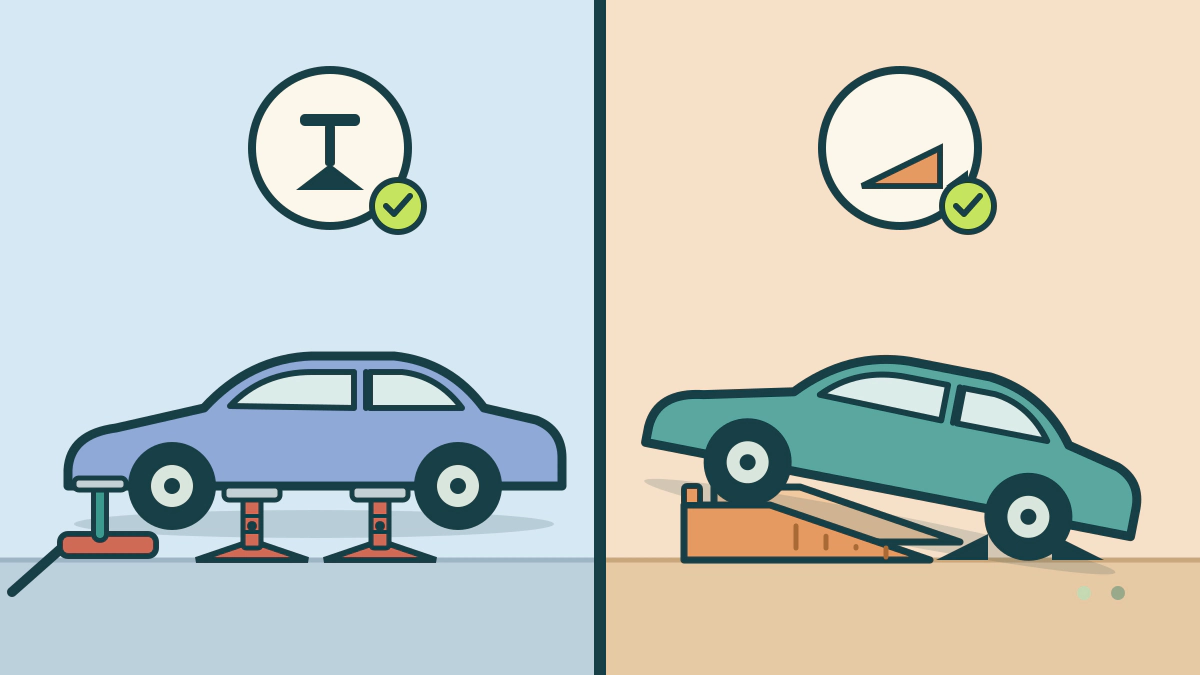
Compare jack stands and car ramps using manual warnings, OSHA and state injury reports, an NHTSA recall and a ramp maker's warning, before you go under a car.
Which is safer for working under a car, jack stands or ramps?
Neither is safe by itself if it is used wrongly, and a jack alone is never enough. No source read for this guide ranks one tool as safer overall. The right choice depends on the job, the vehicle and the equipment’s rating.
This guide covers what authorities and manufacturers say. Your owner’s manual shows the lift points for your exact vehicle. If any setup feels unstable, do not get under the car.
For other home-repair safety topics, see DIY Car Repair. For a wider look at jobs to leave alone, read when a car repair is not safe to do yourself.
Why a jack alone is never enough
A jack lifts a car. Holding it for someone underneath is a different job.
A 2024 Kia owner’s manual says the jack is provided for emergency tire changing only. It also says not to place any part of your body under a vehicle supported only by a jack, because the vehicle can easily roll off. It tells owners to use vehicle support stands. Other makers’ manuals may word this differently, so read yours.
Workplace rules agree. OSHA’s jack rule requires that a load be cribbed, blocked or otherwise secured at once after it is raised. It also requires a rated jack and a blocked base where the foundation is not firm.
Washington State’s labor department reviewed fatal cases. In its hazard alert, a jack slipped or collapsed and the vehicle fell on a worker. Its advice is to support vehicles with designated lifts or jack stands, not only jacks, when working under a vehicle.
How car ramps work and what makers warn about
Drive-on ramps raise the front or rear wheels without a jack. They are simple, but not forgiving.
One ramp maker’s warning sheet, Schwaben’s, calls ramp use “inherently dangerous” when procedures are not followed. Its listed rules include:
- Stay under the weight rating per ramp.
- Use a level, relatively even surface.
- Drive up straight, centered on the ramps, with a spotter standing clear.
- Park, set the parking brake and chock the tires once on the ramps.
- Do not use jacks on the ramp surface or alter the ramps.
- Do not disconnect brakes, drivetrain parts or wheels without bracing the vehicle so it cannot move.
That last rule matters. Ramps hold the car by its wheels, so they suit some jobs better than others.
How jack stands work and what to check
Jack stands hold a vehicle at fixed points after a jack has lifted it. Placement matters as much as the stand.
The New York State Department of Health’s vehicle repair fact sheet gives these cautions:
- Follow the manufacturer’s instructions for lifting and securing.
- Do not place stands under parts of the vehicle that are not fixed in place.
- Use stands that are rated and certified for the work.
The Kia manual also says to use the correct jacking positions, never bumpers.
Stands can fail too. In 2020 NHTSA announced that Harbor Freight was recalling more than 1.7 million jack stands that could collapse under load. Check your stands’ brand and item number on NHTSA’s recall page.
Jack stands and ramps compared
| Question | Jack stands | Drive-on ramps |
|---|---|---|
| How is the car raised? | A jack lifts it, then stands take the load | You drive the wheels up the ramps |
| What carries the weight? | Fixed points the manual allows | The tires and the ramp surface |
| Main caution from sources | Placement, rating and recalls | Weight rating, level ground, alignment, no wheel removal without bracing |
| What do the sources ask for? | Chock wheels, firm level ground, follow the manual | Chock wheels, firm level ground, follow the maker’s sheet |
| Never rely on | A jack alone | A ramp that is damaged, altered or overloaded |
Ground rules that apply to both
The UK Health and Safety Executive says vehicles falling or rolling off incorrectly positioned jacks or stands, particularly when not chocked, are one of the main causes of fatal repair accidents. It also advises a hard, level surface and never exceeding rated capacity. Its guide is British, but the hazard is the same here.
Our guide to squealing brakes gives the same warning.
Habits from these sources:
- Work on firm, level ground, not on a slope.
- Chock the wheels that stay on the ground and set the parking brake.
- Never run the engine while the car is on a jack, as the Kia manual warns.
- Keep children well away, as the Kia manual advises for its jack.
Frequently asked questions
Is a floor jack enough to work under a car?
No. The Washington hazard alert and the Kia manual both say not to work under a vehicle supported only by a jack. Use rated stands or a lift too, and follow your manual’s lift points.
Are car ramps safer than jack stands?
None of the sources read for this guide says so. Each tool has its own risks, such as wrong placement or overloading. Safety depends on rating, level ground, chocks and the maker’s instructions.
Can I use the jack that came with my car for repairs?
The Kia manual quoted here says the jack is provided for emergency tire changing only. Check your own owner’s manual for what it says. It is not a substitute for jack stands under a car you are working beneath.
Should I worry about recalled jack stands?
Yes, because a recalled stand may collapse under load. NHTSA announced a large Harbor Freight jack stand recall in 2020. Check your stands against NHTSA’s recall page and stop using any that are listed.