Compare lowering springs and coilovers for ride height, damper matching, alignment, clearance and headlight aim, and learn which change suits a daily driver.
Which is better for a daily driver: lowering springs or coilovers?
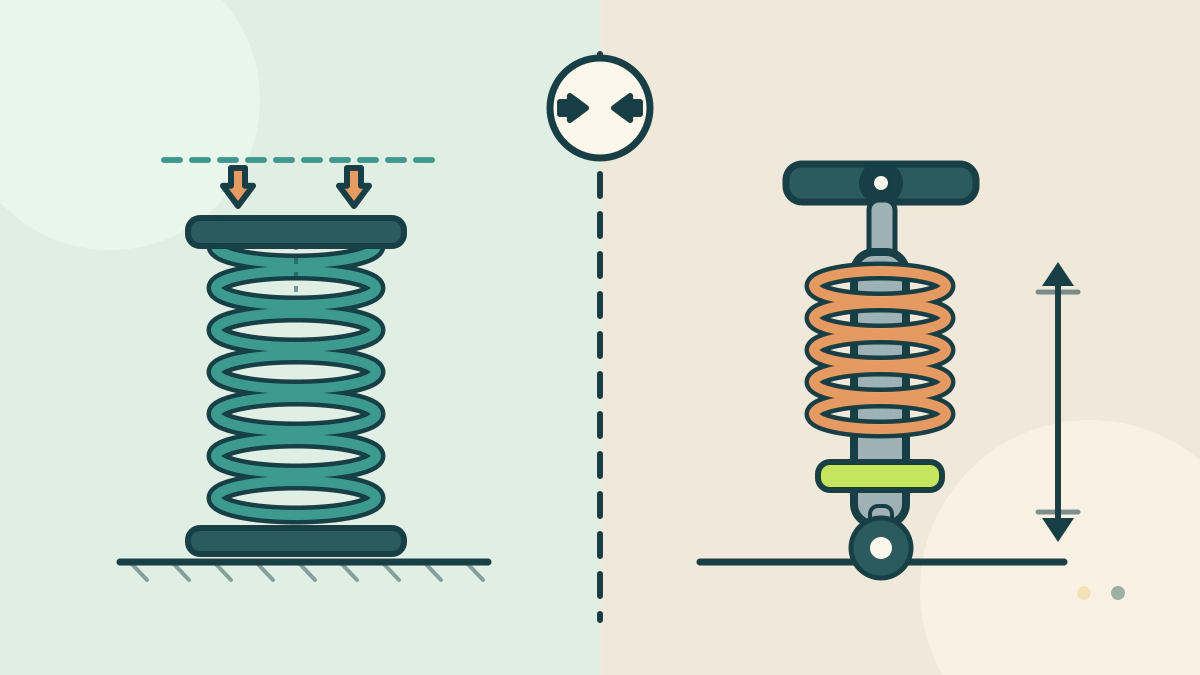
Lowering springs replace only the springs and keep the original dampers; coilovers replace spring and damper as a matched assembly, usually with adjustable ride height. Springs are the simpler change. Coilovers cost more but give you a damper designed for the spring and, on many kits, a height setting you can change.
Neither option is automatically better. The choice depends on how much adjustment you need, the condition of the existing dampers and whether the car must still clear driveways and speed bumps. Both approaches fall under Car Modifications and Tuning.
What a lowering spring kit changes
A spring kit changes ride height and spring rate. The original struts or shocks stay in place. Eibach’s installation guide describes disassembling the factory strut assembly, reusing the original mounts, isolators and hardware, and reassembling with the new spring (Eibach instructions).
Because the damper is unchanged, the result depends heavily on its condition. A worn damper that was marginal at stock height has less room to work when the car sits lower.
What a coilover kit changes
A coilover combines a spring and a damper in one unit, often with a threaded body or perch for height adjustment. Eibach’s threaded-body coilovers list adjustable ride height and precise damping as features (Eibach coilovers). The damper valving is chosen for the spring rate in the kit.
That matching is the main engineering advantage. A coilover can also set ride height, though not every design adjusts height independently of spring preload. Follow the maker’s procedure. The trade-off is cost and more ways to set the car up badly.
| Question | Lowering springs | Coilovers |
|---|---|---|
| What is replaced | Springs only | Spring and damper as a unit |
| Ride height | Fixed by the spring | Often adjustable |
| Damper matching | Original damper, condition unknown | Matched to the spring by the maker |
| Adjustment | None | Height, and sometimes damping |
| Install complexity | Strut disassembly and reuse of parts | Full unit replacement, then setup |
| Alignment after install | Required | Required |
Ride height, travel and clearance
Measure before and after. Eibach’s guide says to measure from the wheel center straight up to the bottom of the fender arch on a level surface, then drive about ten miles before taking the after measurement so the springs can settle (Eibach instructions). Set the tires to the door-sticker pressure first, because a soft tire changes the number.
Lowering reduces suspension travel. Eibach’s damper page explains that lowering a car on stock dampers reduces piston travel, so the bump stop has to prevent the shock from bottoming out internally in hard dips (Eibach Pro-Damper). That is one reason a matched damper with a shorter body can be better than a stock one.
Check clearance at full lock and over bumps. Look at the tire-to-fender gap, the undertray, the inner fender liners and the brake hoses. A drop that looks fine in a parking lot can rub on a driveway or a loaded rear seat.
Alignment and tire wear after the drop
Changing ride height changes the angles the manufacturer set. Eibach’s guide tells installers to mark the alignment-related bolts before disassembly and describes the alignment as a post-installation step (Eibach instructions). Bring the car to an alignment shop after it settles.
Camber and toe are the usual concerns. Too much negative camber wears the inner edge of the tire; wrong toe can wear a tire quickly and make the steering feel vague. Ask for a printout of the before and after readings, and compare them with the manufacturer’s range for your model.
If the car shakes or pulls after the install, do not assume the springs are at fault. Read wheel alignment versus wheel balancing and steering wheel shakes at highway speeds before replacing more parts.
Damper matching and worn parts
A spring and damper are a pair. The spring stores energy and the damper controls how fast it releases it.
Eibach sells its Pro-Damper as a direct replacement shock optimized for its lowering springs, with stroke lengths intended for a lowered car (Eibach Pro-Damper). That is the argument for buying a matched spring-and-damper set rather than springs alone on an older car.
Worn mounts, isolators and bump stops should be replaced while the strut is apart. Worn isolator pads can cause noise and incorrect ride height.
Headlight aim and final checks
FMVSS 108 requires each headlamp to have a mounting and aiming mechanism that permits inspection and adjustment of both vertical and horizontal aim (49 CFR 571.108). Ride height changes the pitch of the car, and NHTSA notes that pitch changes headlamp aim (NHTSA docket). Have the aim checked after the car settles.
Re-torque the mounting bolts after the first 500 miles. Use a proper spring compressor; Eibach warns that a compressed spring can cause serious injury.
Frequently asked questions
Do I need new dampers with lowering springs?
Not always, but the originals must be in good condition and rated for the drop. A worn damper has less travel to spare.
Are coilovers uncomfortable on a daily driver?
They can be, but comfort depends on spring rate, damping and ride height more than on the word coilover. A street-oriented kit set near stock height can ride well.
Will lowering the car ruin the alignment?
It changes the alignment, so it must be measured and reset. Camber and toe often move when ride height changes.
Do I need to re-aim the headlights after lowering?
Yes, it is worth checking. The lamps are aimed relative to the car, and lowering changes the car’s pitch. FMVSS 108 requires the aim to be adjustable, so a shop can reset it.