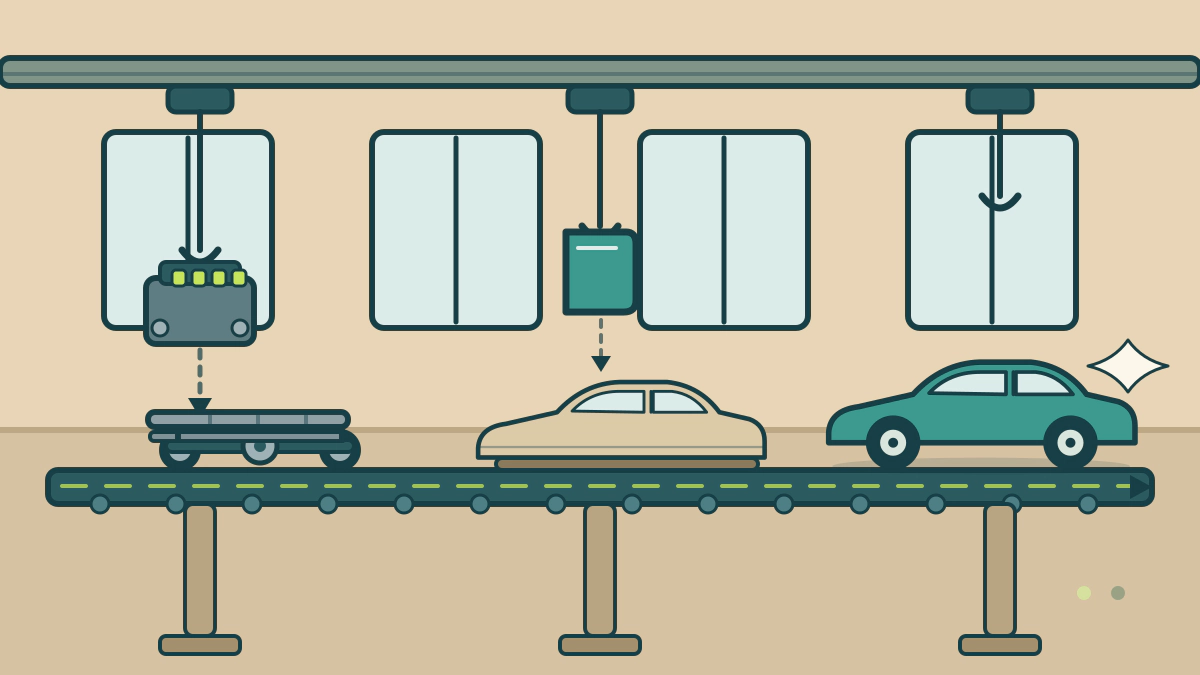
Follow the moving assembly line from Ford's 1913 magneto experiments to the 93-minute line pace, robots and Toyota's just-in-time system.
What did the assembly line actually change?
It reversed the direction of work: instead of a crew moving around a car, the car moved past workers who each repeated one task. Britannica describes the technique as a conveyor system plus the limitation of each worker to a single repetitive task (Britannica).
That sounds simple. Making it work required interchangeable parts, machines arranged in sequence and material delivery timed to the line. The Henry Ford describes the result as standardized parts, subdivided labor and the fluid movement of work to workers (THF).
Before the moving line
Early car factories assembled vehicles at stationary stations, with a crew moving from one chassis to the next. The Henry Ford’s Piquette plant photograph shows that stage (THF).
Ransom Olds had already aimed at mass production with the 1901 curved-dash Oldsmobile. Britannica calls it the first major bid for the mass market, though the car was too lightly built for rough roads (Britannica).
Ford’s route ran through the Model T, introduced in 1908. The car came first; then Ford tackled cheap, high-volume production (Britannica).
The experiments of 1913
The line arrived in stages. The Henry Ford dates the first moving-line experiment to about April 1, 1913, when flywheel magnetos went onto a moving line (THF).
The gain was immediate. A flywheel that took one worker about 20 minutes came off the line every 13 minutes at first, then every five after refinement (THF).
Ford then applied the idea to engines and transmissions, and in August 1913 to complete chassis (THF). Early chassis lines were crude: workers pulled a chassis with a rope and windlass, or pushed it on its own wheels (THF).
By early 1914, chain-driven lines were running. Three continuous lines produced a finished Model T every 93 minutes, against 12.5 hours under stationary assembly (THF). By April 1914, three parallel lines built more than 1,200 chassis in eight hours (THF).
| Date | Change | Recorded effect |
|---|---|---|
| April 1913 | Magneto assembly moves onto a line | 20 minutes per unit to 13, then 5 |
| August 1913 | Moving line applied to complete chassis | Chassis assembly becomes sequential |
| Early 1914 | Chain-driven lines, three continuous lines | One Model T every 93 minutes |
| April 1914 | Three parallel chassis lines | More than 1,200 chassis in eight hours |
Why the line needed more than a conveyor
Interchangeable parts were the foundation. A line depends on parts that fit without hand work. Britannica notes that Ford combined standardization with the line (Britannica).
The line also needed plant layout. The Highland Park plant was designed by industrial architect Albert Kahn (THF). Machines were arranged in work order, and material had to reach the right station on time. The Henry Ford describes constant changes to machine placement and platform height to save seconds (THF).
Synchronization is the key idea. A line is only as fast as its slowest station, and a missing part idles everyone downstream. That is why the line pushed Ford toward standard work, dedicated machines and tight material control.
The human side of the line
The line set the pace, and many workers hated it. The Henry Ford records labor turnover of 380% by late 1913 (THF).
Ford’s January 1914 answer was the $5 day for an eight-hour shift, up from $2.34 for nine hours (THF chronology). The wage helped stabilize the workforce. It did not change the repetitive nature of the task.
This is the central trade-off of line manufacturing. It can raise output and wages while making the individual job narrower and more controlled.
From Ford’s line to robots and lean production
Other makers copied the line. Britannica notes that Morris in Britain studied Ford as early as 1912 but did not install a moving line until 1934. Citroen and Renault pursued low-priced production in France in the 1920s (Britannica).
Automation came next. The first Unimate went to work at a General Motors plant in Trenton, New Jersey, in 1961, unloading a die-casting press (THF). It was a programmable arm for a dirty, dangerous job.
The line changed direction again in Japan. Toyota uses just-in-time delivery and jidoka, which stops equipment when an abnormality appears (Toyota). That aims to hold down inventory and expose defects sooner.
Ford’s line pushed volume. Toyota’s system pushed flow and quality. Modern plants use both ideas.
What the line still determines
Modern plants still use the 1913 logic: a moving body, stations in sequence, parts delivered to the station and a line speed that sets the pace. The tools have changed. The sequence has not.
The line also explains why model changes are expensive. Retooling stops production. Ford’s switch from the Model T to the Model A took 18 months (Britannica). That is why model generations matter when you compare used cars.
The market consequences are in how mass production changed the auto industry. The Automotive History hub has the wider timeline.
Frequently asked questions
Was Ford’s assembly line the first assembly line?
Not the first in general. Ford used moving lines after earlier experiments elsewhere, and Olds used stationary assembly in 1901. Ford’s 1913 line is remembered for combining those ideas at scale.
How much faster was the moving line?
The Henry Ford gives 12.5 hours per car under stationary assembly and 93 minutes by early 1914. The magneto line went from 20 minutes to 13, then five.
Why did Ford pay $5 a day?
To reduce turnover and stabilize the workforce. Turnover reached 380% in late 1913. The $5 wage replaced $2.34 for a nine-hour day.
Do modern assembly lines still use the same idea?
Yes. Cars still move through sequential stations, and parts reach the line. Toyota added just-in-time and jidoka, and robots handle some tasks. Details differ by plant.