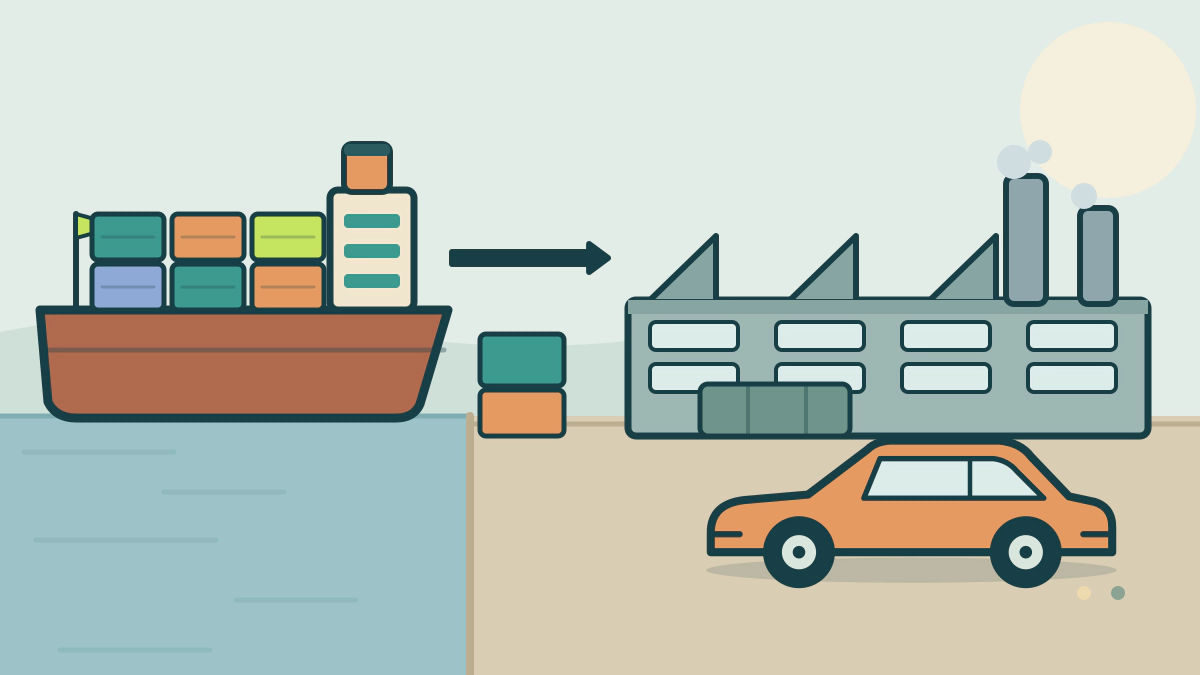
Trace how Japanese brands entered the US market, coped with the 1981 export cap, and moved from imports to American factories and luxury lines.
How did Japanese automakers grow in the US?
They entered through small, fuel-efficient products, then built local factories and dealer networks after trade limits made imported cars scarce. Toyota, Honda and Nissan took different routes, and each route depended on the market conditions of its time.
The history separates into three phases: exports, local production and brand expansion. Company histories are weaker on sales totals, because each company counts vehicles and years differently.
A chronology of the US entry
| Year | Event | Why it mattered |
|---|---|---|
| 1957 | Toyota exports a Toyopet Crown and forms Toyota Motor Sales, U.S.A. | Toyota calls the Crown the first Japanese passenger car exported to the US |
| 1959-1970 | American Honda is incorporated; Datsun appears at the Los Angeles Auto Show; the N600 goes on sale | Sales subsidiaries, a dealer base and Honda’s first US car |
| 1973-1974 | Oil crisis; Civic tops an EPA fuel economy test; CVCC arrives | Fuel economy and emissions become selling points |
| 1981 | Japan announces voluntary export restraints | Passenger-car exports to the US are capped at 1.68 million in the first year |
| 1982-1986 | Honda builds an Accord in Ohio; Nissan builds a pickup in Tennessee; Toyota and GM establish NUMMI; Toyota sets up a Kentucky operation | Japanese-brand local assembly begins |
| 1989 | Lexus launches in the US | Toyota enters the US luxury segment |
Motorcycles and small cars opened the door
Toyota’s history dates the first Japanese passenger car export to the US to 1957, when a Toyopet Crown was shipped and Toyota Motor Sales, U.S.A. was established (Toyota). Nissan says it brought its first Datsuns, a 1000 cc car and a truck, to the 1959 Los Angeles Auto Show (Nissan).
Honda arrived through motorcycles. American Honda was incorporated on June 11, 1959 as Honda’s first overseas subsidiary, with eight staff selling the Dream, Benly and Super Cub from a Los Angeles storefront (Honda). Honda ended 1959 with 170 sales against a 1,000-unit monthly goal.
Honda’s first US car came later. The N600 went on sale in Hawaii in December 1969 and on the mainland in May 1970, using motorcycle dealers as the first sales channel (Honda). That sequence set the pattern: a small vehicle, a narrow region, then a wider dealer base. Buyers researching an early import can use the imported-car checklist.
Fuel economy turned a niche into a market
The 1973-74 oil crisis changed what US buyers valued. Honda’s history says the Civic placed first in a fuel economy test conducted by the EPA in 1974, and that American Honda began selling Civics with the CVCC engine, which it describes as the first power plant to pass the Clean Air Act’s strict emissions standards (Honda). The Accord followed in 1976.
BLS data puts the gap in context. In the 1980s, imported Japanese vehicles made up 17 to 22 percent of US vehicle sales, and their average fuel economy was 5 mpg greater than that of American vehicles (BLS). That is a broad comparison, but it shows why small cars found buyers. The same demand shift appears in how fuel prices influence SUV and truck demand.
The 1981 export cap changed the math
Japan announced voluntary restraints on passenger-car exports to the US on May 1, 1981. The first-year limit was 1.68 million vehicles, and Toyota’s history says the restraints ended with fiscal 1993, in 1994 (Toyota). BLS records later caps of 1.85 million in 1984 and 2.3 million in 1985.
The cap covered imports from Japan, not cars built in the US (BLS). That gave companies a reason to expand American production, but it did not make exports disappear. BLS says Japanese vehicles from both sources still made up more than 25 percent of US sales by 1990.
Factories, dealers and luxury brands
Honda built the first Japanese-brand car in the US, according to its own history: an Accord rolled off the Marysville, Ohio line on November 1, 1982 (Honda). Nissan’s Smyrna, Tennessee plant built its first vehicle, a 720 pickup, on June 16, 1983, and added the Sentra in 1985 (Nissan). Toyota established NUMMI with GM in 1984 and Toyota Motor Manufacturing in Kentucky in 1986 (Toyota).
Local production also created US supplier relationships, a local workforce and a story dealers could tell. Honda says its US dealer count passed 900 by 1986, with more than 70 percent selling Honda exclusively. Those figures are company-reported, but they show the direction.
Honda launched Acura in 1986, and Toyota launched Lexus in 1989 (Honda, Toyota). Both gave the companies a way to sell higher-priced cars without diluting the main brand.
What the company histories leave uncertain
Corporate heritage pages are strong on dates and firsts, but they are also promotional. A claim such as “first Japanese automaker to build cars in America” depends on whether the count includes motorcycles, trucks or joint ventures. Honda, Nissan and Toyota each describe a different milestone, and all three can be correct under different definitions.
Sales totals are another trap. BLS counts cars and light trucks together in some series and separately in others, so this article uses the ranges the sources state. The Automotive History archive has more on model timelines.
Frequently asked questions
Was the 1981 restraint a US tariff?
No. It was a Japanese export restraint announced by the Japanese government, not a US import duty. It limited passenger-car exports to the US, starting at 1.68 million in the first year.
Which company built the first Japanese car in the US?
Honda is the usual answer: its Marysville plant built an Accord on November 1, 1982. Nissan’s first US-built vehicle was a pickup in June 1983, so the answer changes if trucks count.
Why did Japanese brands create luxury marques?
Acura and Lexus let Honda and Toyota sell more expensive cars through separate dealer networks. Honda launched Acura in 1986; Toyota launched Lexus in 1989.
Did the export cap stop Japanese imports?
No. It limited them and was eventually lifted. Japanese companies kept importing some models while building others in North America.