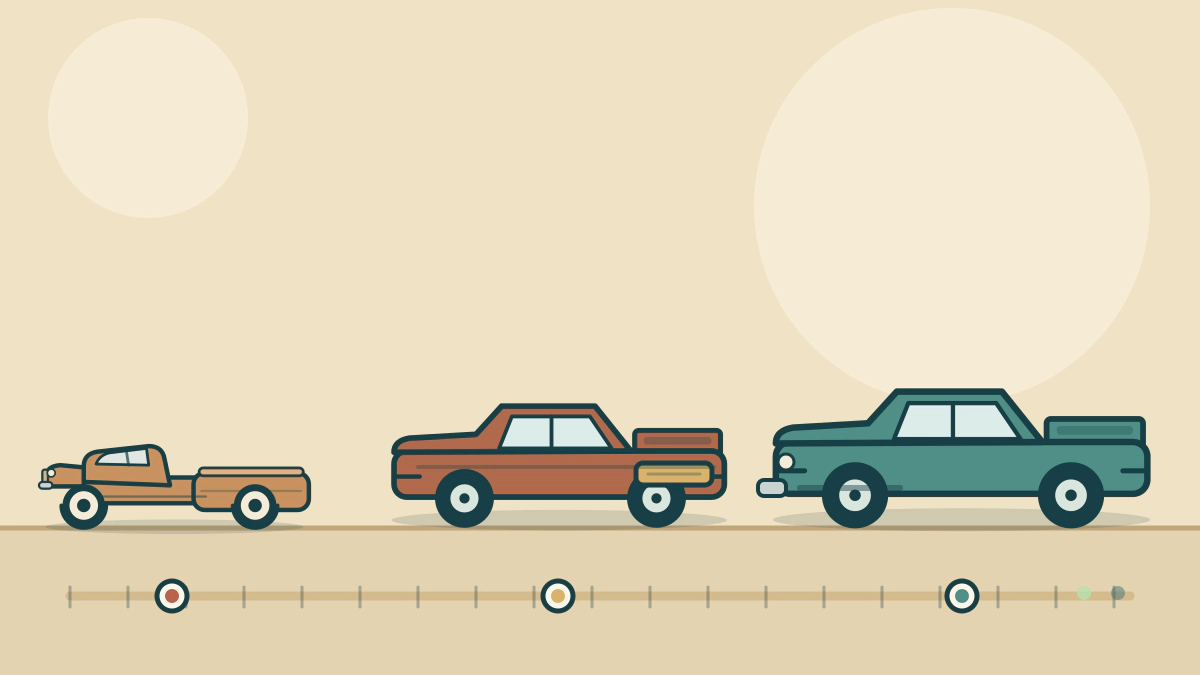
Trace the Ford F-Series from the 1948 F-1 through the 1975 F-150 and the 2015 aluminum body, and see how each era changed the truck.
How did the Ford F-Series become America’s pickup?
The F-Series began in 1948 with a range of trucks from the F-1 to the F-8, and it became America’s best-selling vehicle line by adding comfort, body styles and capability without abandoning the basic pickup layout.
Ford revealed the first F-Series on January 16, 1948. The company describes the F-1 as its first all-new vehicle after the Second World War, advertised with the promise “Built Stronger to Last Longer” (Ford press release).
That launch is the fixed point. Later sales claims come from Ford itself, so they describe how the company counts the market rather than an independent audit.
The 1948 line: F-1 through F-8
The original range ran from the F-1 to the F-8. Ford says early buyers were mainly farmers, manufacturers and small businesses.
This was a working truck, not a lifestyle vehicle. Ford’s own account notes that customers bought it for payload and durability, and that car-like features arrived later.
Ford’s archive holds the period brochures and photographs that document these changes, including a 1954 F-100 photograph (Ford Heritage Vault). The archive is the place to check a specific year’s body style, trim and optional equipment.
The 1950s and 1960s: comfort enters the cab
Ford redesigned the F-Series in 1953, its 50th anniversary year. By the mid-1950s the F-100 name had replaced the F-1; Ford’s archive lists a 1954 F-100 photograph, so the new badge was in use by then.
The bigger shift was in use. Ford says that by the 1950s Americans were buying pickups for recreation, and the F-Series began offering more car-like features. A truck could now be a second family vehicle as well as a work tool.
1974-1982: SuperCab, F-150 and the sales crown
Ford added the first SuperCab in 1974 and the F-150 one year later. The F-150 became the name most buyers know today.
Sales leadership followed. Ford says the F-Series was America’s best-selling truck from 1977 and, as of the end of 2007, the best-selling vehicle of any kind for 26 years in a row. Read backwards, that puts the start of the vehicle-wide streak in 1982.
Fuel rules helped shape the category. The 1975 Energy Policy and Conservation Act created separate fuel-economy standards for passenger cars and light trucks, and pickups fell on the light-truck side (EIA). That split gave truck makers a different target from car makers. See how fuel prices influence SUV and truck demand.
1997-2004: doors, cabs and family duty
The 1997 redesign covered the under-8,500-pound gross vehicle weight trucks, the light-duty part of the line. Ford added a standard three-door SuperCab, then a fourth door in 1999, and a four-door SuperCrew with a full rear seat in 2001.
The 2004 F-150 was another clean-sheet design. Ford cited a new 5.4-liter three-valve V-8 with about 15 percent more power, plus more room for people and cargo.
These changes matter for buyers today because they mark when a used F-150 stopped being only a work truck. Cab size, door count and rear-seat room are the quickest way to sort one generation from another.
2015: the aluminum body
For 2015 Ford replaced the steel body and bed with a high-strength aluminum alloy, which Ford called an industry first for a full-size pickup. Ford said the change cut as much as 700 pounds compared with the 2014 truck, while a high-strength steel frame carried the load (Ford press release).
The weight loss affected towing, braking and fuel economy at once. It also made body repair a specialist job, because aluminum needs different tools and procedures from steel.
A chronological view
| Era | What changed |
|---|---|
| 1948 | F-1 to F-8 line launched on January 16 |
| 1953 | Redesign in Ford’s 50th year; F-100 name follows |
| 1974-1975 | SuperCab added; F-150 joins the range |
| 1977-1982 | Best-selling truck, then best-selling vehicle |
| 1997-2001 | New cab styles, extra doors, SuperCrew |
| 2015 | Aluminum-alloy body and bed |
How to research a specific F-Series
Start with the model year on the door jamb label and the VIN. Decode the VIN through NHTSA’s vPIC decoder rather than trusting a badge.
Then check the engine and axle for that exact year. The F-150 engine list changed often, and the same badge can cover different engines; F-150 engine options by model year explains how to compare. For a rival view, see F-150 vs Silverado 1500.
The wider Automotive History section covers other engineering and industry turning points.
Frequently asked questions
What year did the Ford F-Series start?
Ford revealed the first F-Series, the F-1, on January 16, 1948. The company calls it its first all-new vehicle after the Second World War. Earlier Ford pickups existed, but they were not part of the F-Series line.
Was the F-150 part of the original F-Series?
No. The F-150 arrived in 1975, one year after the first SuperCab. The original range ran from the F-1 to the F-8, and the F-100 was the familiar light-duty name for many years.
Why does Ford call the F-Series America’s best-selling vehicle?
Ford says the line has led US truck sales since 1977 and all vehicle sales since 1982. Those are company figures based on its own sales reporting, so treat them as Ford’s count rather than an outside measurement.
Did the F-Series always have four doors?
No. Early trucks had a single cab. Ford added the SuperCab in 1974, a third door in 1997, a fourth door in 1999 and a four-door SuperCrew in 2001.