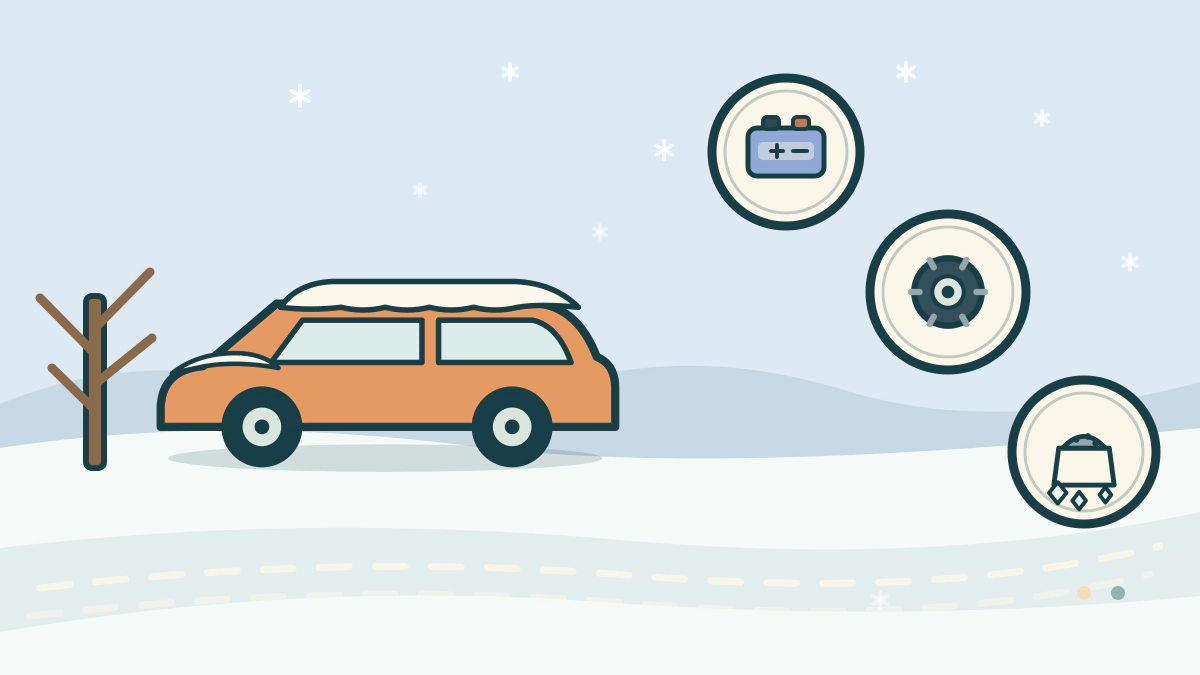
A snow-country used-car checklist covering tire tread and age, battery health, block heaters, salt damage and a genuine cold start.
What should you check before buying a car in a snowy climate?
Check the tires, battery, block heater and underside before you discuss price, because those items decide whether the car starts, stops and survives a salted winter.
Use these checks as a filter on a specific used car. They do not replace a mechanical inspection, and they do not prove how a model behaves on ice. This guide is part of the US state and regional automotive guides section.
Check tire tread, age and winter rating
NHTSA says tire pressure drops as the outside temperature falls. Use the pressure on the driver’s door label or in the owner’s manual, not the maximum number molded on the tire sidewall. Tread should be at least 2/32 of an inch on every tire. In the penny test, a visible top of Lincoln’s head means the tire is worn out (NHTSA winter tips).
Age matters even when the tread looks deep. The last four digits of the DOT Tire Identification Number give the week and year of manufacture, so 0308 means the third week of 2008. Some vehicle and tire manufacturers recommend replacing tires at six to 10 years old regardless of tread. Check both sidewalls, because the full number may appear on only one side (NHTSA tires).
Tire type changes the deal. NHTSA says winter tires are more effective than all-season tires in deep snow, while summer tires are not designed for freezing temperatures, snow or ice. A car sold with worn all-seasons needs a second set or an immediate purchase.
| Check | What to record | Why it matters |
|---|---|---|
| DOT code | Last four digits on the sidewall | Shows tire age independent of tread depth |
| Tread | 2/32 inch minimum on all four tires | NHTSA’s replacement threshold |
| Tire type | Winter, all-season or summer marking | Summer tires are not for freezing conditions |
| Spare | Pressure, age and visible damage | A spare can be old even when unused |
Test the battery and the cold start
NHTSA says battery power drops with temperature, and cold gasoline or diesel engines take more battery power to start. Have a mechanic check the battery, charging system and belts before purchase (NHTSA winter tips).
Start the car from cold, not after the seller has warmed it. Listen for a slow crank and look for a battery date label. A recent battery does not prove the charging system is healthy, and a jump start is a warning sign.
Confirm the block heater and cold-weather equipment
Honda’s 2023 CR-V hybrid owner’s manual tells drivers in extremely cold regions that an engine block heater improves starting and warming, and to consult a dealer for details (Honda manual). If a car is advertised with one, find the cord, inspect the plug and check how the heater is mounted. A missing cord or loose unit is a repair item, not a feature.
The same manual says to turn off lights, climate control and the rear defogger when starting in cold weather to reduce battery drain. Test the cabin heater and defroster during the drive.
Look underneath for salt damage
Road salt is why a clean-looking car can hide expensive problems. PennDOT says it used an average of 776,000 tons of salt over the past five winters to keep state roads passable (PennDOT Winter Facts). That material reaches rocker panels, floor pans, brake lines and subframes.
Ask to see the car on a lift. Look for rust that has gone through metal, not just surface bloom. Pay attention to rocker panels, floor pan seams, frame rails, suspension mounts and brake lines. The rust research guide explains how state inspection rules treat those areas. After purchase, the road salt removal guide covers washing.
Budget for the winter setup
A snow-country car may need winter tires, a second set of wheels, a battery and underside protection. Get separate quotes for each item before you negotiate.
The FTC says add-ons are optional, can cost thousands of dollars and can often be bought elsewhere. It also says to ask for the out-the-door price in writing before visiting a dealer (FTC).
Run a cold-weather test drive
Book the inspection for a cold morning. Start the car cold, operate the heater and defroster, and drive on the surfaces you will actually use. Ask the seller to leave the car outside overnight if possible, so the first start is a real one.
Then pay for an independent mechanical inspection. The FTC says a vehicle history report is not a substitute, and a safety inspection usually covers only things that make a car unsafe to drive. The pre-purchase inspection guide explains what a mechanic should check.
Frequently asked questions
Do I need winter tires if the car has all-wheel drive?
Tire choice is separate from which wheels receive power. NHTSA says winter tires are more effective than all-season tires in deep snow, and summer tires are not designed for freezing conditions.
How can I tell how old a used tire is?
Look for the DOT Tire Identification Number on the sidewall. The last four digits show the week and year of manufacture. Check both sides of the tire, because the full number may not be on both.
Is a block heater worth having?
Honda’s manual says a block heater improves starting and warming in extremely cold regions. Whether one is fitted, and whether it can be added, depends on the model and market. Ask a dealer for the specific car rather than assuming.
Should I avoid a car that was driven in a road-salt state?
Salt exposure alone is not a reason to reject a car. Rust that has perforated structural panels or brake lines is. Inspect the underside and use the state inspection rules as a guide, as described in the rust research guide.