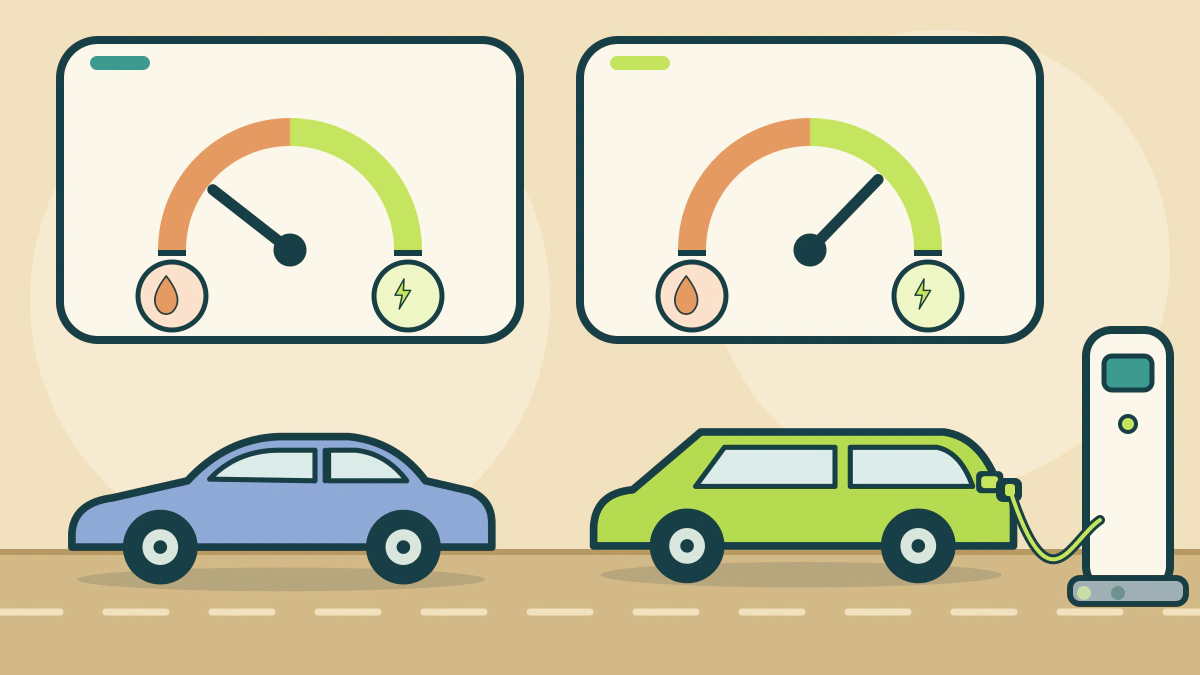
Compare how a hybrid and a plug-in hybrid use fuel, read the plug-in label, and test the savings with a labelled mixed-commute example and your own numbers.
Which saves more fuel, a hybrid or a plug-in hybrid?
A plug-in hybrid saves more fuel only when it is plugged in regularly and driven mostly within its electric range; if it is never plugged in, it uses about as much fuel as a similar hybrid. The Department of Energy says the same. Charging consistently is the best way to maximize the electric benefit.
So the better saver depends on your habits, not on the badge. This guide shows how to test that with a simple example and your own numbers.
For the basics of each type, see BEV vs HEV vs PHEV. The wider topic hub is Electric and Hybrid Vehicles.
Where each type gets its energy
A conventional hybrid cannot plug in. DOE explains that it charges its battery through regenerative braking and the engine. All of its energy ultimately comes from gasoline.
A plug-in hybrid has a larger battery that also charges from an outlet. DOE says that allows about 15 to 60-plus miles on electricity alone in current models. The engine takes over when the battery is mostly depleted, during rapid acceleration, or under heavy heating or air-conditioning loads.
FuelEconomy.gov says plug-ins use roughly 30% to 60% less petroleum than conventional vehicles. It also says operating on electricity typically costs less than half as much as gasoline. Both statements depend on how much of your driving uses the plug.
A labelled example: three days of mixed driving
The numbers below are assumptions, not ratings for any model. Assume both vehicles get 50 mpg on gasoline and the plug-in has 30 electric miles. Equal gasoline economy matches DOE’s “about the same” statement for an uncharged plug-in, though real pairs differ.
| Day type | Miles | Hybrid gas used | Plug-in, charged overnight | Plug-in, not charged |
|---|---|---|---|---|
| Short commute | 24 | 0.48 gal | 0 gal | 0.48 gal |
| Commute plus errands | 45 | 0.90 gal | 0.30 gal | 0.90 gal |
| Long trip | 200 | 4.00 gal | 3.40 gal | 4.00 gal |
On the short day, the plug-in uses no gasoline. On the trip day, it saves only the 30 electric miles, or 0.60 gallons. The more of your miles look like the first row, the bigger the gap.
Now stretch it over a year. Suppose 6,000 miles run on electricity. At 50 mpg, the hybrid would burn 120 gallons for those miles. Assume gasoline at $3.50 a gallon, electricity at $0.10 per kWh and 30 kWh per 100 miles.
- Gasoline avoided: 120 gallons, or $420.
- Electricity used: 1,800 kWh, or $180.
- Net saving: $240 a year.
FuelEconomy.gov says a plug-in can cost roughly $4 to $8 thousand more than a comparable non-plug-in hybrid. Against $240 a year, that gap would take about 17 to 33 years to repay. Change any input and the answer moves, so treat this as a method.
How to read the plug-in label
The EPA label for a plug-in shows two fuel economy boxes. The left box gives MPGe on electricity. The right box gives MPG once the battery is empty and the car runs on gasoline.
It also lists electricity use in kWh per 100 miles, the electric range on a full charge, and charge time on a 240-volt supply. EPA gives no single blended figure, so you build one from your own miles.
Use the label like this:
- Take the gasoline MPG box and compare it with the hybrid’s MPG.
- Take kWh per 100 miles and your local electricity price.
- Estimate how many of your daily miles fit inside the electric range.
- Price the rest on gasoline.
The label’s own cost estimates assume 15,000 miles a year and projected fuel prices. FuelEconomy.gov also offers My Plug-in Hybrid Calculator for your driving habits. See the plug-in hybrid page.
When the plain hybrid is the better choice
A hybrid can be the better saver in several cases:
- You cannot charge where you park. Without a plug, you pay for the larger battery without using it. Compare Level 1, Level 2 and DC fast charging first.
- Most of your miles are long highway runs. The example shows how little a 30-mile battery changes a 200-mile day. Our highway hybrid guide covers the city-versus-highway gap.
- The price difference is large and you keep cars a short time.
FuelEconomy.gov also notes that heating, air conditioning and entertainment systems lower fuel economy on all vehicles, with a greater effect on hybrids and electrics. It suggests pre-heating or pre-cooling a plug-in while it is still plugged in, which can extend electric range.
Neither type is a fixed answer. For electric-only capability in hybrids, read can a hybrid drive on electricity alone. For the SUV body style, see what is a plug-in hybrid SUV.
Frequently asked questions
Does a plug-in hybrid save fuel if I never plug it in?
Not meaningfully. DOE says an unplugged plug-in gets about the same fuel economy as a similarly sized hybrid. You would carry a larger battery without using its main benefit.
How many electric miles will I really get?
The label gives an approximate range for combined city and highway driving on a full charge. Your result changes with speed, weather, load and accessory use. Use the label as a starting point, not a promise.
Is a plug-in hybrid cheaper to run than a hybrid?
It can be, if you charge often and the electricity price is low. FuelEconomy.gov says savings may or may not offset the higher vehicle cost. It depends on the vehicle, your share of electric miles, fuel costs and ownership length.
What if I can only charge on a household outlet?
FuelEconomy.gov says recharging on a 120-volt outlet can take several hours. A 240-volt charger takes about 1 to 4 hours. Check the label’s charge time and ask the manufacturer what a household outlet can do for your model.