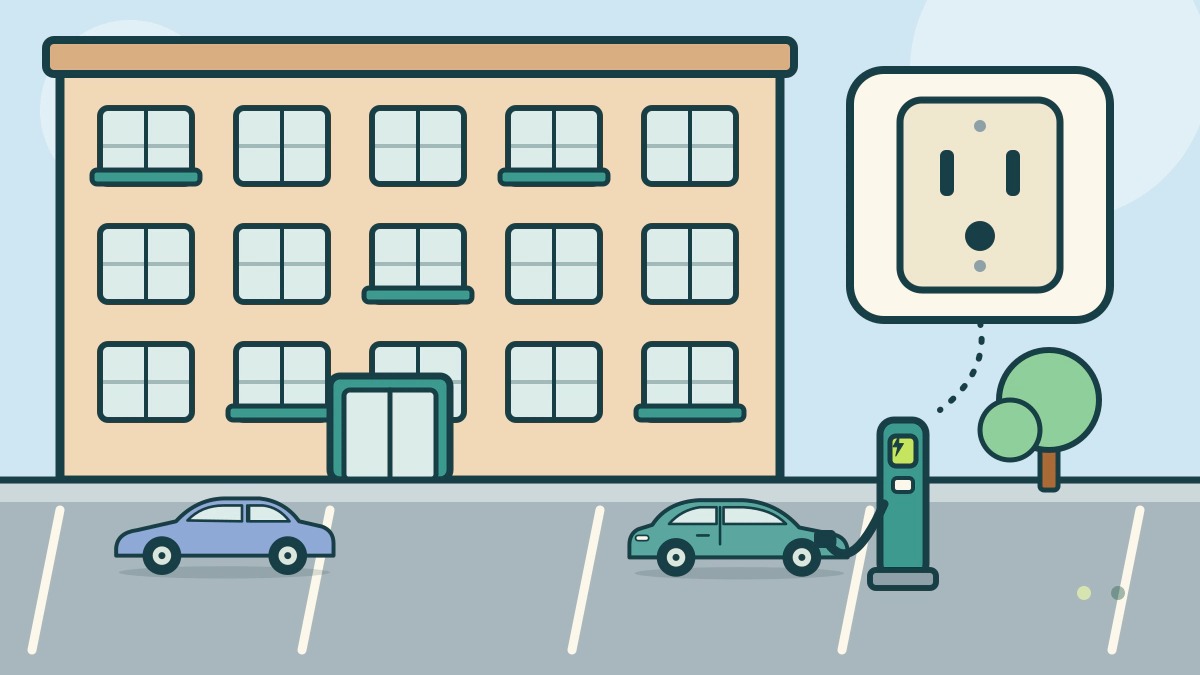
Learn when an EV works without a home garage, how Level 1, Level 2 and public charging compare, and what to ask a landlord or HOA first.
Can you own an EV if you live in an apartment?
Yes, but only if you have a dependable place to plug in. The Department of Energy’s Alternative Fuels Data Center (AFDC) says most EV charging is done at home. Apartment dwellers are the people who often cannot do that.
So the question is not the car. It is access to a plug. The AFDC says charging at multifamily housing needs extra thought and may be more like public charging than charging at a single-family home.
The three ways an apartment dweller can charge
The AFDC charging equipment page rates each level by approximate range added per hour.
| Charging type | Approximate range added | Where an apartment dweller finds it |
|---|---|---|
| Level 1 (120 V outlet) | About 5 miles per hour | A standard outlet near your space, if the property allows it |
| Level 2 (240 V or 208 V) | About 25 miles per hour | Shared complex chargers, workplaces, public lots |
| DC fast charging | About 100 to 200+ miles per 30 minutes | Public stations along busy routes |
The same page says total charging time can range from under 20 minutes at a DC fast charger to 20 hours or more at Level 1.
The AFDC example is 8 hours of Level 1 charging adding about 40 miles for a mid-size EV.
Do the daily mileage math first
The AFDC advises starting with daily driving. Ask how many miles you drive for work and errands.
Here is the arithmetic using the AFDC rates. A 30-mile day needs about six hours on Level 1 at 5 miles per hour. The same day needs about 1.2 hours on Level 2 at 25 miles per hour.
Those are approximations. Check your model’s charge rate in its manual.
If your commute is short and a full night’s outlet is allowed, Level 1 can cover it. If you drive more, you will want Level 2 or regular public stops.
For long trips, the AFDC suggests checking that stations on your route fit your car.
What to ask a landlord, HOA or property manager
Property owners face real questions. The AFDC multifamily page lists parking, electrical service access, billing and legal concerns.
Bring these questions:
- Is there a charger now, or a plan for one?
- May residents use an outlet or install their own equipment?
- Who pays for installation, electricity and upkeep?
- Does the lease or HOA bylaw cover charging?
The AFDC page links to guides for residents, including one on EV charging access for renters. It says owners may also find state or utility incentives for installing chargers.
Any installation must follow local and state codes, and permits may be required, according to the AFDC home charging page. The page also recommends a certified electrical contractor.
Some states have laws about charging in rented or shared housing. This article did not verify any official list. Check your state law and local rules.
Workplace and public charging as a backup plan
The AFDC workplace page says Level 2 is the most common type at workplaces. It also says a Level 1 station generally serves one vehicle in a standard workday.
If your employer has no charger, the consumer page says charging at work can be as simple as an available outlet, with your employer’s permission.
The AFDC public charging page says Level 1 and 2 stations are typically placed where people park for long periods. Examples are shopping centers, airports, hotels and government offices.
Price matters too. The AFDC says drivers can normally expect to pay more at public stations, especially DC fast chargers, than for electricity at home. For costs, see the cost of owning an EV without home charging.
Use the AFDC Station Locator to find chargers. It lists a phone number for each station so you can call ahead.
When a plug-in hybrid may fit better
The AFDC says that if an all-electric car does not meet your needs, or you want gasoline backup, a plug-in hybrid is an option. A plug-in hybrid also has an engine and the maintenance that comes with it.
The AFDC also notes that most plug-in hybrids cannot use DC fast charging. For the differences, read BEV vs HEV vs PHEV.
For more guides, visit Electric and Hybrid Vehicles. If you later install a charger, compare it with public costs in home charger installation versus public charging costs.
Frequently asked questions
Can I charge an EV with a regular outlet at my apartment?
Often yes, if the property allows it. The AFDC says most EVs come with a Level 1 cord for a 120 V outlet. It adds that the outlet should be on a dedicated branch circuit near your parking spot.
Is public charging enough if I have no home charger?
It can work if stations are close and you can fit charging into your routine. The AFDC says public charging is mostly Level 2 or DC fast charging. Check that stations near home and work are reliable before you commit.
Can my landlord refuse an EV charger?
That depends on your lease, your HOA rules and your state’s law. This article could not confirm a federal rule. Ask in writing, read your lease, and check your state and local rules.
Is a plug-in hybrid easier for apartment living?
It can be, because a gasoline engine covers days when you cannot plug in. The AFDC says charging plug-in hybrids regularly reduces gasoline use. You still take on engine maintenance, so compare it with an all-electric car.