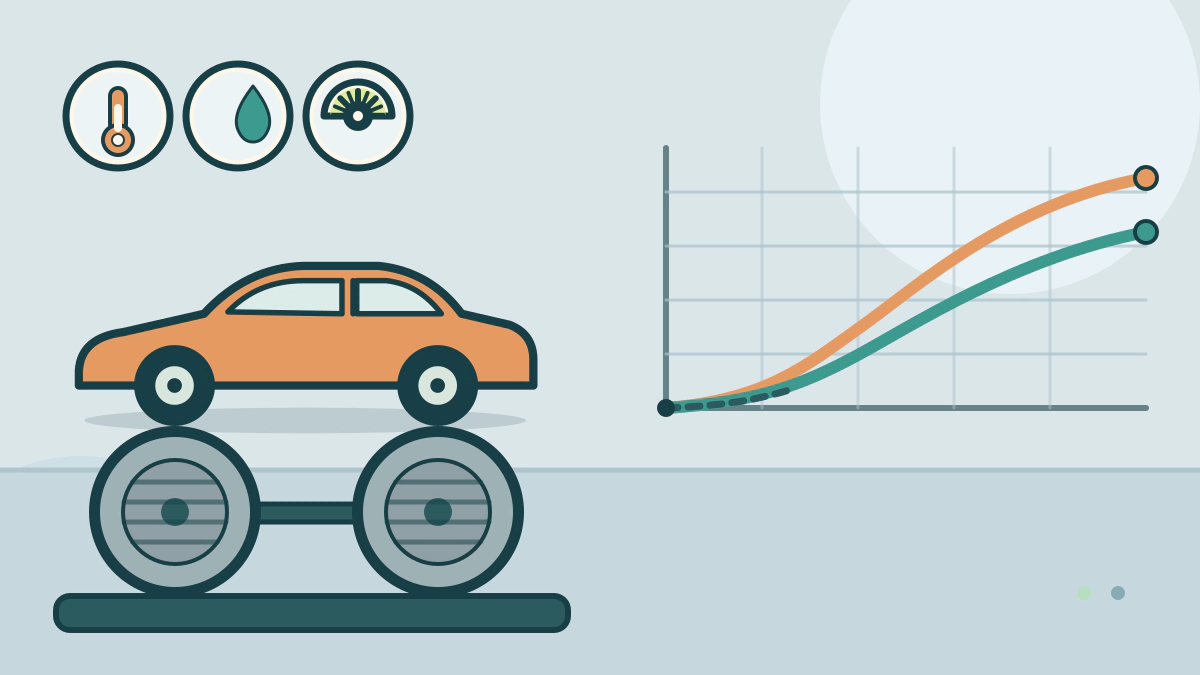
See why two dyno pulls can report different horsepower, from SAE correction factors and weather to inertia versus load-bearing machines and operator settings.
Why can two dyno runs give different horsepower numbers?
Because a chassis dyno measures a car under conditions that keep changing, and the software then adjusts the raw result. Air temperature, barometric pressure, humidity, engine heat, tire drag and the operator’s settings all affect what the drum sees. A correction formula removes some of that variation, but not all of it.
What SAE J1349 correction does
SAE J1349 is the standard for as-installed net engine power and torque ratings. SAE says the procedure is intended to give repeatable measurements that reflect real in-service performance, and it says the engine should not be prepared for its best possible result (SAE J1349).
A chassis dyno applies its own correction factor to the pull. Dynojet’s manual describes its SAE setting as the June 1990 formula. The inputs are dry barometric pressure, intake air temperature and water content. The formula assumes 85 percent mechanical efficiency and a 537 R reference, which is 77 F (Dynojet manual).
Correction can raise or lower the printed number by several percent. On a hot, humid day at altitude it often adds power that the engine did not gain.
Why SAE, STD and DIN give different numbers
Dyno software usually offers more than one correction standard. Dynojet’s manual lists SAE, DIN, EEC and STD choices in its graph settings. The same pull can be displayed with different factors because the standards use different reference conditions and, in some cases, different formulas.
This is one reason a claim of 410 hp from one shop and 398 hp from another may describe the same car. Before comparing sheets, ask which correction standard is selected. It is often printed in small text on the graph.
Inertia and load-bearing dynos load the car differently
An inertia dyno measures how quickly the vehicle accelerates a heavy drum. Dynojet’s manual describes that method directly: it times drum rotation and calculates force from acceleration (Dynojet manual). A load-bearing dyno adds resistance and measures force with a load cell. The federal rule for chassis dynamometers describes electrically generated load forces combined with rotational inertia, applied through rolls driven by motor/absorbers, with a load cell measuring the force at the tires (40 CFR 1066.210).
Those differences can change the curve on the same car. A loaded sweep holds the engine under load longer, which affects boost, intake heat and automatic-transmission behavior. An inertia pull is brief. Neither machine is automatically wrong, but their numbers answer slightly different questions.
Conditions and engine state move the result
Air density is the main reason correction exists. The Dynojet manual explains that correction compensates for barometric pressure, air temperature and water content because an engine takes in less oxygen when the air is thin, hot or humid.
The car’s own state matters too. Coolant and oil temperature, heat soak in the engine bay, tire pressure and how firmly the car is strapped down all change what reaches the drum. A first pull on a cold engine and a fifth pull on a hot one are not the same test. The SAE standard warns against testing that is biased toward the best possible conditions.
Operator choices that appear on the sheet
Smoothing is a display setting, and Dynojet’s software documents it next to the correction factor. Heavy smoothing can flatten a spike. A short pull may not capture the same boost curve as a longer one. Gear choice, tire pressure and strap tension also change what reaches the drum.
What a useful dyno sheet records
| Item | Why it matters |
|---|---|
| Correction standard | SAE, STD, DIN and EEC do not produce the same number |
| Air temperature and pressure | These are inputs to the correction factor |
| Dyno type | Inertia and load-bearing machines load the car differently |
| Gear and run number | Both affect wheel speed, heat and repeatability |
| Smoothing setting | It changes the shape of the displayed curve |
| Baseline and change | A before-and-after on the same day is the useful comparison |
Use the same dyno, correction standard and a similar day. Run a baseline before the part, then the modified run, and keep both sheets. Compare the curve shape as well as the peak.
Do not compare a wheel number with a manufacturer’s crank rating. SAE J1349 ratings are engine test results, and the SAE certified power program covers engines certified to that procedure, not chassis dyno pulls. The same logic belongs in the wider Car Modifications and Tuning picture.
For a broader view of how gearing and engine speed affect the feel of a car, see power-to-weight ratio. Before paying for dyno time, it also helps to understand what an ECU tune can and cannot change.
Frequently asked questions
Why does my car make less power on a hot day?
Hot air is less dense, so each intake stroke brings in less oxygen. The correction factor offsets that, but it cannot fully remove heat soak in the engine, intake or transmission.
Does a higher dyno number mean a faster car?
Not on its own. A peak number says little about the shape of the curve, gearing, weight or traction.
Can two shops dyno the same car and get the same number?
They can get close if they use the same type of dyno, correction standard and similar conditions. In practice, equipment, calibration and operator choices usually differ, so treat the results as different tests.
Should I use SAE or STD correction?
Use whichever standard the shop applies consistently, and keep using it for your own comparisons. SAE is the common industry reference, while STD uses different reference conditions, so mixing the two changes the comparison.