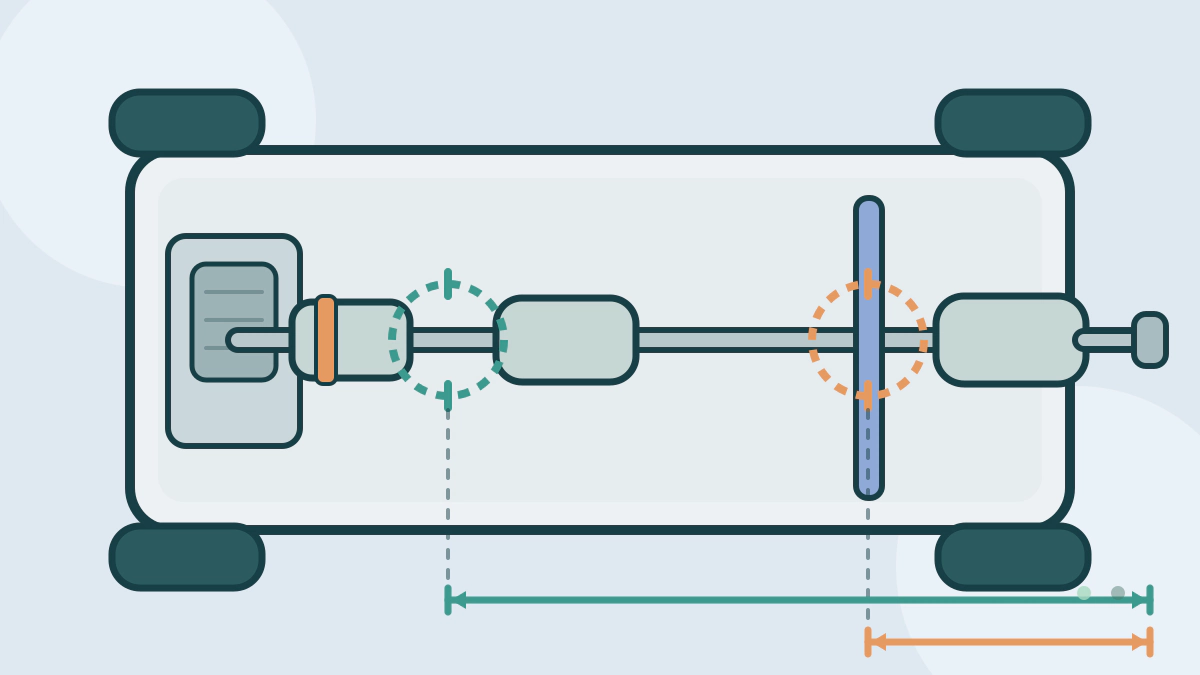
Compare cat-back and axle-back exhaust systems by where they start, what they replace and what they leave untouched, including the converter.
What is the difference between cat-back and axle-back exhaust?
A cat-back exhaust replaces the piping and muffler from behind the catalytic converter to the tailpipe. An axle-back exhaust replaces only the rear section from behind the axle to the tailpipe. The names describe where the new system starts, and both leave the catalytic converter in place.
That last point is the important one for legality. A cat-back or axle-back system is not a converter delete, and it should not be confused with a test pipe or straight pipe. The Car Modifications and Tuning hub covers the wider range of exhaust and performance changes.
Where each system begins
The exhaust path runs from the engine manifold through a downpipe to the catalytic converter, then through mid-pipes, a resonator or muffler, and out the tailpipe. A cat-back system connects behind the converter and replaces the parts after it. An axle-back system connects behind the rear axle and replaces the muffler and tailpipe only.
The cut point explains most of the practical difference. A cat-back replaces more pipe, so it can change the mid-section and the muffler together. An axle-back keeps the factory mid-pipe and resonator.
Neither kit includes a converter. If a listing calls a pipe a cat-back but the pipe replaces the converter, it is not the product this article describes.
The two systems side by side
| Question | Cat-back | Axle-back |
|---|---|---|
| Where it starts | Behind the catalytic converter | Behind the rear axle |
| Parts replaced | Mid-pipe, muffler and tailpipe | Muffler and tailpipe |
| Converter | Stays in place | Stays in place |
| Installation | More joints and more parts to align | Fewer parts, usually a simpler cut |
| Sound change | Comes from the larger section replaced | Comes from the rear section only |
The converter is the legal line
Under the Clean Air Act, a catalytic converter is an emissions control device, and removing or rendering it inoperative is tampering (42 U.S.C. 7522(a)(3)(A)). EPA’s tampering policy gives a hollow straight pipe that replaces a converter as an example of a prohibited part.
A cat-back or axle-back that leaves the converter and its sensors alone does not remove that device. That is the difference between exhaust work and an emissions delete. It does not make every system legal, because sound, inspection and installation rules still apply. The guide to why emissions equipment removal is illegal explains the federal side, and the street-legality checklist covers the state and insurance layers.
Sound is a state and local question
Sound rules come from state and local law, and they differ. Washington’s muffler statute is one example. It requires every motor vehicle to have a muffler in good working order and in constant operation to prevent excessive or unusual noise, and it bars a muffler cutout, bypass or similar device on a highway.
A system that is legal on emissions can still fail that kind of rule. Local ordinances can be stricter, and an officer can cite a car that is simply too loud for the setting. Check the state statute and the local ordinance for where you drive.
Sensors, fit and the check-engine light
An axle-back or cat-back install can go wrong at the joints. A leaking clamp or a hanger that rubs can create noise, and a leak is a fault in its own right. A cloud of smoke can also point to an engine problem rather than the new system; the guide to white, blue and black exhaust smoke explains the difference.
Oxygen sensors deserve their own check. A system that moves a sensor, leaves no bung for it, or requires a simulator is no longer a simple exhaust change. The safe kit keeps every sensor in its original position and does not need an eliminator.
Follow the manufacturer’s instructions for cutting and tightening, and have a shop check the system if the car has an unusual factory layout. A system that fits one trim may not fit another.
Warranty, emissions checks and power claims
The FTC says an aftermarket part does not by itself void a vehicle warranty. A dealer can deny a claim for a part the system damaged, but it must prove the link. Keep the stock system and the receipt.
For emissions, the question is whether the converter and its monitors remain in place. A cat-back or axle-back that leaves them alone does not remove an emissions control. A system that removes a converter does, regardless of what the listing calls it.
This article makes no power estimate. Sellers publish their own figures, and a result from one car on one dyno does not transfer to another. Ask for the test data and ask whether the setup keeps the emissions controls intact.
Frequently asked questions
Does a cat-back exhaust remove the catalytic converter?
No. A cat-back starts behind the converter and replaces the piping and muffler after it. The converter stays on the car.
Is an axle-back exhaust easier to install?
It usually involves fewer parts and fewer joints than a cat-back, so installation is often simpler. The exact labor depends on the vehicle and the kit.
Will a cat-back exhaust pass emissions inspection?
It can, if the converter and its sensors remain in place and the system does not leak. Inspection rules vary, so check your state program before buying.
Is a cat-back exhaust illegal because it is louder?
Not automatically. Loudness is judged under state and local noise rules, not federal emissions law. A system can be emissions-compliant and still violate a noise limit.