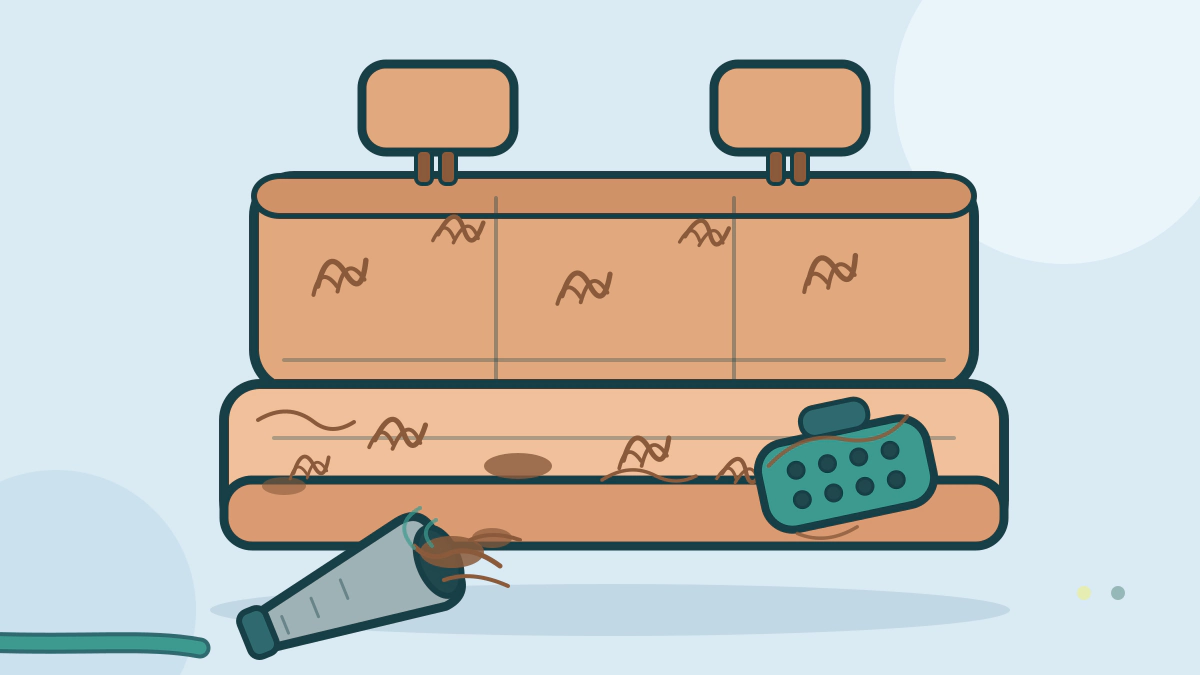
Learn how a vacuum, rubber brush, lint roller and pumice stone lift pet hair from car seats, and how to avoid snagging looped fabric.
What is the fastest way to remove pet hair from car upholstery?
Vacuum first with a brush or crevice tool, then lift the remaining hair with a rubber brush or lint roller, working in one direction a small section at a time. Hair that has worked into the nap will not come out with a single pass. The vacuum removes the loose layer, and the brush or roller pulls the rest off the fibers.
Ford recommends starting a cleanup by vacuuming the carpet, seats and dash. It suggests the brush attachment for stubborn dirt and the crevice tool for hard-to-reach spots such as under the seats (Ford).
Kia’s manual adds that fabric seats should be vacuumed regularly to remove dust and sand, and wiped with a soft sponge or microfiber cloth (Kia).
Why vacuuming first matters
Pet hair arrives in two layers. Some of it is loose on the surface, and some is caught in the weave. A vacuum removes the loose layer before a brush drives it deeper. Toyota’s interior care section likewise starts with a vacuum to remove dirt and dust (Toyota).
Use the brush attachment with light pressure. A crevice tool along the seat base and rails reaches the hair that collects out of sight. Empty the canister or check the filter before you start, because a full vacuum loses suction quickly.
Work the seat in sections: seatback first, then the cushion, then the sides and base. Finishing one area before moving on keeps you from spreading hair back over clean fabric.
Tools that lift hair instead of pushing it
| Tool | Best use | Caution |
|---|---|---|
| Vacuum brush attachment | Loose hair on flat panels | Too much pressure drives hair deeper |
| Crevice tool | Seat rails, gaps, under cushions | Can scratch plastic trim |
| Rubber brush or squeegee | Embedded hair on woven cloth | Use light, one-way strokes |
| Lint roller | Final pass on small areas | Uses adhesive sheets quickly |
| Pumice stone | Tough, tight-loop carpet | Abrasive; keep off soft or looped fabric |
| Damp rubber glove | Small areas and contours | Test for color transfer first |
No single tool wins everywhere. A vacuum does the bulk work, a rubber brush lifts the rest, and a lint roller cleans the last visible film. A pumice stone is a specialty tool, not a first choice.
The stroke that works
Use short strokes in one direction, overlapping each pass, with the vacuum nozzle close to the fabric. Pull the fabric taut with one hand if the seat allows it. Start at the top of the seatback and work down, so loosened hair falls toward the vacuum rather than into a crease.
Do not scrub in circles. Circular scrubbing rolls hair into the nap and can fuzz the fabric. It also spreads the hair over a larger area, which makes the next pass less effective.
For a stubborn patch, brush lightly against the nap, then vacuum with the grain. Repeat the pair of passes instead of pressing harder. Pressure is what damages the fabric, not the number of gentle passes.
Protect looped and delicate fabric
Kia’s manual warns that hook-and-loop closures and sharp objects can snag or scratch seat fabric (Kia). A stiff brush or an abrasive stone can do the same thing. On a looped weave, a pulled loop can become a run that no vacuum will fix.
Test any tool on a hidden area first. Keep pumice stones off soft microfiber, suede-like panels, leather and vinyl. Use them only on a tight, sturdy carpet with very light pressure, and stop if the surface starts to fuzz. A rubber brush or lint roller is the safer choice on a seat you are unsure about.
Hair returns through the carpet and cabin filter
Hair and dander can collect in the carpet, under the seats and in the cabin filter. Vacuum the carpet and the seat gaps, then check the filter at the interval your manual lists. A loaded filter is not cleaning the air that carries the rest of the debris around the cabin.
The guide to replacing a cabin air filter shows the usual glove-box layout. If the car still smells like the pet after the hair is gone, clean the surfaces rather than adding fragrance. A detailer can extract the carpets and seats, and the detailing cost guide explains what to ask for.
For the wider cleaning routine, see the Car Detailing and Protection hub and how to clean fabric car seats.
Frequently asked questions
Does a lint roller work on embedded pet hair?
It works best as a final pass, after the vacuum and rubber brush have loosened the hair. On its own, a roller fills with surface hair and misses the fibers below. Use overlapping strips and replace the sheet when it stops picking up hair.
Is a pumice stone safe on car seats?
Only on a tight, sturdy fabric, and only with very light pressure. A pumice stone is abrasive and can pull loops, fuzz a soft weave, or scratch leather and vinyl. Test it on a hidden area, and use a rubber brush instead if the fabric is loose or looped.
How do I get pet hair out of seat crevices?
Use the crevice tool with the vacuum on high suction, and move the seat forward or back to open the gap. A rubber-tipped tool or a soft brush can loosen hair that is stuck at the rail. Avoid metal picks, which can scratch the trim or tear the fabric.
Why does the hair keep coming back?
Hair works into the foam, carpet and cabin filter, and it gets airborne again when the seats are used. Vacuum the carpet and gaps, check the cabin filter, and repeat the brush-and-vacuum pass after a few days. If a smell remains, the source may be in the padding rather than the surface.