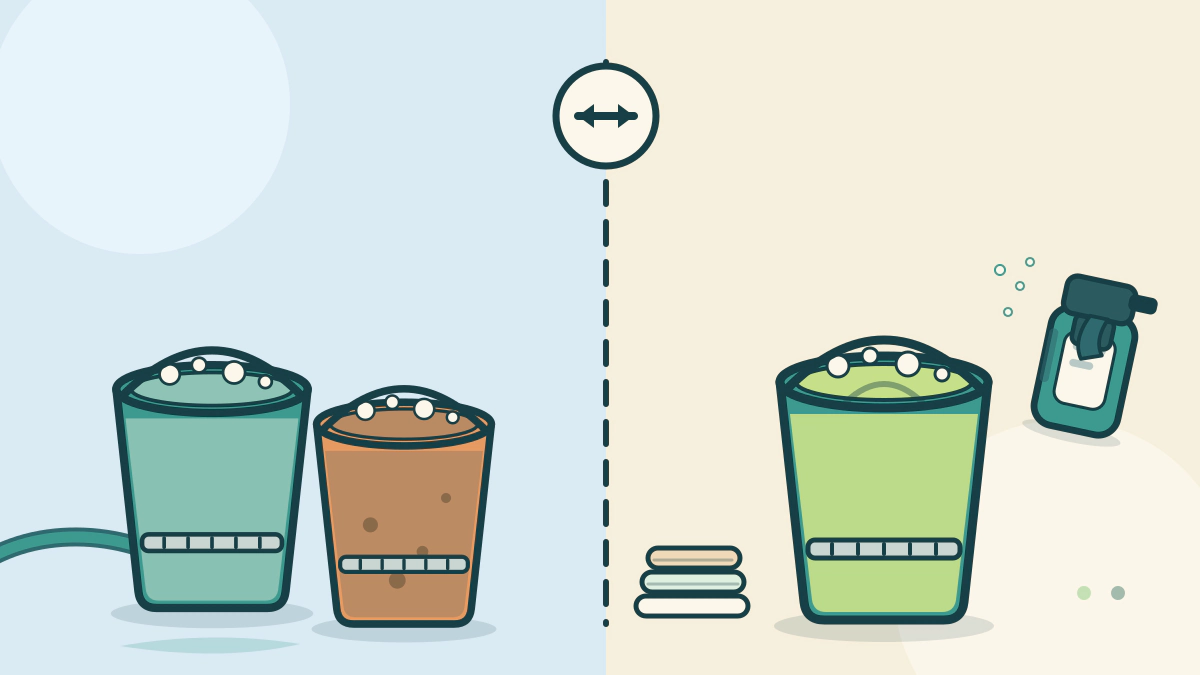
Compare the two-bucket hose wash with rinseless products on water use, grit control and safe use, including when a rinseless wash is the wrong choice.
Which is safer, a two-bucket wash or a rinseless wash?
Both can be safe, but they suit different levels of dirt. A two-bucket hose wash gives clean rinse water and a final rinse, which helps with muddy lower panels and road salt. A rinseless wash uses a small bucket of mixed solution and no hose, which is convenient when water is limited or the car is only lightly dusty.
Rinseless is not a direct replacement in every situation. Meguiar’s says plainly that a muddy or gritty car cannot be washed with a waterless product instead of a bucket, mitt and shampoo. The Car Detailing and Protection hub covers the wider care routine.
How the two-bucket method works
Mitsubishi’s exterior care guide lays out the sequence. Fill one bucket with shampoo and water, fill a second with plain water, and add a grit guard to each if you have one. Rinse the car first, then wash from the top down, one section at a time. Rinse the mitt in the plain-water bucket after each section and reload it with soap.
Meguiar’s describes the same logic: the rinse bucket lets grit fall away from the mitt before the mitt goes back into the soap. The goal is to avoid carrying the dirt you just removed back onto the paint.
The method uses a hose for the pre-rinse and final rinse. That is more water than a rinseless wash, but it flushes grit off before any media touches the paint. For the full hand-wash sequence, see how to wash without scratching paint.
How a rinseless wash works
A rinseless product is mixed at a low dilution in a bucket, and the wash media is soaked in that solution. You wash one section, then dry it immediately with a clean microfiber towel. There is no hose rinse and no second bucket of clean water unless you choose to add one.
Optimum’s directions for its No Rinse Wash & Shine call for 1 ounce of product per 2 gallons of water. The company says an entire vehicle can be washed with less than 2 gallons, and that heavily soiled vehicles may need a pre-rinse or a second wash before drying.
A rinseless wash relies on the solution and towel to lift dirt. If the panel is covered in mud, grit or road salt, there is more abrasive material than the method can handle safely.
Side-by-side comparison
| Factor | Two-bucket wash | Rinseless wash |
|---|---|---|
| Water use | Two buckets plus a hose rinse | Under 2 gallons in one bucket |
| Grit control | Rinse bucket and grit guard | Clean towel per section; optional rinse bucket |
| Best for | Mud, salt, heavy road film | Light dust, garage-kept cars, water restrictions |
| Weak point | More water and setup time | Not suitable for heavy mud or grit |
| Drying | Chamois or microfiber after final rinse | Dry each section immediately |
When rinseless is the wrong choice
Skip rinseless when the car has visible mud, sand, heavy road salt or gritty splash on the lower panels. Meguiar’s says a muddy or gritty car cannot be substituted with a waterless wash, and Optimum says heavily soiled vehicles may need a pre-rinse or a second wash. If you cannot remove the grit before the towel touches the paint, use a hose.
Rinseless is a poor fit for a salted winter road or caked-on bugs and tar. Those deposits need softening and a proper wash, not a wipe-down. See safe bug and tar removal for those spots.
Water, runoff and product choice
Rinseless washing is often chosen for water conservation or when no hose is available. Optimum’s page states the under-2-gallon figure for a full wash. A two-bucket wash uses more because the hose runs, but it carries grit away.
Use a pH-neutral shampoo or the rinseless product’s specified dilution. Mitsubishi’s guide recommends a pH-neutral wash and warns that acidic or alkaline products can degrade a protective coating. Do not mix household cleaners into either bucket.
The International Detailing Association describes its exterior wash procedure as a baseline, not the only acceptable method, and says steps should be adjusted for surface condition, weather, workplace and chemicals. The steps should match the car in front of you.
Drying and towel control
Optimum says to dry each section with a clean microfiber drying towel, and to rewash a section if the solution dries before you wipe it. Mitsubishi’s guide recommends drying with a microfiber towel or chamois and working from the top down.
Use enough towels that you can switch to a clean one. A towel that has picked up grit will keep dragging it across the panel. The Car Accessories and Equipment hub covers buckets, grit guards and drying towels. If you plan to pay someone else, read how detailing quotes are built.
Frequently asked questions
Does a rinseless wash scratch paint?
It can if the car is too dirty or the towel is contaminated. Meguiar’s says muddy or gritty cars should not be washed with a waterless product instead of a bucket wash. Optimum says heavily soiled vehicles may need a pre-rinse or a second wash. Use the method within its limits and change towels often.
Can I use a rinseless wash in winter?
Yes, if the car is only lightly soiled and you can work out of the wind. If the car is covered in road salt or slush, use a hose wash or a pre-rinse first.
How much water does a rinseless wash use?
Optimum says its No Rinse Wash & Shine can wash a vehicle with less than 2 gallons when mixed at 1 ounce per 2 gallons. That is the wash solution only, before any wheel or pre-soak water.
Is waterless wash the same as rinseless wash?
No. A rinseless wash uses a bucket of diluted solution and soaked media, then dries each section. A waterless product is sprayed on and wiped off with towels, usually for light dust. Meguiar’s says neither method replaces a bucket wash on a muddy or gritty car.