How the 2026 Ford Mustang Mach-E charges, from its two battery types and mobile cord to public AC, DC fast charging and charge settings, using Ford's manual.
Which battery is in your Mach-E?
Ford’s 2026 manual treats the two Mach-E battery packs differently, so the first charging question is which one your car has. Standard-range cars use a lithium iron phosphate pack. Extended-range cars use a nickel cobalt manganese pack.
The manual gives a way to tell them apart. Find the vehicle identification label through the driver-side windshield or on the driver door. If the eighth character is a 4 or a 5, the car has the LFP pack. Any other digit or letter means the NCM pack.
Ford’s daily advice differs. For the LFP pack, set the maximum charge level to 100% and charge to 100% at least once a month so the range estimate stays accurate. For the NCM pack, Ford recommends a 90% maximum for everyday use and charging times that begin two to three hours after you plug in, so the battery can cool first.
What the mobile power cord can and cannot do
Ford’s mobile power cord has two connector ends. The low-power end fits a 120-volt NEMA 5-15 outlet. The high-power end fits a 240-volt NEMA 14-50 outlet. The cord’s table lists 32 amps maximum continuous, a cable of about 20 feet, a weight of 8.6 pounds and an operating range of -22°F to 122°F.
Use a dedicated circuit, because a shared circuit can trip the breaker. The cord will not charge if the outlet has no ground. Do not use an extension cord. Support the control box with the wall bracket instead of hanging it from the outlet.
Home and public AC charging
Ford’s sequence is specific. Plug the connector into the control box first, then into the wall outlet, then the coupler into the car. The car must be in park, and it cannot be shifted out of park until the coupler is removed.
Charging starts immediately and runs to 100% by default unless you have set a schedule for that location. To open the charge port door, press and release its right-hand edge.
At public AC stations, the manual says an adapter is required at stations that use the NACS plug. Ford’s 2026 order guide lists a SAE J1772 CCS charge port and a fast-charging adapter as an option. The manual points owners to the Ford app for station pricing and availability.
DC fast charging and the 80% taper
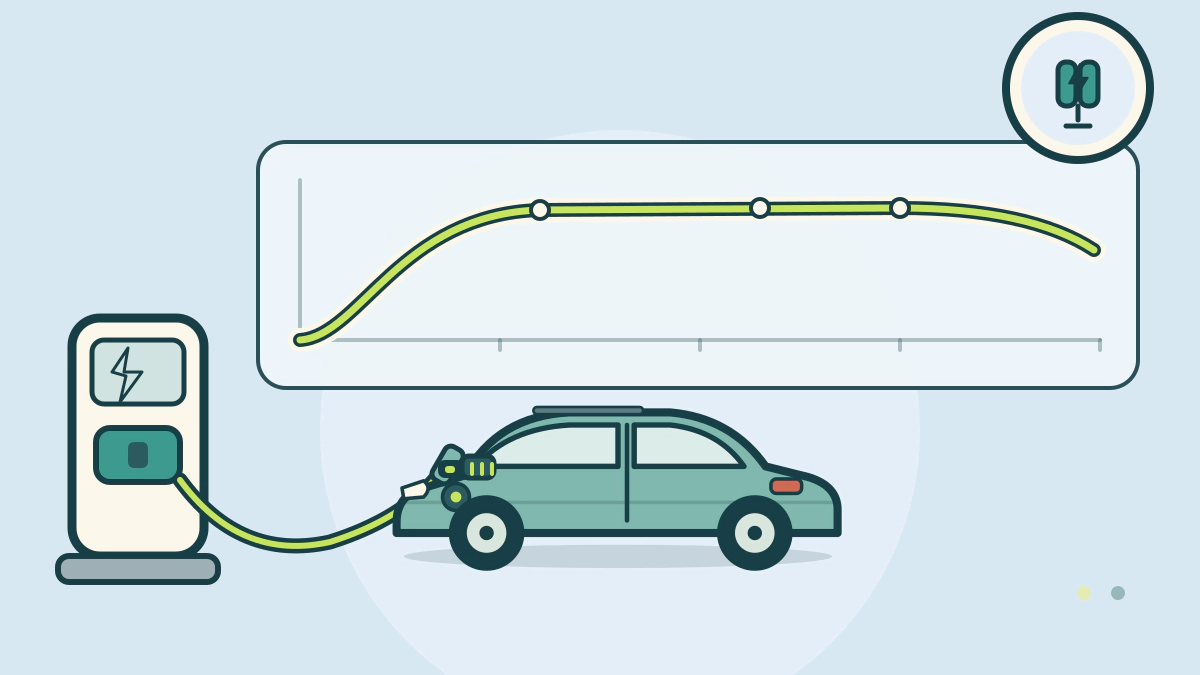
Ford’s DC section says charge rates are significantly slower above 80% state of charge, and ending at 80% or lower helps preserve battery health.
Cold changes the session. Below 50°F (10°C), DC charging can take longer. The manual suggests reducing climate control for the first 10 to 15 minutes so the battery can warm and accept a higher rate. The car may also reduce the rate to protect the battery.
Ford adds that frequent DC charging can reduce battery efficiency and lifespan, and that the effect is more noticeable on the standard-range pack. The shape of that taper is explained in what is an EV charging curve, and the general differences between AC and DC equipment are covered in Level 1 vs Level 2 vs DC fast charging.
Charge settings and 2026 EPA figures
The Charge Settings screen shows live charging power and current, the target charge, the estimated end time and a status line. The status line explains a slow session: the station is limiting power, the rate is tapering after 80%, the battery is warming, or the car is avoiding overheating. Scheduled charging and up to two departure times per day can be set in the car or the Ford app. For how power and energy differ, see kW versus kWh in EV charging.
EPA’s 2026 listings give these figures. The last column is EPA’s estimated 240-volt charge time, not a promise for every outlet or starting state of charge.
| 2026 variant | EPA range | Combined MPGe | EPA 240-volt time |
|---|---|---|---|
| RWD | 260 mi | 107 | 7.8 hr |
| RWD Extended | 320 mi | 110 | 9.6 hr |
| AWD Extended | 300 mi | 104 | 10.2 hr |
| GT | 280 mi | 90 | 9.9 hr |
| Rally | 255 mi | 84 | 10.0 hr |
EPA puts the rear-wheel-drive cars in the Small Sport Utility Vehicle 2WD class and the all-wheel-drive cars in the 4WD class. Treat the time figure as a comparison rather than a schedule.
Safety ratings and recalls
NHTSA’s ratings list five stars overall for both the rear-wheel-drive and all-wheel-drive 2026 Mach-E, with four stars for frontal crash and five for side crash and rollover.
NHTSA’s recall search returned these campaign counts on November 8, 2026: 5 for 2024, 7 for 2025 and 2 for 2026. A campaign can cover several models, so the count is not a quality score. Check your VIN with how to check car recalls by VIN.
Ford’s manual does not publish a charge time for every trim, so the table uses EPA data. For other models, browse Car Brands and Models.
Frequently asked questions
Does the Mach-E come with a charging cord?
Ford’s manual describes a mobile power cord that works on 120-volt and 240-volt outlets, but lists it under optional equipment. The 2026 order guide also lists it as an option.
Can I charge a Mach-E at a Tesla Supercharger?
Only with the right adapter. Ford’s manual says an adapter is required at stations that use the NACS plug, and Ford sells a fast-charging adapter as an option. Check station compatibility in the Ford app first.
Should I charge the Mach-E to 100 percent?
It depends on the battery. Ford says to charge the standard-range LFP pack to 100% and to do so at least monthly. For the extended-range NCM pack, Ford recommends a 90% limit for everyday use.
How long does a Mach-E take to charge?
EPA lists 240-volt charge times from 7.8 to 10.2 hours depending on the variant. DC fast charging is quicker but slows above 80%, and cold weather can lengthen either session.