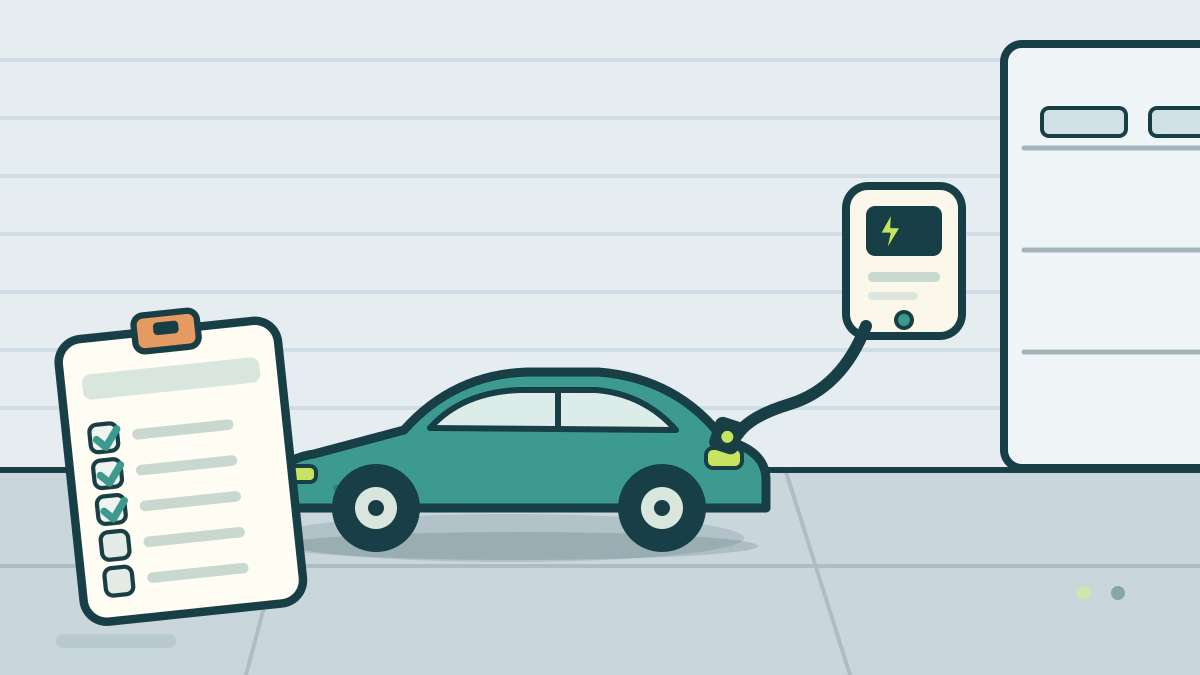
A home-charging checklist for the 2025 and 2026 Chevrolet Equinox EV, built from the owner's manual circuit rules, cord limits, charge targets and status lights.
What has to be true before you plug in at home?
The 2026 Equinox EV owner’s manual asks for a dedicated branch circuit, a grounded outlet and an electrician’s inspection before the first charge. It also bans extension cords, power strips and splitters.
This guide covers the 2025 and 2026 Equinox EV, front-wheel and all-wheel drive, and follows the 2026 Chevrolet Equinox EV Owner Manual, document 19301060. Confirm any changed 2025 wording in your own booklet.
Charging categories are explained in Level 1 vs Level 2 vs DC fast charging. Other makes appear in Car Brands and Models.
The electrical rules the manual states plainly
The manual names extension cords, multi-outlet power strips, splitters, grounding adapters and surge protectors. It also says not to use an outlet that is worn, damaged, ungrounded or shared with other electrical loads.
Before the first plug-in, the manual says to have a qualified electrician inspect the outlet, wiring, junctions and protection devices. The stated test is heavy-duty service at a 12 amp continuous load.
Outdoor charging adds conditions. The outlet must be weatherproof, the cord must be supported so its weight does not strain the plug, and it must never sit where it could be submerged.
The manual also warns that charging stresses a building’s electrical system more than a typical appliance.
What the included portable cord can draw
| Cord specification | Manual figure |
|---|---|
| Voltage range | 85 to 265 volts AC, single or split phase |
| Frequency | 45 to 66 Hz |
| Maximum current, NEMA 5-15P plug | 12 amps |
| Maximum current, NEMA 14-50P plug | 32 amps |
| Enclosure rating | NEMA 4X |
| Operating temperature | -30 to 50 degrees C |
A standard 120-volt household plug tops out at 12 amps through this cord, while a 14-50 plug allows up to 32 amps.
The manual says the cord must be on a dedicated individual branch circuit. If no dedicated circuit exists, it sends the owner to a qualified electrician.
Charge target, schedule and departure time
The vehicle’s default target is 80 percent when plugged in, a setting the manual ties to battery life. The driver can move it with the gauge in the Charging app.
The manual says to charge to 80 percent or less unless a trip needs more, and to avoid dropping below 20 percent when possible.
The manual says to keep the battery at 80 percent or less before long, steep descents, so regenerative braking has room to work.
The Charging app has three relevant modes:
- Charge Now starts immediately and is the default.
- Charge Later delays the session so it finishes by your departure time.
- Schedule stores a plan for each day at a saved Home Location.
Preconditioning runs at the end of a scheduled charge and uses charger energy rather than battery energy. If no Home Location is saved, the manual says the Level 1 cord limit returns to its lowest setting each time the car leaves Park.
Reading the car and the cord
The charge status light and, on equipped cars, the headlight bar report the session. A solid blue light means the connection succeeded. A pulsing blue light means charging is delayed. Blinking green means active charging, and solid green means the session finished. Pulsing red points to an error or a station that has not initialized.
The portable cord has its own indicator on the control box. Solid green means ready, and three red blinks mean the control box is too hot. Two blinks mean a ground fault, which the manual says auto-resets after 15 minutes and the cord retries four times before shutting down.
If the plug feels hot, the manual says to stop and have an electrician inspect the circuit. It also says the portable cord is not serviceable and should be replaced through a dealer.
Range and charge time in context
| EPA listing | 2025 FWD | 2026 FWD | 2025 AWD | 2026 AWD |
|---|---|---|---|---|
| Range | 319 mi | 319 mi | 307 mi | 307 mi |
| Combined MPGe | 109 | 108 | 103 | 103 |
| Listed 240-volt charge time | 9.5 h | 9.5 h | 9.5 h | 9.5 h |
The EPA time assumes a 240-volt supply and the conditions of its test. A 120-volt session will take much longer, which is why the manual’s cord-limit setting matters.
A short checklist for the first week
- Have an electrician confirm the outlet and circuit at a 12 amp continuous load.
- Decide between the 120-volt cord setup and a dedicated 240-volt circuit.
- Mount the control box so the cord is supported, not hanging from the plug.
- Set the Home Location and a charge target before the first overnight session.
- Confirm the status light behavior on the first charge.
For charger selection, see how to choose a home EV charger. For target-level context, see should you charge your EV to 100 percent.
Frequently asked questions
Can I use an extension cord to charge the Equinox EV?
No. The owner’s manual explicitly prohibits extension cords, power strips, splitters, grounding adapters and surge protectors. It also requires a dedicated branch circuit.
What charge level should I set for daily driving?
The car defaults to 80 percent, and GM recommends 80 percent or less unless a trip needs a full battery. The manual also says to stay below 80 percent before long, steep descents or when towing.
How long does a home charge take?
EPA lists 9.5 hours on a 240-volt supply for both front-wheel-drive and all-wheel-drive versions. A 120-volt session takes much longer, and the manual lets the driver set a lower cord limit for that case.
Can I drive the car while it is plugged in?
No. The manual states that the vehicle cannot be driven while the charge cord is connected. Unplug it, close the charge port door and then drive.