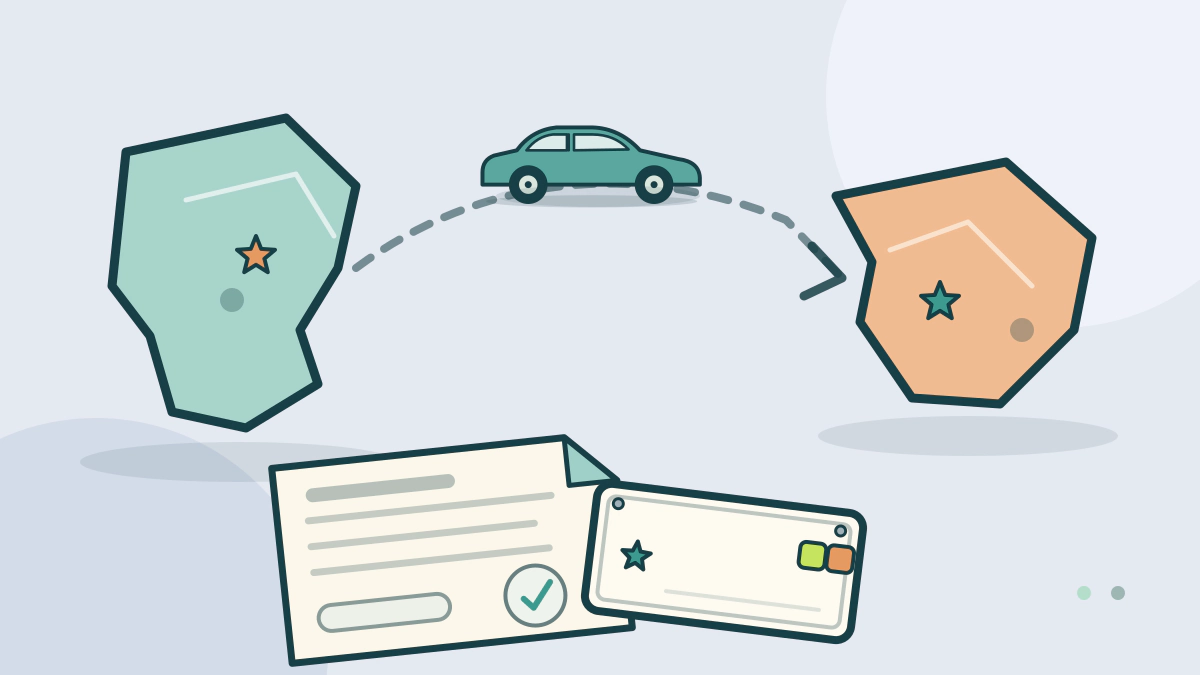
Register a car bought in another state by transferring the title, paying your home state's tax, passing its inspection and filing before the deadline.
What is the sequence for registering an out-of-state car?
Buy a car with a transferable title, pay your home state’s tax, complete its inspection if required, then title and register it where you will keep it. The seller’s state issues the ownership document. Your state grants the right to drive. Deadlines usually start when you bring the car home, so do not wait for the seller to finish their paperwork.
The examples below come from the California DMV, the New York DMV and the Texas DMV, checked on November 9, 2026. They show how much the details differ. Confirm your own state’s rules before you travel to collect the car.
Get a title your state will accept
An out-of-state purchase needs an original title signed over to you. Texas asks for an original out-of-state title or other valid ownership evidence when you apply. New York says a private buyer normally needs a title or transferable registration signed over as proof of ownership. A photocopy is not a substitute.
Ask the seller for a bill of sale as well. New York lists the year, make, VIN, sale date, price and signatures of both parties as the contents of an acceptable vehicle bill of sale. A bill of sale helps when the title and the seller’s name do not match, or when your state’s form asks for the purchase price.
If a lender holds the title, the seller cannot simply hand it to you. Ask for a lien release or for the lender’s instructions. A title with an unreleased lien can block a new title in your name.
Expect to pay tax where you register
Most states collect a sales or use tax when you title a car bought elsewhere. Do not assume the tax you paid in the seller’s state will be credited at home. Some states credit it and some do not.
Texas lists a 6.25% motor vehicle sales tax among the items due when an out-of-state vehicle is titled and registered, along with proof of sales tax payment. California’s private-party guidance lists a use tax and applicable fees. Ask your own state’s office which document proves payment and whether an out-of-state receipt counts.
Keep the buyer’s order, bill of sale and tax receipt together.
Inspection rules follow the destination state
An inspection that satisfied the seller’s state does not automatically satisfy yours. Texas requires an emissions inspection before registration in 18 named counties. California’s private-party checklist includes a smog certification. New York issues a 10-day inspection extension when you register, and the previous owner’s inspection is not valid.
Some states also verify the VIN in person. Texas requires a law enforcement VIN inspection for imported vehicles. Your own state’s application instructions will say whether a physical VIN check is required. Build that appointment into your first week.
| Document | Why the destination state wants it |
|---|---|
| Signed original title | Shows the seller transferred ownership |
| Bill of sale and odometer record | Records date, price, miles, VIN and both parties |
| Lien release | Proves a loan no longer encumbers the car |
| Insurance proof | Required before plates in most states |
| Inspection or VIN report | Confirms the car meets local rules |
| Tax receipt or exemption | Shows sales or use tax was handled |
Watch the clock in your home state
Deadlines differ, and one state’s deadline is not a safe assumption for another. Texas says a vehicle must be titled in your name within 30 days of the date of sale and registered within 30 days of bringing it to Texas. California gives a private-party buyer 10 days to transfer ownership. New York ties registration to the effective date on your insurance ID card, with a 180-day limit.
Put the sale date, the date the car entered your state and your insurance start date on one sheet. Take that sheet to the office. If a deadline is close, ask about a temporary permit rather than driving on the seller’s plates.
What to do before you leave the seller
Do not hand over money for a title you have not seen. Check that the VIN on the title matches the car, that the seller’s name matches the ID, and that the title has no unexpected brand. Read Buying a Used Car From Another State before you travel.
Bring the signed title, bill of sale, lien release, insurance card and proof of identity to your DMV or tax office. If the car fails an emissions test, read Emissions Testing When Moving States before spending money on repairs.
State guides such as How to Register a Car in California and the Texas title transfer guide show the local forms. The Vehicle Registration and US Legal Guides hub lists the wider set.
Frequently asked questions
Can I drive the car home before it is registered?
Usually you need some authority to drive, such as a temporary permit or the seller’s valid plates where your state allows it. Rules differ, so ask your state DMV before the trip. Do not assume an out-of-state plate stays valid after you become a resident.
Do I pay sales tax in both states?
Not necessarily. Many states give credit for tax paid elsewhere or charge the difference, and some do not. Keep the receipt.
What if the seller’s title is held by a lender?
Ask the seller to obtain a lien release or follow the lender’s payoff process. You need clear ownership evidence before your state will issue a title. A bill of sale alone does not remove a lien.
Can I register the car if the title is still in the seller’s name?
That is the normal step: the seller signs the title over, and you file it with your state. If the seller never titled the car in their own name, stop and ask your DMV how to proceed.