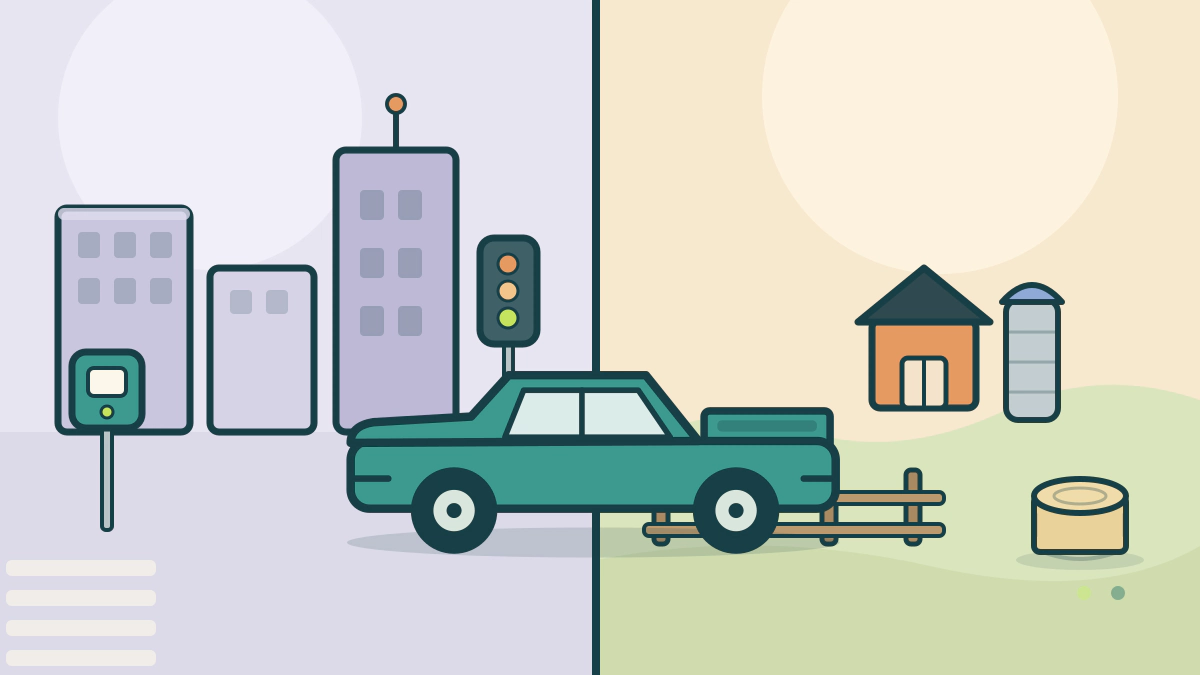
Rural and city car buying differ in inventory, travel for inspection and service, registration timing and charging access. Compare the real total.
Does where you buy a car change the deal?
Yes. The car may be the same, but inventory, travel for inspection and service, registration timing and charging access change the total cost. The negotiation basics stay the same in both places.
The US Census Bureau treats an area as urban when it has at least 2,000 housing units or 5,000 people. Rural is everything outside those areas (Census). That definition says nothing about dealer quality, so compare the actual transaction rather than the label.
How much choice do you really have?
The US DOT says rural areas are home to about 20 percent of Americans but contain almost 70 percent of the country’s lane miles. Rural residents also drive more than urban residents and spend more on fuel and maintenance (DOT Rural EV Toolkit).
Fewer franchises usually mean fewer colors, trims and model years on a local lot. A rural buyer may need a search radius of several hours to find the exact vehicle. A city buyer can often visit several dealers in one day and compare competing quotes. More choice is useful only if you use it to get written prices.
The test drive and inspection trip
The FTC says to ask for the out-the-door price in writing before you visit a dealer. That lets you confirm advertised discounts and spot add-ons before you travel (FTC).
An independent inspection is harder to arrange at a distance. The FTC suggests a mobile inspection service if the dealer will not let the car leave the lot, or asking the dealer to bring the car to a facility you choose. If a dealer refuses an independent inspection, the FTC says to consider another dealer.
A rural buyer should book the inspection before making the trip. A city buyer has more shops, but should still confirm that the shop can see the car on the day of the visit.
Service and recall work after the sale
Check the distance to a franchised dealer for the brand you are considering. Warranty repairs and some recall work are easier when the dealer is not a day’s drive away. Also check whether independent shops in your area work on that model.
Every state has different rules, so verify registration and inspection with your own DMV. Vermont, as one example, requires new residents to register within 60 days, then inspect the vehicle within 15 days of registration. An insurance identification card is needed before the inspection can proceed (Vermont DMV).
Charging access is the biggest split for EVs
The DOT says rural residents often have fewer alternatives to driving, which makes range and charging access more important. The DOE says most EV drivers charge overnight at home. Level 1 charging on a standard 120-volt outlet can add about 40 miles of range in eight hours. Level 2 charging adds roughly 25 miles per hour and usually needs a 240-volt circuit (AFDC home charging).
A house with a driveway usually makes home charging easier than an apartment without a dedicated parking space. Rural public charging can still be sparse. Use the DOE station locator to check the routes you actually drive, not just the address (AFDC stations).
| Question | Rural area | Large city |
|---|---|---|
| Inventory | Fewer local franchises, wider search needed | More dealers and more trims nearby |
| Inspection | Travel or a mobile inspector | More shops, but book ahead |
| Service | Check distance to a franchise dealer | More independent shops to choose from |
| Registration | Same state rules, fewer offices nearby | Same state rules, more office options |
| EV charging | Home charging often possible; public sites sparse | Home charging may be hard; public sites denser |
Compare the out-the-door number
The FTC lists registration, insurance, fuel and maintenance as costs beyond the sticker price. Add travel, an inspection fee and any charging installation to that list (FTC).
Write two columns: the local deal and the distant deal. Add fuel, time, inspection and temporary transport for the distant car. If the distant car is cheaper only before those costs, it is not cheaper. If it is the exact trim and condition you want, the trip may still be worth it.
The documents guide covers paperwork, and the pre-purchase inspection guide covers the mechanical check.
Frequently asked questions
Is it cheaper to buy a car in a rural area?
There is no general answer. A rural dealer may face less local competition, but the specific price, fees and vehicle condition decide the deal. Compare written out-the-door quotes, including the cost of travelling to inspect and collect the car.
Can I buy a car in another state and register it at home?
Registration is normally handled by your home state, so check its DMV requirements before you travel. Vermont, for example, requires an application, ownership documents and payment of purchase and use tax, with a 15-day inspection window after registration.
Do I need a home charger for an EV in a rural area?
The DOE says most EV charging happens at home, and Level 1 may cover modest daily driving. A longer commute or a larger battery may make Level 2 more practical. Check public charging on your regular routes as well.
How can I inspect a car that is far from home?
Ask the dealer whether a mobile inspector can visit, or whether the car can be taken to a shop you choose. Get a written report with the VIN and repair estimates. If the seller refuses, consider another vehicle.