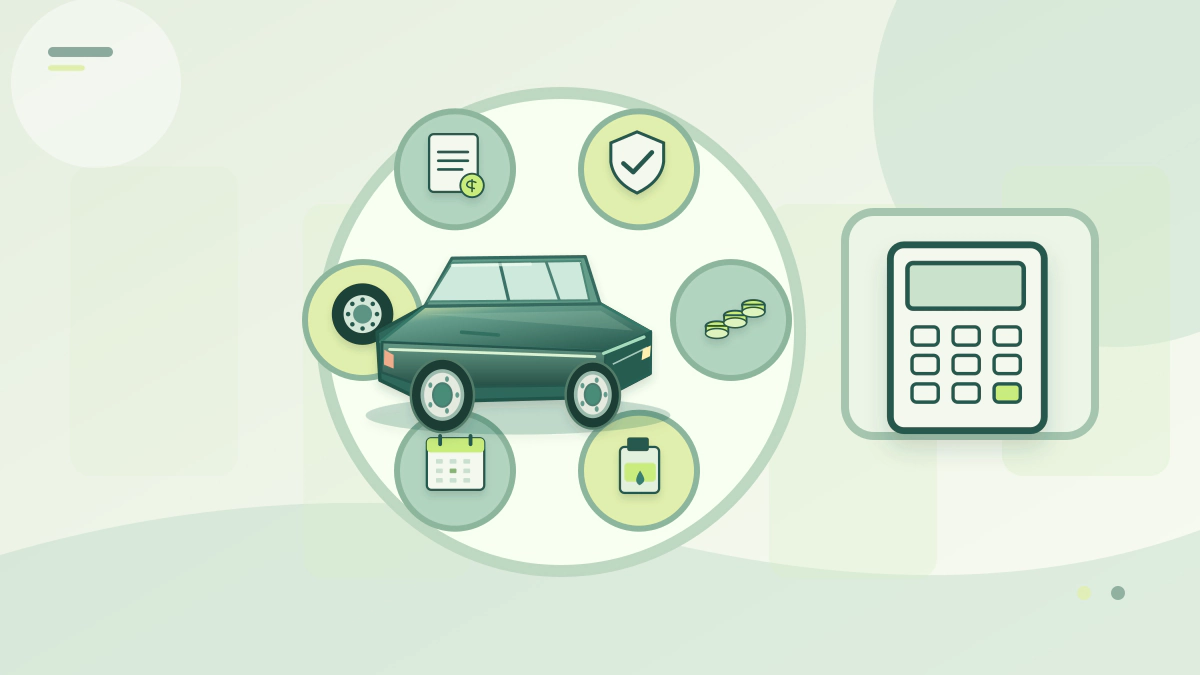
A car costs more than its sticker price. Depreciation, financing, insurance, energy, maintenance and fees all affect the true cost of ownership.
Start with depreciation
Depreciation is the difference between what you pay and what the vehicle is worth when you sell or trade it.
It varies by market conditions, mileage, model, condition and timing.
For a new car, depreciation may be a substantial cost even when it does not appear on a monthly bill.
For a used car, prior depreciation may be priced in, but repair expenses can be higher.
Add fixed costs
Insurance premiums, registration, local taxes, parking permits and any loan interest or lease charges can apply regardless of how far you drive.
Get real insurance estimates before buying.
If you have a loan, separate loan principal from ownership expense when comparing economic cost.
Principal repayments build equity; financing charges are the cost of credit.
Estimate running and repair costs
Multiply annual miles by energy consumption and local fuel or electricity prices.
Then budget for tires, filters, brakes, scheduled servicing and irregular repairs.
Owners who drive more often face faster wear and energy expenses.
EVs can have lower routine maintenance needs for some components, but tire costs, insurance and out-of-warranty repairs still matter.
Build scenarios
Make a low-, expected- and high-cost scenario rather than relying on one exact number.
Compare a vehicle you own outright, a financed new car and a comparable used car over the same timeframe.
Use the total ownership calculator in this site to test how mileage, depreciation and energy prices change the answer.
Example annual ownership worksheet
| Expense | How to estimate | Annual amount |
|---|---|---|
| Depreciation | Estimated value drop over the year | $___ |
| Financing interest | Interest paid during that year (not the whole payment) | $___ |
| Insurance | Actual quote for driver, vehicle and location | $___ |
| Fuel or charging | Annual miles ÷ efficiency × local energy price | $___ |
| Maintenance and tires | Manufacturer schedule plus wear budget | $___ |
| Repairs | Reserve informed by vehicle age and condition | $___ |
| Registration, taxes, parking and tolls | State/local rules and personal routine | $___ |
Do not count a loan’s full principal repayment and full depreciation as separate economic expenses. Principal repayment changes your cash balance and reduces debt; depreciation measures loss in vehicle value.
If you are budgeting cash flow, include loan payments and cash expenses.
If you are comparing economic ownership cost, use depreciation plus financing interest and operating expenses instead.
Example fuel math, not a market average
A driver covering 12,000 miles at 30 MPG uses about 400 gallons.
At an illustrative $3.50 per gallon, annual gasoline spending is $1,400 before detours, idling and changes in driving conditions.
Replace each assumption with your actual mileage, EPA vehicle data and local fuel price.
An EV owner should calculate kilowatt-hours purchased, charging losses and any public charging fees separately.
Match the ownership horizon for every alternative
A five-year ownership estimate is different from a one-year cash budget.
Record when you expect to sell, how many miles you will drive and whether a car is already paid off.
Compare alternatives over the same time frame so one car does not appear cheaper simply because its eventual sale or major maintenance falls outside the calculation.
Insurance should come from real quotes for the driver, vehicle and address.
Energy estimates should reflect the vehicle’s efficiency and realistic annual use, including public charging charges when relevant.
Scheduled service is easier to estimate than unexpected repairs; use a reasonable range for the latter rather than pretending every vehicle will need identical work.
Separate cash flow from economic cost
A monthly budget tracks the cash that leaves your account: loan payments, insurance, fuel, taxes and repairs.
An economic-cost calculation instead incorporates the loss in vehicle value and the interest cost, without counting loan principal a second time.
These views serve different decisions and can produce different totals without contradicting each other.
For a hypothetical car bought for $25,000 and sold for $15,000, depreciation is $10,000 over the holding period.
If total interest is $2,000, those economic costs are $12,000 before insurance and operating expenses.
Adding the entire $25,000 purchase price on top would double count value that is partly recovered on sale.
Test uncertainty before deciding
Estimate insurance increases, fuel-price variation and an unexpected repair scenario. A low-maintenance car may still have high insurance or depreciation. A low purchase price may expose you to higher near-term repairs.
Compare vehicles by the total cost and your ability to absorb an unfavorable case, not by a single advertised payment.
Common questions
Is the vehicle with the cheapest payment the cheapest to own?
No. Insurance, energy, depreciation, maintenance and repair risk can change the total considerably.
Is depreciation a real cost if I keep my vehicle?
It is the reduction in estimated resale value, not a cash bill each month. It matters when comparing the economic cost of alternatives and eventual resale value.