An auto loan lets you borrow part of a vehicle purchase price and repay it over time with interest. Your down payment, interest rate, APR and term all affect the total cost.
What you borrow
The principal is the amount financed after subtracting your down payment, trade-in value and applicable credits and adding any financed taxes or fees. A lender typically holds a lien until the debt is paid off.
Before choosing a payment target, calculate the entire purchase price including sales tax, registration, insurance and likely maintenance.
How interest and APR work
Interest is the cost of borrowing.
APR is a broader annualized measure that can include certain borrowing fees; compare APR alongside any other required charges and the amount financed.
Your credit profile, lender, term and market conditions influence offers.
Longer terms generally spread principal over more payments, which can reduce the monthly bill but increase total interest.
Compare written loan offers rather than negotiating solely from a monthly payment.
Down payments and trade-ins
A larger down payment reduces borrowing and can help reduce negative equity.
When trading in a financed car, ask for the exact payoff and make sure the dealer separately shows trade-in value, old-loan payoff and the new loan amount.
Be wary of rolling significant negative equity into a new loan.
It can leave you owing more than the replacement car is worth.
Before signing
Confirm the selling price, taxes, lender, APR, term, payment due date, total of payments and whether there is a prepayment penalty.
Evaluate optional add-ons separately.
Our on-site auto loan calculator can illustrate payments, but actual disclosures from your lender govern the transaction.
Worked example: how the term changes interest
The following is a CFPB-published illustrative comparison for a $20,000 loan at 4.75% interest, without additional charges.
These figures are not current loan offers.
| Loan term | Approx. monthly payment | Approx. total interest |
|---|---|---|
| 36 months | $597 | $1,498 |
| 48 months | $458 | $1,999 |
| 60 months | $375 | $2,508 |
| 72 months | $320 | $3,024 |
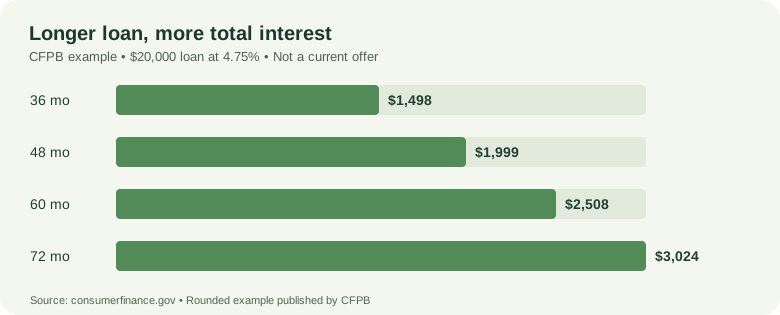
Interpretation: extending the term from 36 to 72 months lowers the approximate payment by $277 a month, but increases interest by roughly $1,526 in this example.
For your situation, enter the actual amount financed, interest rate and term in the Motor Atlas auto loan calculator.
The example illustrates how loan duration—not just the advertised monthly payment—affects the result.
What the dealer should disclose
Under federal Truth in Lending rules, you should receive written information about major financing terms.
Check the APR, finance charge, amount financed, total of payments, and payment schedule, not merely the monthly payment.
Determine whether taxes, warranties, accessories or negative equity were added to the financed balance.
If the dealer presents a credit offer at a particular price only after you take an optional product, ask for the offer without that product as well.
Do not assume extended warranties, GAP products or dealer service packages are mandatory just because a salesperson groups them with the payment.
Follow the money from purchase to payoff
The vehicle’s out-the-door price is established first. A buyer may contribute a down payment, a trade-in’s positive equity or both.
The remaining financed balance can also include taxes, fees and optional products selected for financing.
Ask the lender or dealership to show the exact amount financed so you can reconcile it with the purchase agreement.
Each scheduled payment on a conventional amortizing loan generally pays interest and reduces the outstanding principal.
Earlier payments often contain more interest because the unpaid balance is larger.
That is different from depreciation: the vehicle’s resale value can fall even while you repay the debt as agreed.
Understand what changes your obligation
Borrowing more increases repayment costs, while a longer term can lower the scheduled monthly payment and raise lifetime interest.
Rates and eligibility can depend on lender evaluation, vehicle age and your credit information.
Do not assume that a quoted maximum loan amount is a recommended spending limit.
If you trade a car with an existing loan, compare the dealer’s allowance with the actual lender payoff. A shortfall is negative equity, which must be resolved and might be included in a new loan subject to the lender’s terms.
It is not eliminated by a seemingly larger trade-in credit.
Close the process carefully
Before signing, compare the buyer’s order, finance disclosures and every optional product.
Look for the amount financed, APR, finance charge, term and total payments; confirm due dates and consequences of late payments.
Ask whether early payment changes cost and whether any penalty applies.
Once paid off, follow the lender’s lien-release and state title procedures. A completed payment schedule and a clear title are related but distinct administrative steps.
Common questions
Does a car loan build equity immediately?
Not automatically. A vehicle often depreciates, while the loan balance declines according to the repayment schedule. A low down payment or a long term can produce negative equity.
Does APR include car insurance?
No. APR concerns borrowing cost; insurance, vehicle operating costs and many ownership fees are separate. Include these expenses in your household budget.
Official reference: CFPB — How to compare auto loan offers.