Compare Tesla Model 3 and Model Y size, cargo space, rear seat room, ground clearance and 2026 EPA range using Tesla manuals, EPA and NHTSA data.
Is the Tesla Model Y roomier than the Model 3?
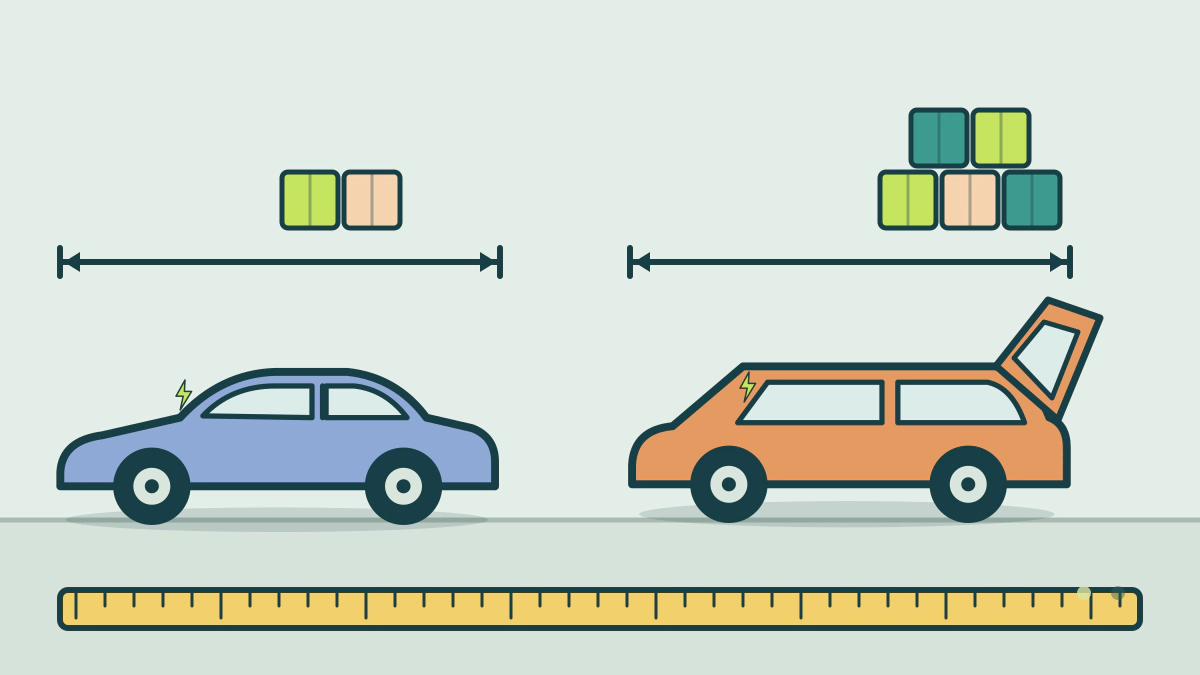
Yes, in the back. The Model Y has more cargo room and rear leg room, and it sits taller. The Model 3 is shorter and lower. Which one fits you depends on cargo, rear passengers and your garage.
Both are listed in fueleconomy.gov for 2026. NHTSA lists 2026 ratings for both, too. Browse other makes on Car Brands and Models.
Tesla’s own pages block scripted requests. The owner’s manual figures below were read from Wayback Machine copies of Tesla’s manual pages, taken in 2025 and 2026. They were checked on November 5, 2026. Tesla’s configurator was not readable.
How the two cars measure outside
Tesla’s Dimensions pages list these figures. Model 3 is the rear-wheel-drive and Long Range page. Model Y is the five-seat page.
| Exterior (mm) | Model 3 | Model Y |
|---|---|---|
| Length | 4,720 | 4,790 |
| Width, mirrors out | 2,089 | 2,129 |
| Width, without mirrors | 1,850 | 1,920 |
| Height | 1,440 | 1,624 |
| Wheelbase | 2,875 | 2,890 |
| Ground clearance | 138 | 138 laden, 167 unladen |
The Model Y is only 70 mm longer but 184 mm taller. That matters for low garage doors.
Passenger room and rear seat comfort
Tesla’s manuals list these interior figures, in inches, as front / rear.
| Interior (in) | Model 3 | Model Y (5 seats) |
|---|---|---|
| Head room | 40.3 / 37.8 | 41.0 / 39.4 |
| Leg room | 42.7 / 34.5 | 41.9 / 40.5 |
| Shoulder room | 56.7 / 54.2 | 56.4 / 53.2 |
| Hip room | 53.0 / 52.3 | 54.0 / 50.5 |
The biggest gap is rear leg room. It is 34.5 inches in the Model 3 and 40.5 in the Model Y. That is six inches more.
EPA’s listing puts the Model 3 in the Midsize Cars class. It shows 97 cubic feet of passenger volume and 15 of luggage volume. The Model Y is in a Small Sport Utility Vehicle class. The page shows no passenger or luggage volume for it. Use Tesla’s figures for cargo.
Cargo space, hatch and loading height
Tesla lists these cargo volumes.
| Cargo (cu ft) | Model 3 | Model Y (5 seats) |
|---|---|---|
| Front trunk | 3.1 | 4.1 |
| Behind second row | 21 | 29.0 |
| Most, with 5 passengers | 24.1 | 33.1 |
| Behind first row, rear seats folded | Not listed | 71.4 |
The Model Y has about 8 cubic feet more behind the rear seats. Its opening is a liftgate. The Model 3 has a powered trunk. Tesla’s manuals say the Model Y liftgate can open to about 7.5 feet. They say the Model 3 trunk can open to about 6.5 feet, depending on wheel selection.
Both manuals describe how to limit the opening height. Check this for your garage ceiling.
Tesla’s pages did not list a separate underfloor figure for either car. No figure was verified here.
Towing, range and efficiency
Tesla’s Model 3 manual lists 1,650 lb without trailer brakes and 2,200 lb with them. This applies to cars with the towing package. US availability of that package was not verified. A Model Y towing page could not be read. Check Tesla before buying if towing matters to you.
EPA lists these 2026 range figures.
| 2026 variant (EPA) | Range (mi) | Combined MPGe |
|---|---|---|
| Model 3 Standard RWD | 321 | 139 |
| Model 3 Premium RWD | 363 | 137 |
| Model Y Standard RWD (18 in wheels) | 321 | 138 |
| Model Y Long Range RWD | 357 | 134 |
EPA lists the Performance AWD at 314 miles for the Model 3 and 306 for the Model Y.
Safety ratings and recalls
NHTSA’s ratings list five stars overall for both cars. Both show five stars for frontal crash, side crash and rollover. This covers the 2026 Model 3 RWD and AWD and the 2026 Model Y RWD and AWD entries.
On November 5, 2026, NHTSA’s recall data listed these campaign counts.
| Model year | Model 3 | Model Y |
|---|---|---|
| 2024 | 5 | 5 |
| 2025 | 3 | 3 |
| 2026 | 1 | 8 |
A campaign can cover several models. Counts are not a quality score. Check your own VIN. See how to check car recalls by VIN.
Which one fits your use?
Pick by measuring, not by badge.
- Child seats: NHTSA says not all car seats fit in all vehicles. Test the seat in the car. More rear leg room can leave more space for a bulky seat.
- Garage: Measure door height, width and depth. Include open mirrors. The Model Y is 184 mm taller.
- Cargo: Bring your stroller or gear to a test drive. Compare the loading height of the liftgate and the trunk lid.
- Larger families: Other Model Y seating layouts and the Model Y L listed by EPA for 2027 are not covered here. See two-row versus three-row SUV space.
Trim and year details can change. Read the configurator and your owner’s manual for your exact car. For more on this, see why the same car model has different features by year.
Frequently asked questions
Does the Model Y have more cargo space than the Model 3?
Yes. Tesla lists 29.0 cubic feet behind the Model Y’s second row and 21 in the Model 3. It also lists 4.1 cubic feet in the Model Y front trunk against 3.1 in the Model 3.
Is the Model Y much bigger than the Model 3 outside?
Not by length. It is 70 mm longer on Tesla’s pages. It is 184 mm taller and about 70 mm wider without mirrors. Check your garage for height.
Do the Model 3 and Model Y have the same safety ratings?
For 2026, NHTSA lists five stars overall, five frontal, five side and five rollover for both. Check the exact trim and release you plan to buy, because NHTSA lists several entries.
Can I rely on these figures for my exact car?
No. Tesla’s pages say values are approximate and vary with options. This guide compares 2026 EPA listings with Tesla manual pages from 2025 and 2026. Confirm your car’s figures in Tesla’s configurator and owner’s manual.