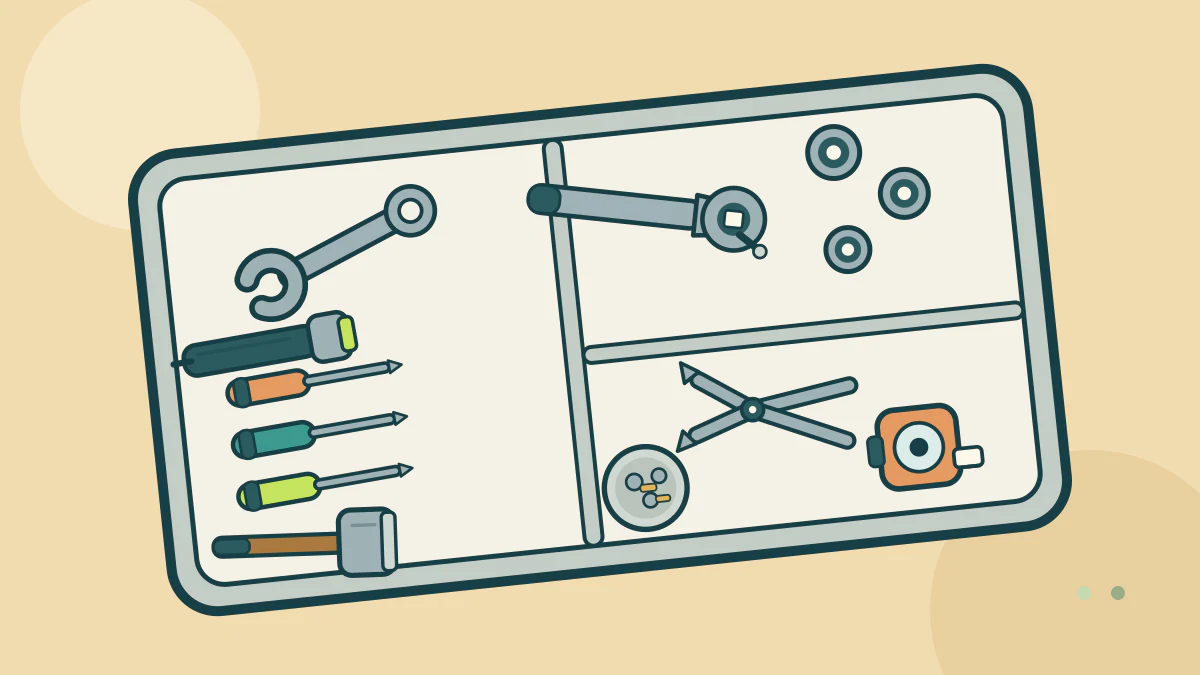
Build a first tool set from a school program list and BLS guidance, covering sockets, wrenches, pliers, test gear and safety equipment in buying order.
What tools does an entry-level automotive mechanic need first?
Start with a complete set of hand tools and your own safety gear. BLS says technicians typically own their hand tools, while employers usually own the jacks, hoists, power tools and computerized diagnostic equipment.
That split decides your first purchases. You are not expected to buy a lift or a scan tool. You are expected to arrive with the wrenches, sockets, pliers and test gear you will use every day.
School programs publish the same message. Pine Technical and Community College tells students that “an employed automotive technician furnishes his/her own hand tools” and treats its list as a starting kit that grows over time.
The core set, by category
A first set should cover fasteners on engines, brakes, suspension, trim and electrical connectors.
| Category | What to include | Where it gets used |
|---|---|---|
| Sockets and ratchets | 1/4, 3/8 and 1/2 inch drive sets, shallow and deep, metric and SAE, extensions and universal joints | Battery, trim, engine and chassis fasteners |
| Wrenches | Combination sets in metric and SAE, flare-nut set, hex and Torx keys | Brake lines, suspension, engine accessories |
| Screwdrivers and picks | Flat, Phillips, Torx drivers, trim tools and a pick set | Interior panels, connectors, hose clamps |
| Pliers | Combination, needle nose, diagonal cutters, locking, channel lock and snap ring | Hoses, wiring, clips, brake hardware |
| Hammers, punches and pry bars | Ball peen, dead blow, punch and chisel set, pry bar set | Seized parts, bearings, alignment work |
| Measuring and testing | Multimeter, 12 volt test light, feeler gauges, tire pressure and tread depth gauges | Electrical checks, gaps, tire work |
What a school list actually asks for
Pine’s minimum list is specific. It calls for 1/4 inch drive metric and standard sockets in deep and short lengths, 3/8 inch drive sockets from 5/16 to 7/8 inch and 8 to 19 mm, and a 1/2 inch drive set with a breaker bar. It adds spark plug sockets in 9/16, 5/8 and 13/16 inch, combination wrenches from 1/4 to 1 inch and 8 to 24 mm, flare-nut wrenches, a Torx set, safety glasses, hearing protection, a multimeter and a lockable box no longer than 42 inches.
Other programs split the list into a first-year set and an optional set. Read your own program’s list before buying, because another school’s list may not match your lab work.
Buy in this order
- Safety gear first: safety glasses and hearing protection, which Pine’s list requires.
- A 3/8 inch drive socket set and combination wrenches in metric and SAE.
- Screwdrivers, pliers, a hammer and pry bars.
- A 1/4 inch drive set for small fasteners and interior work.
- A 1/2 inch drive set and a torque wrench.
- A multimeter, test light and measuring tools.
Complete sets are usually cheaper than filling gaps one piece at a time, and they avoid duplicate sizes. Ask about student pricing.
What the shop supplies, and what it does not
BLS lists pneumatic wrenches, lathes, welding torches, jacks, hoists and computerized diagnostic tools as employer-owned equipment. That is why a scan tool should not be an early purchase. You need to know which system the shop uses before spending money on one.
The line is less clear for test gear. Pine asks each student for a multimeter and a 12 volt test light, both used in basic electrical checks. Treat a meter as personal equipment and a scan tool as shop equipment.
Specialty tools are the gray area. Some live in a shop’s tool room and are signed out. Others are expected in your box, so ask before buying anything that fits only one brand.
Skip these at the start:
- A scan tool before you know what the shop uses.
- A full impact socket set if the shop supplies air tools.
- Specialty engine tools for a single brand.
- Storage you cannot lock, or a box larger than your program allows.
Safety gear and clothing belong in the budget
Pine’s list treats safety as part of the required kit, not an accessory. It requires safety glasses and ear protection. It also requires leather work shoes or boots that cover the whole foot, plus two uniform shirts.
Plan for those costs with the tools. O*NET reports that 41% of technicians are exposed to hazardous equipment every day, so eye and hearing protection are daily equipment.
The car’s own tool kit is not a starter set
Every car carries some tools, but they are for roadside emergencies. Honda’s 2019 Odyssey owner’s guide describes a tool case holding a jack and wheel nut wrench for a tire change, not a mechanic’s set.
The owner’s manual still matters. Jacking points and wheel nut torque are model-specific, and the manual is where those values live. Read it for the car in front of you.
For more on the work itself, see the DIY Car Repair and Car Maintenance hubs. The Automotive Careers and Education hub covers training and job routes.
Frequently asked questions
Do I need my own tools before my first shop job?
Most shops expect hand tools. BLS says technicians typically own wrenches, pliers, sockets and ratchets, while employers own hoists, power tools and diagnostic equipment. Ask the employer for its list before your first day.
How much should a first tool set cost?
This guide does not quote prices, because they change by brand, region and student discount. Compare complete sets rather than single pieces, and ask your program about student pricing.
Is a multimeter necessary for an entry-level job?
Many school programs require one. Pine’s list includes a multimeter and a 12 volt test light, and electrical checks are part of basic maintenance and diagnosis.
Can I use the tools that come with my car?
No. The tool case in a car is roadside equipment for a tire change. Honda’s Odyssey owner’s guide lists a jack and wheel nut wrench there, not the hand tools a technician uses.